2.5 Ton Lead Acid Electric Forklift: Practical Power for Demanding Warehouse Operations
2026-09-30
Content
Material handling equipment must do more than lift a rated load. It must start reliably, move safely through busy aisles, operate for a complete working shift, and remain economical throughout its service life. The 2.5 Ton Lead Acid Electric Forklift, model 8FBN25, is designed around these everyday requirements. With a 2,500 kg load capacity, a 500 mm load center, a 48V/565AH battery, solid tires, a compact 980 mm wheelbase, and a durable metal construction, it provides a balanced solution for warehouses, workshops, factories, distribution centers, and enclosed industrial facilities.
This forklift combines the quiet, zero-emission advantages of electric power with the familiar service structure of a lead-acid battery system. It is especially suitable for customers seeking dependable lifting performance without the higher acquisition or maintenance complexity that can accompany some alternative power systems. Its configuration supports standard pallet handling while retaining the agility needed in restricted operating areas.
Rated load capacity for common industrial pallet and material-handling tasks.
High-capacity lead-acid battery designed for extended operating periods.
Standard load center compatible with a wide range of palletized goods.
Short wheelbase supporting responsive handling in compact work areas.
For purchasing teams, fleet managers, warehouse operators, and equipment distributors, the value of this model lies in the complete operating package rather than in a single specification. Capacity, battery endurance, tire durability, chassis strength, serviceability, and supply support all influence the real cost and usefulness of an industrial forklift. The following guide explains how these elements work together and why this configuration can be a practical alternative to both internal-combustion forklifts and higher-cost electric options.
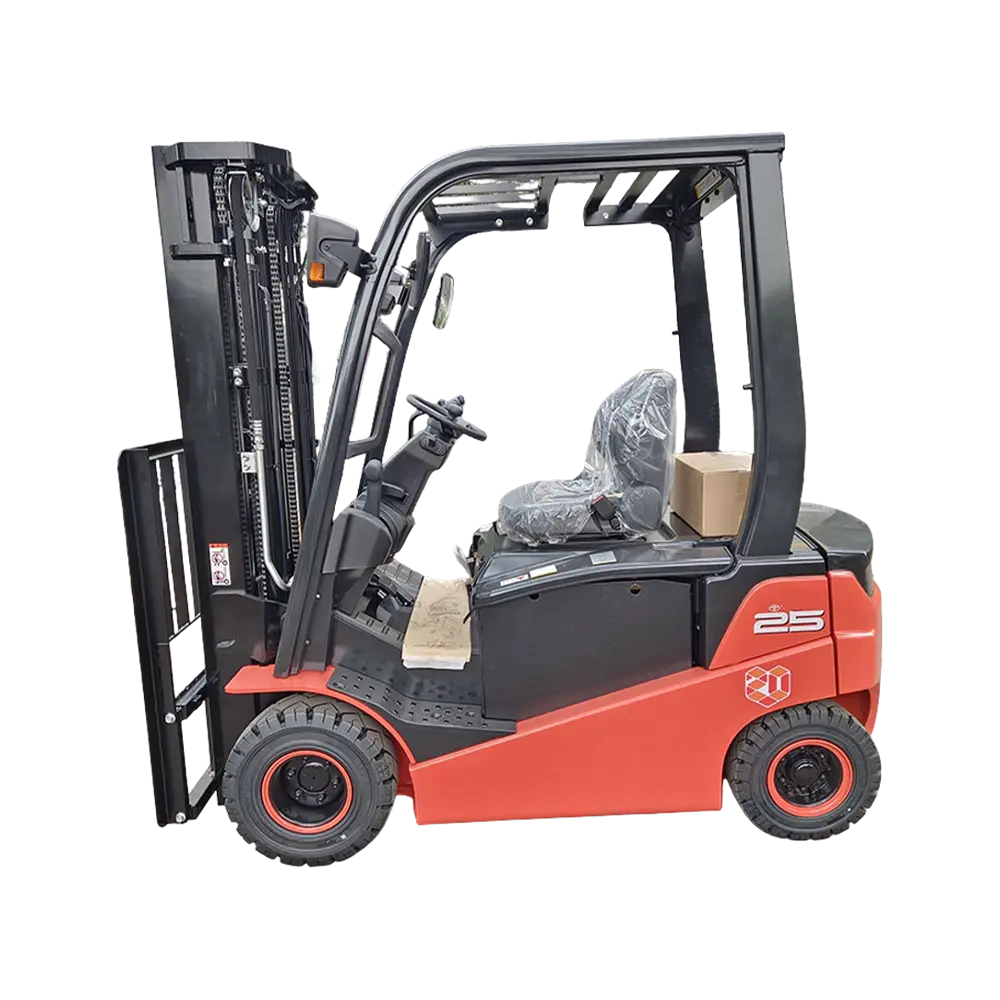
2.5 Ton Lead Acid Electric Forklift
The 8FBN25 is rated to lift up to 2,500 kg. This capacity places it in a useful range for many routine warehouse and factory applications, including palletized raw materials, finished products, packaging supplies, metal components, building materials, machinery parts, and boxed inventory. A 2.5-ton forklift is often selected when a smaller truck lacks sufficient reserve capacity but a much larger model would add unnecessary size, cost, and operating limitations.
The 500 mm load center is another important part of the specification. Load capacity is not determined by weight alone. The distance between the load's center of gravity and the vertical face of the forks affects the stability and lifting capability of every forklift. A standard 500 mm load center corresponds with many commonly used pallets and compact industrial loads, making the truck suitable for normal warehouse handling when the load is correctly positioned and secured.
Operators should always verify the actual capacity chart for the selected mast, attachment, lift height, and load dimensions before handling a specific item. Long, irregular, liquid, or high-mounted loads may change the effective capacity. Correct load assessment is an essential part of safe forklift operation and helps preserve the stability advantages built into the truck.
A forklift that is too small may be forced to work near its maximum rating during every cycle. This can reduce flexibility and make it difficult to respond to unexpected loads. A much larger truck, on the other hand, may require wider aisles, consume more energy, and create additional maneuvering challenges. A 2.5-ton model offers a useful middle ground for facilities that regularly move medium-to-heavy loads while still needing a relatively compact footprint.
The forklift uses a 48V/565AH lead-acid battery. This high-capacity configuration is intended to provide practical energy storage for extended operating periods and repeated lifting cycles. Lead-acid technology remains widely used in industrial vehicles because it is familiar to maintenance teams, supported by an established parts market, and available in many regions.
Electric power eliminates direct exhaust emissions at the point of operation. This makes the forklift appropriate for indoor warehouses, workshops, production areas, and other enclosed spaces where diesel or liquefied petroleum gas exhaust may be undesirable. Electric drive also reduces operating noise, which can improve communication between workers and make the working environment more comfortable during long shifts.
Battery performance depends on load weight, travel distance, acceleration frequency, lift height, floor conditions, ambient temperature, operator technique, and charging practice. The 565AH rating provides a strong foundation, but a suitable charging plan remains necessary. Facilities operating multiple shifts may use planned charging periods, battery rotation, or a fleet schedule that matches each truck to its daily workload.
Lead-acid batteries are familiar to many industrial maintenance teams. Routine inspection, charging, watering where applicable, and terminal care can be incorporated into existing service procedures.
The technology has a long history in material handling, creating broad availability of related chargers, connectors, service components, and replacement battery options.
For facilities prioritizing a practical initial investment, a lead-acid electric forklift can provide a cost-conscious alternative to more complex battery platforms.
When charging intervals and maintenance responsibilities are clearly scheduled, the battery system can support consistent daily warehouse routines.
Battery charging should take place in a designated, ventilated area using compatible equipment and trained personnel. Operators should inspect cables, connectors, terminals, and battery condition according to the service schedule. Avoiding deep discharge, overcharging, contamination, and poor ventilation helps protect battery life and supports dependable availability.
The 980 mm wheelbase contributes to the forklift's agile operating character. A shorter wheelbase can help reduce the space required for turning and positioning, which is valuable in crowded warehouses, production corridors, loading zones, and aisle ends. A compact configuration may also make it easier to align the forks with pallets when the operator must work around racks, machinery, columns, or staging areas.
Compact maneuverability does not remove the need for proper aisle planning. Before placing any forklift into service, the facility should confirm aisle width, turning clearance, rack dimensions, floor load limits, overhead obstructions, pedestrian routes, and emergency access. The truck should be selected and operated according to the real geometry of the worksite.
Wheelbase affects the relationship between stability, turning response, and available operating space. A longer wheelbase can be useful for certain load and ride characteristics, while a shorter wheelbase can support more responsive turning in restricted areas. The 8FBN25 is configured for customers who need a 2.5-ton capacity without moving to an unnecessarily large chassis.
In practical terms, this can improve the flow of short-distance warehouse tasks. The operator can collect a pallet from a staging point, position it at a rack or production station, reverse, and return through the work area without requiring excessive space for every maneuver. Less repositioning can help reduce idle travel and support a more organized material flow.
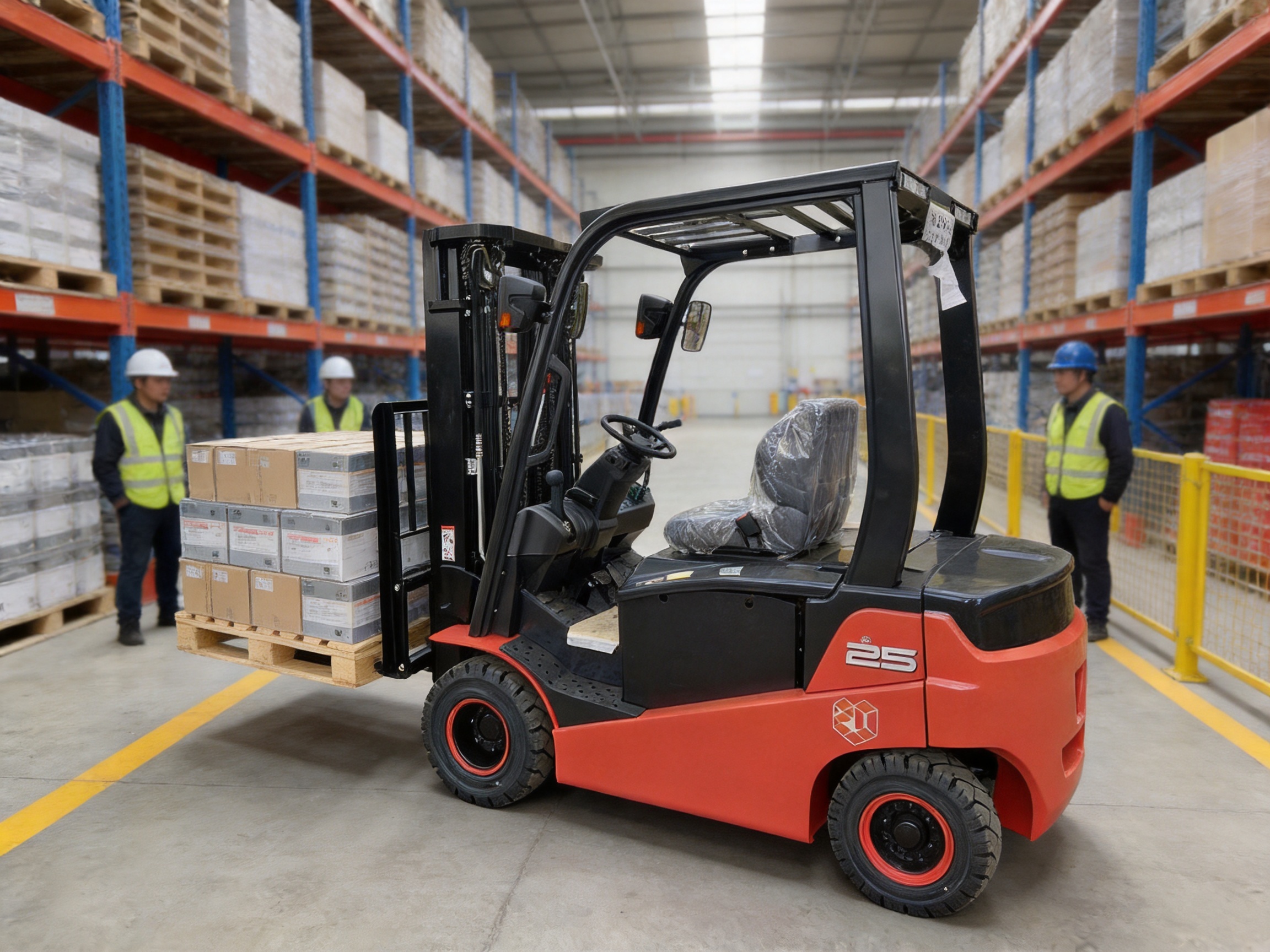
The forklift is equipped with solid tires. Unlike pneumatic tires, solid tires do not require air pressure and are resistant to punctures caused by small metal fragments, nails, sharp packaging material, and other debris commonly found in industrial environments. This feature is particularly valuable in factories, recycling areas, workshops, construction-related warehouses, and facilities where floor contamination is difficult to eliminate completely.
Solid tires can also reduce the risk of unexpected downtime caused by a flat tire. Operators do not need to stop work to inflate a tire or wait for a puncture repair before the forklift can return to service. For facilities that value predictable availability, this can be a meaningful advantage.
As with any tire type, solid tires must be inspected for wear, cuts, separation, embedded objects, and abnormal damage. Floor condition remains important. Large potholes, steep ramps, loose debris, and uneven surfaces can affect ride comfort, steering response, and component life. Good housekeeping and controlled travel speeds help the tires deliver their intended service benefits.
| Consideration | Solid tires | Pneumatic tires |
| Puncture resistance | High resistance to punctures during normal industrial use | More vulnerable to sharp debris and air loss |
| Routine inflation | No regular air-pressure adjustment required | Requires pressure checks and inflation management |
| Downtime risk | Lower risk of flat-tire interruptions | Higher risk when operating around sharp materials |
| Typical strength | Durability on industrial floors and debris-prone areas | Potentially smoother performance on suitable outdoor surfaces |
| Best operating environment | Factories, workshops, warehouses, and demanding industrial floors | Applications where air-filled cushioning and terrain flexibility are priorities |
The truck uses a full metal construction intended to withstand the repeated impacts and stresses associated with material handling. Forklifts often operate around pallets, racks, loading docks, steel products, production equipment, and heavy containers. A durable frame helps protect the essential structure against the routine wear that occurs when equipment is used throughout the day.
Material quality is listed as metal, but durability is not created by material selection alone. It also depends on accurate fabrication, controlled welding, correct alignment, surface preparation, component fitting, and final inspection. A well-organized manufacturing process ensures that the chassis, counterweight, mast area, guards, and mounting points are assembled consistently.
A professional forklift production process typically begins with technical review and component planning. The intended capacity, load center, wheelbase, battery configuration, tire type, and operating environment must be considered together. This prevents isolated component decisions from creating an unbalanced finished truck.
During fabrication, metal components are cut, formed, drilled, welded, and prepared for assembly according to working drawings and production requirements. Dimensional checks help maintain consistent mounting positions and alignment. Welding quality is important because structural joints must withstand repeated loading and vibration. After fabrication, surfaces can be cleaned and finished to improve protection against normal industrial wear.
Assembly is completed in stages so that major systems can be checked before the forklift moves to the next production step. Electrical connections, battery installation, steering-related parts, lifting components, tires, protective structures, and operator controls all require careful fitting. A staged approach makes it easier to identify deviations early rather than discovering them only after final delivery.
Final inspection should include visual checks, operating checks, battery and electrical review, lifting and lowering function, steering response, braking performance, tire condition, fastener security, and confirmation that the product information corresponds with the ordered configuration. These controls help support repeatable quality across different orders and destination markets.
Capacity, load center, battery, tire, application, and delivery requirements are reviewed before production planning.
Metal parts are prepared and assembled with attention to dimensions, joint quality, and structural consistency.
Electrical, lifting, steering, braking, battery, tire, and protective components are installed in controlled stages.
Completed trucks are checked for operating response, visible quality, configuration accuracy, and readiness for shipment.
Forklift comparison should focus on the complete operating requirement rather than on one isolated feature. The 8FBN25 offers several practical advantages for facilities that need a medium-capacity electric truck with manageable ownership demands.
The most immediate difference is the operating environment. Electric power produces no direct exhaust emissions during operation, making the truck more suitable for enclosed facilities. It also generally produces less operating noise than an internal-combustion truck, which can support clearer communication and a more comfortable workplace.
Electric drive may also simplify daily energy management in facilities that already have suitable charging infrastructure. There is no need to store fuel or manage fuel delivery for the forklift. For indoor operations, the reduced exhaust burden can lower the ventilation challenge associated with combustion-powered equipment.
A 2.5-ton rating provides more capacity than many compact warehouse trucks while retaining a relatively short wheelbase. This is useful for businesses that occasionally handle heavier pallets but do not want to maintain a separate large truck for every demanding task. The higher rating may also provide more flexibility when product weights vary throughout the day, subject to the applicable capacity chart and operating rules.
A larger forklift may be appropriate for very heavy loads, but it can require more space and may be less convenient in narrow aisles. The 8FBN25 is positioned for customers who need substantial lifting capability without unnecessarily increasing the physical scale of the vehicle. Its compact wheelbase and standard load center support a practical balance between capacity and maneuverability.
Lithium-powered trucks can offer fast opportunity charging and reduced battery service requirements in certain operating models. However, the preferred battery technology depends on duty cycle, budget, charging infrastructure, climate, and service capability. The lead-acid system in this forklift benefits from established maintenance knowledge, broad market familiarity, and widely available replacement support. For facilities with planned shifts and scheduled charging, these characteristics can produce a straightforward and economical ownership model.
| Evaluation area | 8FBN25 lead-acid electric forklift | Why it matters |
| Load capacity | 2,500 kg | Supports many medium-to-heavy pallet and industrial handling tasks. |
| Load center | 500 mm | Matches a common pallet handling reference point. |
| Power system | 48V/565AH lead-acid battery | Provides substantial stored energy with familiar service procedures. |
| Wheelbase | 980 mm | Helps support agile operation where space is limited. |
| Tires | Solid | Reduces puncture-related interruptions in demanding industrial areas. |
| Construction | Metal frame and components | Designed for repeated use in factories, warehouses, and workshops. |
| Emissions at point of use | Zero direct exhaust emissions | Suitable for many indoor and enclosed operating environments. |
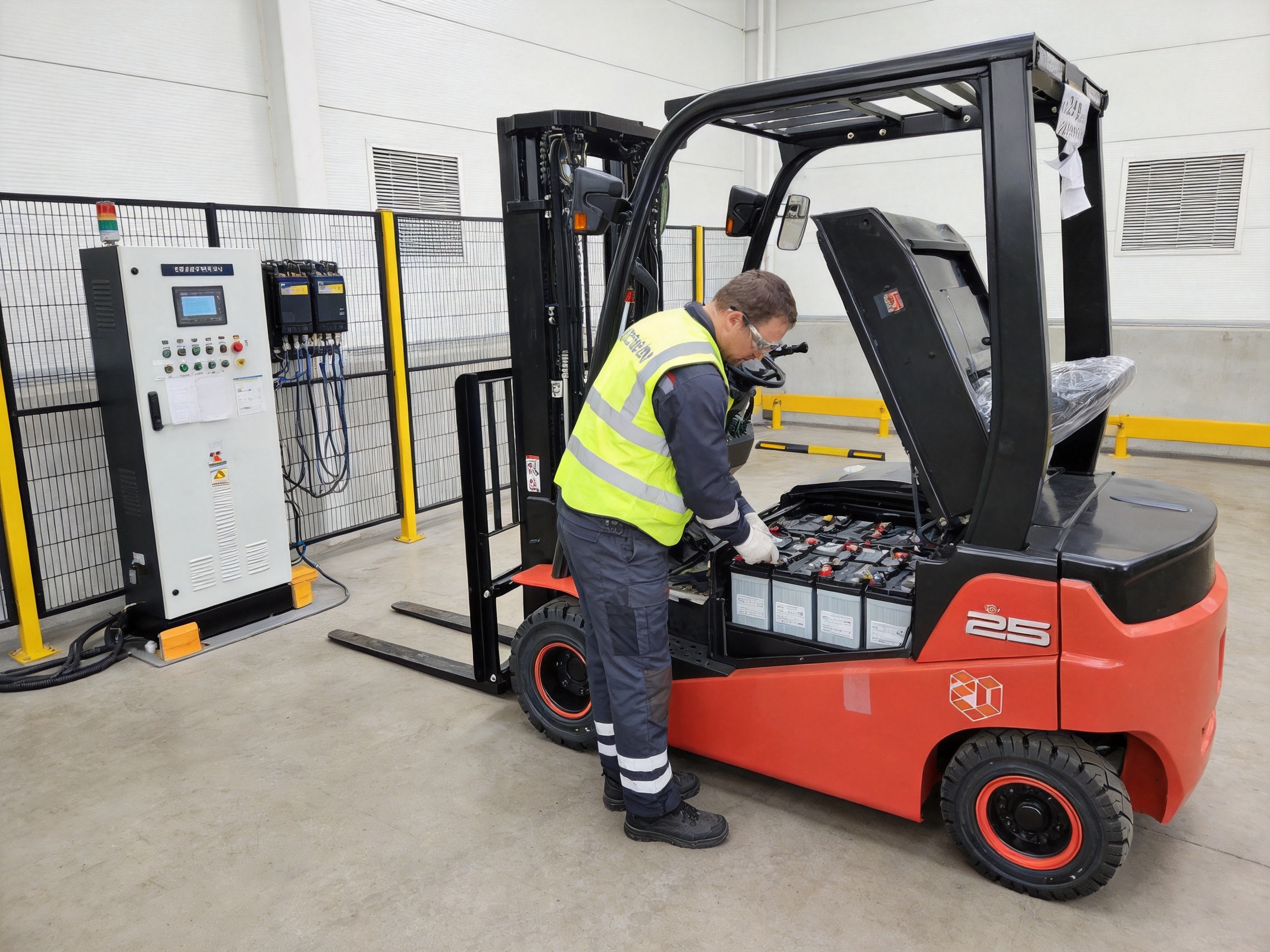
A forklift's purchase price is only one part of its total ownership cost. Energy, tires, battery care, spare parts, planned maintenance, unexpected repairs, operator training, and downtime all influence the long-term result. The 8FBN25 is configured to support cost control through a combination of electric operation, solid tires, a familiar lead-acid system, and a durable metal structure.
Electric operation can reduce the need for fuel-related handling and may help lower the environmental management burden in indoor facilities. Solid tires can reduce puncture repairs. Lead-acid technology allows maintenance teams to use established procedures and commonly understood service practices. These advantages do not eliminate maintenance, but they can make maintenance more predictable.
Preventive maintenance is most effective when it is assigned clearly. Operators can complete daily checks, while trained maintenance personnel handle scheduled service, electrical work, battery servicing, and structural inspections. A documented process helps ensure that a truck does not remain in use after a safety-critical issue has been discovered.
Capacity and durability must always be matched with safe operating practice. The rated load is valid only when the load is properly positioned, stable, and within the limits of the truck's configuration. Operators should understand the capacity plate, mast height, attachment effects, visibility limitations, travel rules, pedestrian routes, and site-specific procedures.
Before lifting, the operator should assess the pallet condition, load balance, fork spacing, overhead clearance, and travel path. The forks should be inserted sufficiently and evenly beneath the load. Loads should remain stable during travel, and the operator should maintain a clear view or use an approved spotter when visibility is restricted.
Travel speed should reflect floor conditions, traffic, load size, turning space, and pedestrian activity. Sudden turns, hard braking, elevated-load travel, and operation on damaged floors can increase risk. The compact wheelbase supports maneuverability, but it does not replace the need for gradual control and adequate clearance.
Inspect tires, forks, battery connections, controls, warning devices, mast components, brakes, and steering.
Confirm the load is centered, stable, within rated limits, and clear of people and overhead obstructions.
Keep the load low, use controlled speed, observe intersections, and follow marked pedestrian routes.
Park in an approved location, lower the forks, apply the parking brake, switch off the truck, and charge according to procedure.
Shanghai HanDavos International Trading Co., Ltd. supports customers seeking new and used forklifts, spare parts, attachments, exports, and leasing services. Its connection with Kunshan Hanzhi and more than 20 years of experience in material handling provide a broad foundation for product selection and customer support.
The company operates more than 20,000 square meters of standardized warehouse space in Kunshan, China. This inventory-oriented infrastructure can support faster product preparation, parts coordination, and consolidated procurement. For customers managing several types of equipment, access to forklifts, accessories, and spare parts through one supply channel can simplify communication and reduce the time spent coordinating different vendors.
The product portfolio includes equipment associated with leading international and domestic forklift manufacturers, including BYD, Toyota, HELI, HANGCHA, JAC, and LINDE. This broad product knowledge allows the company to compare capacity classes, power systems, mast configurations, attachments, tire choices, and application requirements rather than recommending one type of truck for every site.
Equipment selection is only the beginning of a successful material-handling project. The company provides support covering product selection, technical consultation, operating guidance, spare parts, maintenance, and after-sales service. These services are important because the right forklift depends on more than rated capacity. A correct recommendation should consider aisle width, floor type, working hours, battery charging space, load dimensions, climate, operator skill, and expected maintenance resources.
For international customers, export experience is also valuable. Shipment preparation, product documentation, parts availability, packaging requirements, destination conditions, and communication after delivery all influence the reliability of the purchasing process. A supplier with warehouse resources and a wider equipment portfolio can help customers plan replacement units, accessory requirements, and future fleet expansion more effectively.
Before ordering the 8FBN25, users should prepare a clear operating profile. This improves configuration accuracy and helps determine whether a 2.5-ton lead-acid electric forklift is the right choice for the site.
Record the average and maximum load weights, load dimensions, pallet type, center of gravity, and frequency of unusual or oversized loads.
Review indoor or outdoor use, floor quality, ramps, debris, temperature, humidity, dust, and exposure to corrosive materials.
Map travel distances, aisle widths, pedestrian crossings, loading points, rack positions, and areas requiring frequent reversing.
Estimate operating hours, lift frequency, travel distance, number of shifts, break periods, and available charging windows.
Identify trained operators, battery service personnel, inspection responsibilities, spare parts needs, and emergency repair arrangements.
Consider changes in product weight, warehouse volume, shift patterns, storage layout, and the possibility of adding attachments.
This planning process can also reveal when a different configuration is necessary. For example, a facility with long outdoor travel routes may need a different tire or chassis arrangement. A site handling very tall loads may require a specific mast and capacity review. A continuous multi-shift operation may need additional battery planning or a larger fleet. Honest application assessment protects both productivity and safety.
Battery management should be treated as an operating system rather than an occasional maintenance task. Operators should use the approved charger, keep connectors clean, avoid unnecessary deep discharge, and allow the battery to cool when required before charging. Charging areas should be organized to prevent vehicle collisions, cable damage, unauthorized access, and exposure to ignition sources.
Facilities should also establish a simple battery record. The record can include charging time, inspection results, water service where applicable, unusual heat, visible damage, and any changes in operating duration. Tracking these details helps maintenance personnel identify declining performance early and plan replacement before an unexpected battery failure interrupts production.
Battery capacity is only one factor in shift endurance. Excessive acceleration, unnecessary travel, heavy loads, steep ramps, poor floor conditions, and frequent high lifts can increase energy consumption. Operator training and route planning can therefore improve productivity without changing the equipment.
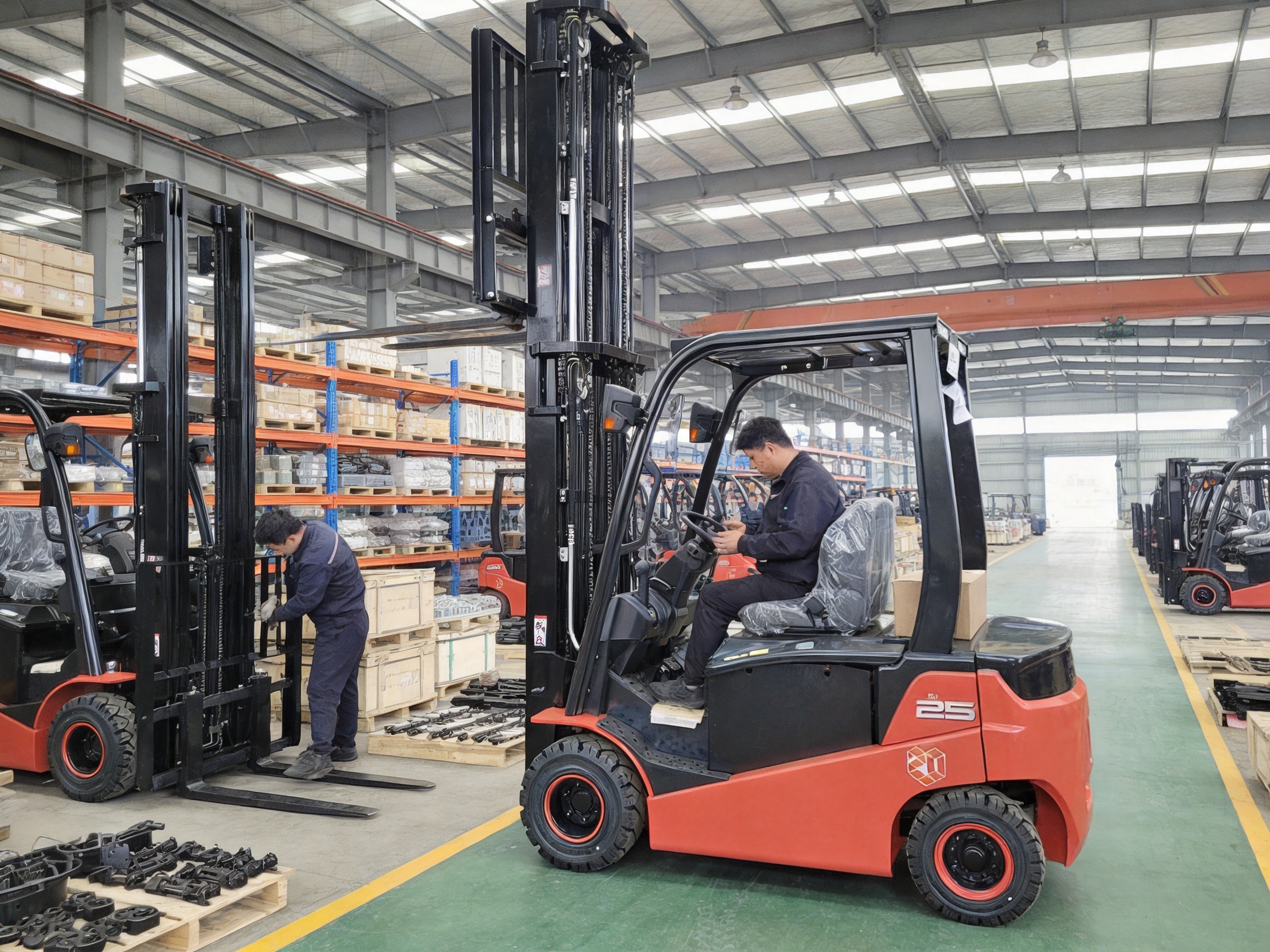
A new 8FBN25 may be appropriate when a customer needs a predictable configuration, a fresh battery, current production support, and a defined service relationship. A used forklift may be attractive when the application is seasonal, the budget is limited, or an additional truck is needed for occasional peak demand. The important point is to compare the complete condition and operating suitability rather than focusing only on purchase price.
When evaluating a used unit, buyers should check the hour meter, battery condition, mast wear, fork heel thickness, tire status, frame integrity, steering, brakes, hydraulics, electrical functions, and maintenance history. They should also confirm that the truck's actual capacity matches the intended loads. A lower-priced unit can become expensive if it requires immediate structural, battery, or hydraulic work.
Because Shanghai HanDavos provides new and used forklift sales as well as leasing services, customers can compare several acquisition approaches. A fleet plan may combine new trucks for critical production routes with used units for secondary tasks, or use leasing to manage temporary demand. The correct choice depends on utilization, budget, expected service life, and the importance of predictable availability.
The 2.5-ton rating means the forklift has a stated load capacity of 2,500 kg under the applicable rated conditions. The actual allowable load can change with load center, lift height, mast type, attachments, and load dimensions. Operators must follow the capacity plate and site safety procedures.
The 500 mm load center is a reference distance used to describe the position of the load's center of gravity relative to the fork face. It is common for standard pallet handling. A load extending farther forward or carrying its weight unevenly can reduce the effective capacity.
Yes. Its electric power produces zero direct exhaust emissions at the point of use and supports low-noise operation. The solid tires and compact wheelbase are also useful in many warehouse and factory environments. The facility should still verify floor conditions, aisle dimensions, charging arrangements, and ventilation requirements.
Solid tires resist punctures and do not require inflation. They are useful in industrial areas where sharp debris or uneven factory-floor conditions could cause frequent pneumatic tire problems. They should still be inspected regularly for wear, cuts, separation, and other damage.
The 48V/565AH battery is designed for extended operating capability, but actual shift endurance depends on load weight, travel distance, lift frequency, environment, operator behavior, and charging time. Facilities running multiple shifts should develop a battery and charging plan based on real duty-cycle data.
Maintenance can include charging control, connector and cable inspection, terminal cleaning, battery condition checks, and electrolyte service where the battery design requires it. The exact procedure should follow the battery and charger instructions and be completed by trained personnel.
The electric forklift is better suited to enclosed spaces because it produces no direct exhaust emissions and generally operates more quietly. An internal-combustion model may be preferred for certain outdoor routes, long continuous travel, or applications where charging infrastructure is unavailable. The correct choice depends on the site and duty cycle.
Lithium-powered forklifts can be advantageous where rapid opportunity charging and reduced battery service are priorities. The lead-acid configuration offers established maintenance practices, broad service familiarity, and potentially lower acquisition cost. Charging schedule, shift pattern, budget, and local service resources should guide the decision.
Confirm maximum load weight, load center, lift height, aisle width, floor conditions, tire requirements, battery charging space, operating hours, number of shifts, environmental conditions, attachment needs, delivery requirements, and available maintenance resources.
Shanghai HanDavos supports product selection, technical consultation, operation guidance, spare parts, maintenance, after-sales service, exports, and forklift leasing. Customers should provide their application details so the appropriate configuration and support plan can be discussed.
The 2.5 Ton Lead Acid Electric Forklift is designed for users who need a dependable balance of capacity, maneuverability, battery endurance, and ownership economy. Its 2,500 kg rated capacity supports common medium-to-heavy industrial loads. The 500 mm load center aligns with standard pallet handling. The 48V/565AH battery offers substantial energy storage for planned operating cycles. The 980 mm wheelbase helps the truck work in restricted areas, while solid tires reduce puncture-related interruptions.
Its strongest advantage is the way these features work together. A high-capacity truck that is too large for the facility may reduce productivity. A compact truck with insufficient capacity may limit flexibility. A low-cost truck with poor service access may create long-term downtime. The 8FBN25 is positioned as a practical middle solution for facilities that need electric indoor performance, industrial durability, and a familiar lead-acid service model.
Manufacturing quality and supply capability are equally important. Controlled fabrication, staged assembly, functional inspection, warehouse inventory, product knowledge, spare parts support, and after-sales service all contribute to the value of the final equipment. With more than two decades of material-handling experience, standardized warehouse resources, and access to a broad forklift portfolio, Shanghai HanDavos can support customers from initial application review through delivery and continued operation.
For a quotation or configuration review, customers should prepare information about load weight, load center, lift height, pallet dimensions, aisle width, floor conditions, working hours, shift pattern, charging location, and destination requirements. This information allows the equipment recommendation to be matched to the real operating environment instead of relying on a generic specification.
Recommended Products
Recommended NEWS



 English
 中文简体
 русский
 Español
 عربى