LED Indicator Light Forklift Battery Charger: Efficient, Safe, and Flexible Power for Modern Material Handling
Reliable battery charging is central to forklift productivity. A forklift may be mechanically sound and correctly maintained, yet still lose valuable operating time if its charger delivers unstable power, charges too slowly, or lacks adequate protection. The LED Indicator Light Forklift Battery Charger is designed to address these daily challenges with controlled charging, broad voltage options, clear status visibility, and protection for demanding industrial environments.
Available for 48V, 72V, and 80V forklift battery systems, this charger supports a wide range of output currents, from compact 30A versions to higher-capacity 150A models. The range makes it suitable for warehouse trucks, electric counterbalance forklifts, pallet handling equipment, industrial vehicles, and other electric material-handling machines that require dependable battery power.
Its value is not limited to electrical output. The charger combines automatic charging control, multi-stage charging logic, thermal management, LED and LCD status information, and multiple safety functions in a practical industrial housing. These features help operators charge batteries with less supervision while helping maintenance teams reduce avoidable interruptions.
48V, 72V, and 80V options
Multiple battery voltage platforms for different electric forklift applications.
30A to 150A output range
Charging capacity can be selected according to battery size and operating schedule.
Automatic charging management
Charging stages, protection functions, and automatic stopping reduce manual intervention.
Industrial protection design
Protection against over-voltage, over-current, overheating, short circuits, and reverse connection.
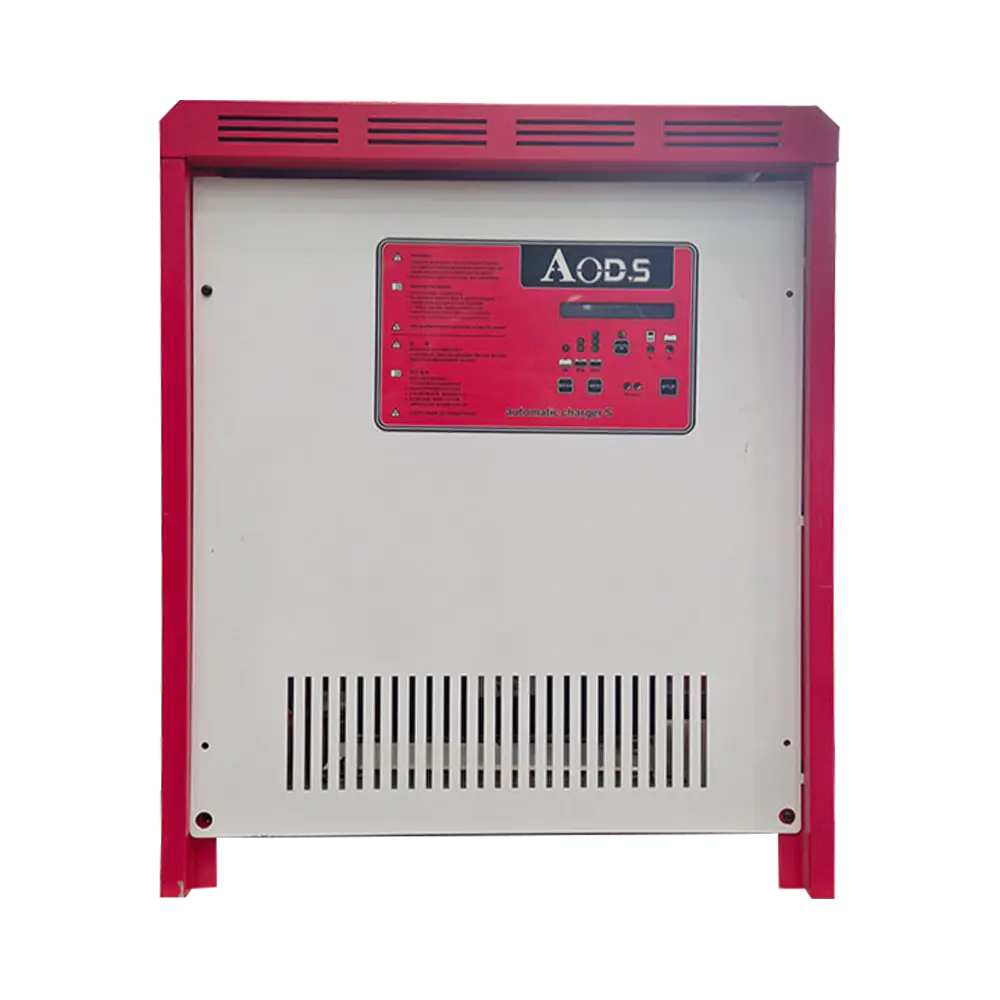
LED Indicator Light Forklift Battery Charger
Why Forklift Charging Equipment Directly Affects Productivity
Electric forklifts are increasingly used in warehouses, production plants, distribution centers, cold-chain facilities, retail logistics operations, and indoor manufacturing areas. They produce no direct exhaust emissions during operation and generally offer quiet running, precise control, and lower routine energy costs than internal-combustion equipment. However, the performance of an electric forklift depends strongly on how its battery is charged.
An unsuitable charger may create several operational problems. Charging may take longer than expected, the battery may not reach its usable capacity, or the battery may experience unnecessary stress from excessive current or voltage. Repeated charging irregularities can contribute to reduced battery life, greater maintenance requirements, and uncertainty when planning shifts.
A correctly matched charger supports a more predictable workflow. Operators can connect the forklift after a shift, observe the charging status, and allow the charging cycle to complete without repeatedly checking the equipment. When the charger automatically stops after completion, the risk of prolonged charging is reduced. When the system detects abnormal conditions, protective functions can interrupt or limit output before a minor issue becomes a larger equipment problem.
This is particularly important in operations where several forklifts work continuously. A warehouse may have different battery capacities, charging windows, and vehicle types. A flexible charger range allows the equipment manager to choose an output model that matches each battery rather than applying one oversized or undersized unit to every vehicle.
Core Product Advantages
Broad Compatibility for Lead-Acid and Lithium Batteries
The charger is designed for use with lead-acid batteries and lithium batteries across various forklift applications. Battery chemistry, nominal voltage, capacity, charging profile, and communication requirements must always be confirmed before ordering or installation. Within the appropriate configuration, the charger can provide stable output matched to the battery system.
This flexibility is valuable for facilities that are gradually modernizing their fleets. Some operators continue to use lead-acid batteries because of existing infrastructure and familiar service procedures, while others are introducing lithium batteries for faster opportunity charging, reduced routine maintenance, and improved energy utilization. A charger family that covers different battery platforms can simplify equipment planning as the fleet changes over time.
Compatibility should never be interpreted as universal plug-in interchangeability. The correct model must be selected according to battery voltage, battery cells, output current, connector arrangement, charging requirements, and local electrical conditions. Technical confirmation before shipment helps prevent mismatched equipment and supports a safer installation.
Intelligent Multi-Stage Charging
The charger uses intelligent control to identify the charging condition and manage the charging process through multiple stages. Rather than supplying an uncontrolled fixed output for the entire cycle, the charger can adjust its behavior as the battery progresses from a lower state of charge toward completion.
Multi-stage charging helps balance charging speed and battery protection. During the initial stage, the charger can provide the required current for efficient energy recovery. As the battery approaches its target condition, the charging process can transition in a controlled manner. Once the charging cycle is complete, the automatic stop function helps avoid unnecessary continued output.
This approach provides practical benefits for both operators and maintenance personnel. Operators do not need to manually estimate when to disconnect the charger under normal conditions. Maintenance teams can also work with a more consistent charging process across a fleet, provided that each charger is configured for the correct battery type and voltage.
High Conversion Efficiency and Lower Energy Waste
Charging equipment converts incoming electrical power into the voltage and current required by the battery. Conversion losses are unavoidable, but efficient power electronics can reduce unnecessary energy dissipation. The charger is designed with high conversion efficiency to support stable output while limiting power loss.
Reduced loss can be meaningful in facilities that charge several forklifts every day. Lower wasted energy may contribute to more manageable operating costs, less heat generation inside the cabinet, and improved use of available electrical capacity. Shorter charging periods can also help the same forklift return to service sooner, depending on battery condition, charger selection, and operating requirements.
Energy performance is affected by the complete charging system, not only the charger. Battery age, ambient temperature, cable length, connector condition, ventilation, and charging settings all influence results. Even so, an efficient charger provides a sound foundation for reducing avoidable electrical consumption.
Comprehensive Protection for Industrial Use
Forklift charging areas are active working environments. They may contain moving vehicles, metal structures, dust, vibration, changing temperatures, and frequent connection and disconnection cycles. Protection functions are therefore essential rather than optional conveniences.
The charger incorporates multiple protective functions, including over-voltage protection, over-current protection, over-temperature protection, short-circuit protection, reverse-connection protection, and anti-leakage protection. These functions are intended to help protect the charger, battery, operator, and surrounding electrical system when abnormal conditions occur.
Over-voltage protection
Helps limit abnormal voltage conditions that could damage charging components or affect the battery system.
Over-current protection
Helps control excessive current caused by unsuitable conditions, connection problems, or electrical faults.
Over-temperature protection
Monitors thermal conditions and helps reduce risk during high-load or extended charging operation.
Reverse-connection protection
Helps prevent damage when battery polarity is connected incorrectly.
Short-circuit protection
Helps isolate abnormal output conditions and supports safer troubleshooting.
Anti-leakage protection
Supports safer operation by addressing unwanted leakage conditions in the charging system.
Clear LED and LCD Charging Information
Charging equipment should communicate its status clearly. The LED indicator lights provide a quick visual reference for normal operation, charging activity, completion, or abnormal conditions. The LCD display provides more detailed information about the charging process and operating status, helping users understand what the charger is doing without opening the housing.
Clear status information is especially useful in shared charging rooms. A supervisor can quickly review several chargers, while an operator can identify whether a unit is charging or requires attention. This improves daily workflow and helps reduce unnecessary service calls caused by uncertainty about the equipment status.
The display system also supports practical maintenance. When a charger does not operate as expected, the visible status indication can provide an initial reference before a technician checks the electrical supply, connector, battery, ventilation, or protection state.
Technical Specification Overview
The product family includes models for 48V, 72V, and 80V battery systems. Input voltage for the listed models is 380V, with input current and input power varying according to the selected battery voltage and output current. The following table presents the available configurations supplied in the product range.
| Battery voltage |
Battery cells |
Output current options |
Input voltage |
Approximate input power range |
| 48V |
24 |
40A–150A |
380V |
3.0–11.3kW |
| 72V |
36 |
30A–150A |
380V |
3.4–16.9kW |
| 80V |
40 |
30A–150A |
380V |
3.8–18.8kW |
The 48V series includes 40A, 50A, 60A, 70A, 80A, 90A, 100A, 110A, 120A, and 150A models. The 72V series includes 30A, 40A, 50A, 60A, 70A, 80A, 90A, 100A, 110A, 120A, and 150A models. The 80V series includes 30A, 40A, 50A, 60A, 70A, 80A, 90A, 100A, 110A, 120A, 130A, and 150A models.
Input current also changes according to the model. For example, listed 48V models range from 4.6A input current at 40A output to 17.1A at 150A output. Listed 72V models range from 5.1A input current at 30A output to 25.6A at 150A output. Listed 80V models range from 5.7A input current at 30A output to 28.5A at 150A output.
These figures are reference specifications. Actual installation should be reviewed by qualified electrical personnel. The facility power supply, protective devices, cable size, grounding, ventilation, connector type, and local electrical standards must be considered before commissioning.
Thermal Management for Continuous Charging
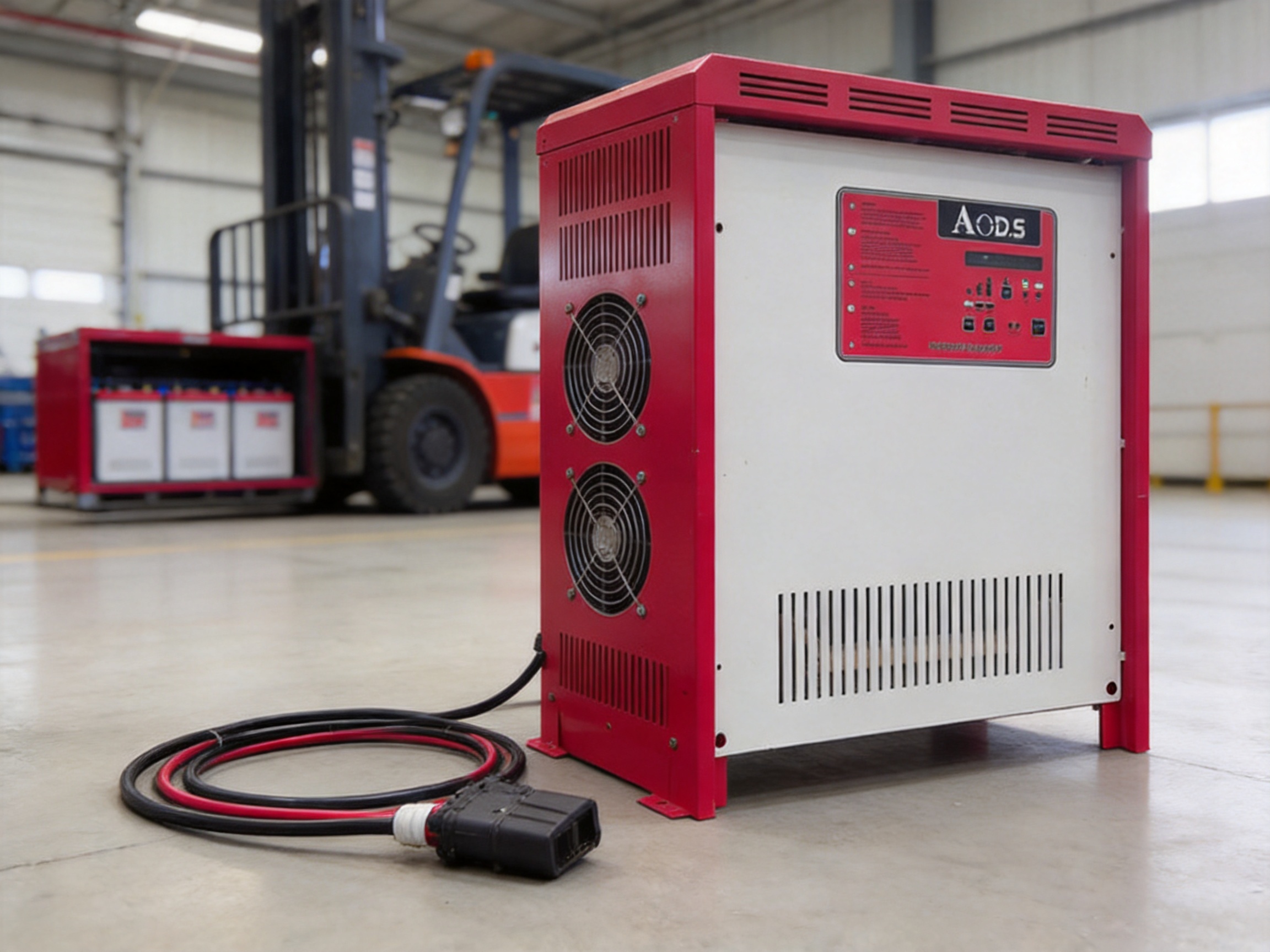
Heat is a natural result of power conversion. If heat accumulates inside a charger, electronic components may experience additional stress and the equipment may reduce output or stop for protection. The charger uses an optimized heat dissipation structure and fan cooling system to help remove heat during operation.
Effective cooling supports stable performance during long charging sessions. It is particularly useful in busy facilities where batteries are charged repeatedly throughout the day and the charger is expected to operate for extended periods. A robust housing and suitable internal arrangement also help protect electronic components from the surrounding environment.
Cooling performance depends on installation conditions. The charger should be positioned with adequate clearance around air inlets and outlets. Dust accumulation should be controlled, and the fan and ventilation paths should be inspected according to the site maintenance schedule. Installing the equipment in a sealed, damp, or excessively hot location may reduce its service life even when the charger itself has appropriate thermal protection.
Design and Manufacturing Quality Considerations
Industrial charging equipment must be evaluated as a complete product rather than by output rating alone. Component selection, circuit design, enclosure construction, thermal layout, protection logic, assembly consistency, and final testing all influence long-term performance.
The charger is built around quality electronic components and a robust housing intended for stable operation in material-handling environments. The design emphasizes anti-interference performance, controlled power conversion, practical heat management, and accessible operating information. These features help distinguish an industrial charging product from a basic power supply that may not be designed for repeated forklift battery cycles.
Structured Product and Supply Coordination
Shanghai HanDavos International Trading Co., Ltd. supports customers through product selection, technical consultation, equipment guidance, spare parts coordination, and after-sales communication. Its experience in forklifts, forklift parts, attachments, exports, and leasing services provides useful application knowledge when specifying a charger for a mixed equipment fleet.
The company operates standardized warehouse facilities covering more than 20,000 square meters. This infrastructure supports organized inventory management, product handling, inspection coordination, and international order preparation. For customers purchasing charging equipment together with forklifts, batteries, spare parts, or attachments, a broad material-handling product portfolio can simplify sourcing and delivery planning.
A reliable supply process should begin before the order is placed. Model selection, battery information, electrical requirements, connector details, destination standards, and operating conditions should be confirmed in advance. The company’s product consultation process is intended to help customers identify the correct configuration rather than selecting a charger only by nominal voltage.
Quality Control from Specification to Shipment
Consistent quality depends on several linked stages. The first stage is specification review, where the requested battery voltage, output current, input supply, and application conditions are checked. The second stage is product and component coordination, ensuring that the selected configuration corresponds with the required charging application. The third stage is inspection and shipment preparation, where product identification, packaging condition, and documentation are reviewed.
For international shipments, packaging and labeling are also important. Charging equipment should be protected against impact, moisture, and movement during transportation. Model information should remain legible, and the shipment should include the necessary product details for receiving, installation, and maintenance personnel.
This structured approach helps reduce common purchasing errors, such as ordering the wrong output current, selecting an unsuitable input supply, or failing to confirm the connector before dispatch. It also gives customers a clearer basis for comparing charger models and planning their charging infrastructure.
01
Application review
Confirm forklift type, battery chemistry, battery voltage, capacity, shift pattern, and charging location.
02
Model matching
Select output current, input requirements, connector arrangement, display configuration, and protection options.
03
Inspection coordination
Review product identification, visible condition, operating information, packaging, and order documentation.
04
Delivery support
Coordinate shipment preparation and provide product guidance for installation and routine use.
Advantages Compared with Basic or Poorly Matched Chargers
Many charging products may appear similar when viewed only from the outside. The important differences are found in control logic, protection coverage, thermal design, status information, output selection, and application support.
A basic fixed-output charger may provide power without adapting effectively to the battery’s changing condition. By contrast, an intelligent multi-stage charger is designed to manage the charging process more carefully. A low-cost unit may also have limited protection functions, unclear indicators, or insufficient cooling for repeated industrial use. These limitations can create hidden costs through downtime, troubleshooting, premature component replacement, or battery service requirements.
The LED Indicator Light Forklift Battery Charger offers several practical advantages over a narrow, one-configuration alternative:
- More configuration choices: 48V, 72V, and 80V platforms cover a wider range of electric forklift applications.
- More suitable output selection: Operators can select a current rating based on battery capacity and required charging time.
- Better operating visibility: LED and LCD displays provide clear information about the charging condition.
- Stronger protection coverage: Multiple protective functions help address common electrical and thermal risks.
- Improved heat control: Fan cooling and a planned heat dissipation structure support long operating periods.
- Lower maintenance burden: The plug-and-play design and automatic control reduce routine user intervention.
- More dependable sourcing: Product consultation, warehouse capability, and material-handling experience support international procurement.
These advantages do not remove the need for correct installation or battery maintenance. They provide a stronger foundation for reliable operation when the charger is correctly selected and used according to its specifications.
Choosing the Correct Output Current
Output current should be selected according to the battery capacity, manufacturer recommendations, desired charging period, and operating schedule. A higher current rating is not automatically better. If the charger is oversized for the battery or incompatible with the battery’s charging requirements, it may create unnecessary stress or prevent the charging system from operating correctly.
A lower-current model may be appropriate for smaller batteries or facilities with longer overnight charging periods. A higher-current model may be preferred where forklifts have shorter charging windows or where the operation requires faster turnaround. The correct selection should consider the full duty cycle rather than only the forklift’s nominal voltage.
For example, two forklifts may both use 48V batteries but have different capacities and work patterns. One may operate in a single shift and charge overnight, while the other may work across multiple shifts and require a shorter charging window. These vehicles may benefit from different output current selections even though their nominal battery voltage is the same.
Installation and Daily Use Recommendations
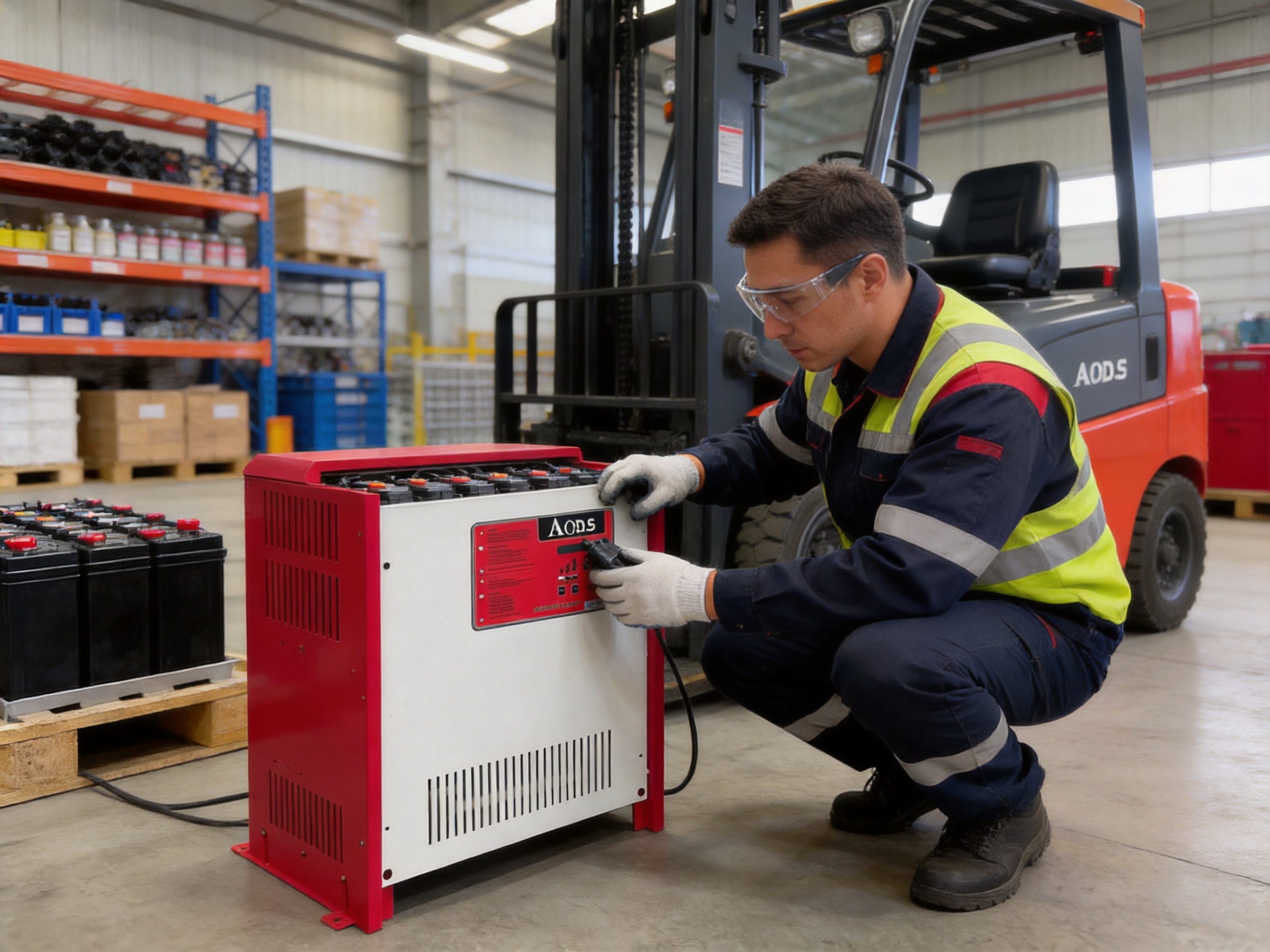
The charger should be installed by qualified personnel familiar with industrial electrical systems. Before connection, confirm the input voltage, grounding arrangement, battery polarity, connector condition, and charger model. The battery should be inspected for visible damage, leakage, loose terminals, or other conditions that could affect safe charging.
Place the charger on a stable surface in a clean and ventilated area. Keep the cooling openings unobstructed. Avoid placing tools, packaging materials, or other objects on top of the charger. The charging area should be protected from unnecessary water exposure and should allow operators to connect and disconnect the equipment safely.
During operation, review the LED or LCD status information. If the charger displays an abnormal condition, disconnecting the input supply and following the site troubleshooting procedure may be appropriate. Do not bypass protective functions or continue operation when there is visible smoke, unusual noise, burning odor, damaged cabling, or excessive heat.
Routine inspection should include the power cable, charging connector, housing, cooling fan, display, grounding connection, and ventilation openings. Dust should be removed using an appropriate method that does not introduce moisture into the electronic enclosure. Service work should be performed by trained personnel with the charger isolated from the electrical supply.
Practical Maintenance Checklist
- Check that the charger housing is clean, dry, and free from visible impact damage.
- Confirm that air inlets, outlets, and fan areas are not blocked.
- Inspect charging connectors and cables for looseness, wear, heat marks, or exposed conductors.
- Verify that the LED and LCD indicators operate normally.
- Keep the charger away from standing water, corrosive chemicals, and excessive dust.
- Record unusual alarms or repeated protection events for technical review.
- Use only a compatible battery and approved charging configuration.
Applications in Different Material-Handling Environments
Warehouses and Distribution Centers
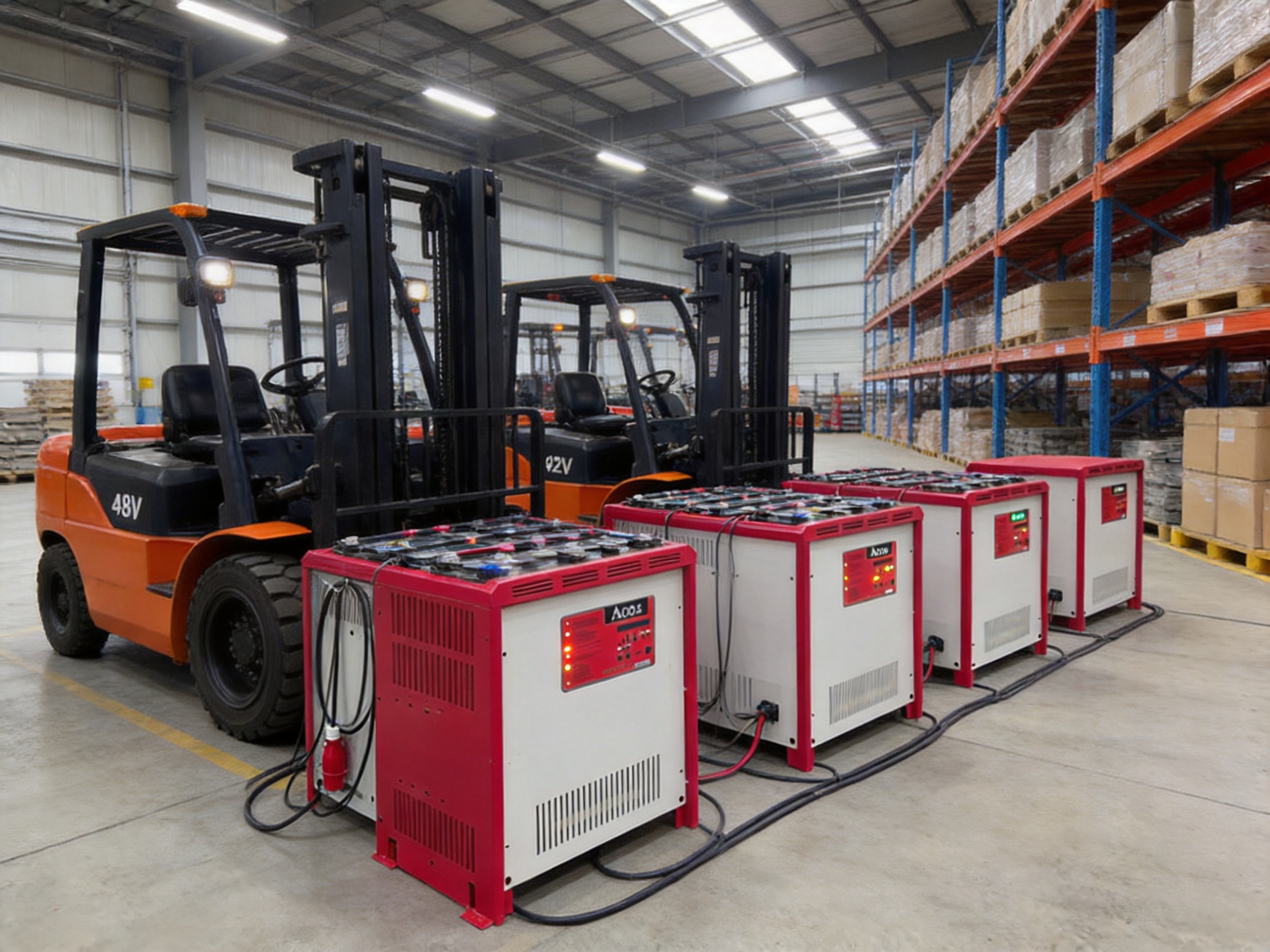
Warehouses often require predictable charging between shifts. A charger with clear status information allows operators to identify available and charging equipment quickly. The range of current options can support both compact warehouse forklifts and larger electric trucks used for pallet movement.
Manufacturing Plants
Production facilities may operate forklifts near metal structures, machinery, loading bays, and storage areas. A robust charger with multiple protection functions and effective thermal management can support dependable charging in these demanding conditions, provided that the installation area is appropriately ventilated and protected.
Cold-Chain and Temperature-Controlled Operations
Battery performance can vary with temperature. Charging equipment for cold-chain operations should be installed and configured according to the environmental conditions and battery manufacturer’s requirements. The charger’s status displays and protective functions help users monitor operation, while site-specific engineering remains essential.
Fleet Replacement and Electrification Projects
When a facility replaces internal-combustion forklifts with electric models, charging infrastructure becomes a major part of the transition. The 48V, 72V, and 80V options provide a starting point for planning different vehicle classes. The equipment manager can evaluate battery capacity, charging locations, electrical load, and future fleet expansion before selecting the final models.
How to Plan a Forklift Charging Area
A charging area should be treated as part of the facility’s operating system. It needs sufficient space for forklift access, safe cable routing, appropriate ventilation, electrical protection, and clear separation from incompatible materials. The area should be visible to responsible personnel and arranged to reduce the risk of vehicles striking the charger.
Charging demand should also be calculated. Count the number of forklifts, battery voltage, battery capacity, average daily operating hours, charging windows, and expected future fleet growth. This information helps determine how many chargers are required and whether the site electrical supply can support simultaneous operation.
Where several chargers are installed, clear labeling is recommended. Each charger should identify its voltage and current configuration, and each charging connector should be associated with the correct battery system. This simple organizational step can reduce the possibility of connecting an unsuitable charger to a battery.
Facility managers should also establish rules for reporting damage, abnormal alarms, connector wear, and incomplete charging. A short daily inspection combined with scheduled technical maintenance can help identify issues before they cause an unexpected stoppage.
Why Technical Support Matters in International Procurement
Purchasing a charger from an international supplier involves more than comparing a model number and price. Electrical standards, shipping conditions, connector preferences, battery specifications, and installation practices may vary by region. Clear communication before production and shipment helps ensure that the equipment is appropriate for the destination site.
Shanghai HanDavos International Trading Co., Ltd. provides product selection assistance and technical consultation alongside its forklift and material-handling product portfolio. Its experience with new and used forklifts, spare parts, attachments, exports, and leasing services allows customers to discuss the charger in the context of a complete fleet rather than as an isolated electrical component.
The company’s warehouse resources in Kunshan support inventory organization and order coordination. Its service scope includes product guidance, operation information, spare parts support, maintenance communication, and after-sales assistance. These capabilities are useful for customers who want to source chargers together with forklifts or replacement components.
When requesting a quotation or technical recommendation, customers should provide the battery type, nominal voltage, capacity, required charging time, input power available at the site, preferred connector, destination country, and expected operating environment. Complete information makes it easier to recommend a suitable model and prepare the order correctly.
Frequently Asked Questions
What forklift batteries can this charger support?
The charger is designed for compatible lead-acid and lithium forklift batteries. The exact model must be selected according to battery chemistry, nominal voltage, battery cells, capacity, charging profile, and connector requirements. Customers should confirm compatibility before connection.
What battery voltages are available?
The product range includes 48V, 72V, and 80V models. The corresponding listed battery cell counts are 24 cells for 48V, 36 cells for 72V, and 40 cells for 80V systems.
What output current options are available?
Depending on the voltage series, output current options range from 30A to 150A. The 48V series begins at 40A, while the 72V and 80V series include 30A options. Selection should be based on battery capacity and the required charging schedule.
Does the charger stop automatically?
The intelligent control system is designed to manage the charging stages and stop automatically when the charging process is complete, subject to correct installation, battery compatibility, and normal operating conditions.
How does the LED indicator help operators?
The LED indicator provides a quick visual reference for the charger’s operating condition. Combined with the LCD display, it helps users understand whether the unit is charging, complete, or reporting an abnormal condition.
Is the charger suitable for continuous operation?
The charger includes a heat dissipation structure and fan cooling system intended to support long charging periods. Continuous operation still depends on proper ventilation, ambient conditions, correct model selection, and routine inspection.
What input voltage is listed for these models?
The listed models use a 380V input. Before ordering, the customer should confirm the site power supply, phase requirements, protective devices, grounding, and applicable local electrical standards.
Can the charger be used outdoors?
Some configurations may be available with a certain level of waterproof and dustproof protection. Outdoor use requires confirmation of the specific protection grade and installation requirements. The charger should not be exposed to conditions beyond its rated environmental specification.
How should the charger be maintained?
Keep the housing and ventilation openings clean, inspect cables and connectors, check the cooling fan, review display information, and record unusual alarms. Electrical servicing should be performed by qualified technicians after isolating the equipment from the power supply.
What information should be supplied when requesting a model recommendation?
Provide the battery chemistry, battery voltage, battery capacity, battery cell count if available, desired charging duration, forklift model, input power, connector details, installation environment, and destination country. This information supports more accurate configuration and order preparation.
Final Selection Guidance
The right forklift charger should deliver more than electrical power. It should match the battery system, support the required operating schedule, provide clear information, protect against common abnormal conditions, and remain stable during repeated industrial use. The LED Indicator Light Forklift Battery Charger combines these requirements in a broad model range for 48V, 72V, and 80V forklift batteries.
Its intelligent charging control, automatic stopping, multiple safety functions, efficient power conversion, fan-assisted cooling, and LED and LCD displays make it a practical choice for facilities that value predictable charging and straightforward daily operation. The available output range also makes it possible to select a more suitable charger for different battery capacities and work patterns.
Product performance begins with correct selection. Before purchase, confirm the battery chemistry, voltage, current requirement, input supply, connector, environmental conditions, and local installation requirements. With accurate technical information and professional supply coordination, the charger can become a dependable part of a forklift fleet’s energy and maintenance system.
References
1. Product specification information for LED Indicator Light Forklift Battery Charger, including voltage, current, battery cell, and input power configurations.
2. Industrial battery charging and material-handling equipment maintenance principles.
3. General guidance for electric forklift battery compatibility, charging area planning, and electrical safety.
4. Manufacturer and supplier information concerning forklift equipment, spare parts, attachments, warehouse logistics, and after-sales support.
For model selection, battery compatibility review, and international order support, contact the material-handling equipment service team with your forklift and battery specifications.



 English
 中文简体
 русский
 Español
 عربى