2 Ton Lithium-Ion Electric Stacker for Safer, Smarter Warehouse Handling
Modern warehouses need more than lifting capacity. They need equipment that can operate accurately in restricted aisles, protect operators and loads, reduce maintenance interruptions, and support a predictable cost of ownership. The ES20-WA warehouse electric stacker is designed around these practical requirements. With a 2,000-kilogram rated load capacity, lithium-ion battery compatibility, AC drive technology, pedestrian operation, and a compact structure, it provides a dependable solution for pallet stacking, short-distance transport, order replenishment, and daily warehouse movement.
This electric stacker combines a high-strength mast, an efficient hydraulic system, mechanical steering, electromagnetic braking, polyurethane wheels, and a range of active and passive safety functions. Its design is intended for distribution centers, manufacturing warehouses, cold-chain preparation areas, retail logistics facilities, packaging operations, and other indoor material-handling environments where reliability and maneuverability are essential.
Unlike basic walkie stackers that focus only on lifting and travel, the ES20-WA is engineered as a complete handling system. Its electrical architecture, frame, mast, controls, battery access, hydraulic components, and service layout are developed to work together. This integrated approach helps operators complete repetitive tasks with less physical effort while helping fleet managers maintain stable productivity over long working cycles.
2,000 kg
Rated load capacity
4.5 / 5.0 km/h
Laden and unladen travel speed
AC
Drive control technology
Why Warehouses Are Moving Toward Lithium-Ion Electric Stackers
Warehouse operations are becoming more time-sensitive and space-conscious. A single facility may handle mixed pallet sizes, frequent replenishment tasks, narrow travel lanes, and multiple shifts each day. Traditional equipment can complete these jobs, but it may require more maintenance, produce more noise, or lack the control precision needed in a modern storage environment.
Lithium-ion battery systems are increasingly selected for electric warehouse equipment because they support opportunity charging, efficient energy use, and consistent performance during routine work. They do not require the same watering procedures associated with conventional lead-acid batteries, and they can reduce the need for dedicated battery-changing infrastructure in suitable applications. When combined with a reliable battery indicator and intelligent low-voltage protection, lithium-ion power can help operators plan charging more effectively and protect the battery from damaging operating conditions.
The ES20-WA is well suited to businesses that want to replace manual pallet movement or supplement a larger forklift fleet. It offers the lifting capability required for heavy pallets while retaining the compact footprint and pedestrian operating format expected in indoor warehouse work. The result is a practical middle ground between a basic pallet truck and a larger rider-operated forklift.
Efficient Indoor Operation
Electric drive and hydraulic lifting produce zero direct exhaust emissions during operation, making the machine suitable for many indoor applications where air quality and noise control are important.
Controlled Handling
AC drive technology, electromagnetic proportional valve control, and mechanical steering support predictable movement during pallet pickup, stacking, and positioning.
Reduced Service Burden
Maintenance-free AC motors, accessible components, controller self-diagnosis, and a simple cover structure help reduce the time required for routine inspection.
Operator-Focused Design
An ergonomic handle, emergency reverse function, automatic corner deceleration, and a shock-absorbing foldable platform improve comfort and control during repeated work.
Product Specifications at a Glance
Clear specifications help warehouse planners determine whether a machine is appropriate for their load profile, aisle layout, floor conditions, and operating routine. The following data describes the principal configuration of the ES20-WA electric stacker.
| Specification |
Value |
Operational meaning |
| Product type |
Electric stacker |
Designed for pallet lifting, stacking, and internal transport |
| Drive system |
Electric |
Suitable for indoor material-handling applications |
| Operator type |
Pedestrian |
Operator controls the machine from the walking or platform position |
| Rated load capacity |
2,000 kg |
Supports heavy pallet and warehouse handling requirements |
| Load center distance |
600 mm |
Reference point for rated capacity and load stability |
| Load distance from drive axle to fork |
693 mm |
Important for layout planning and load distribution |
| Wheelbase |
1,305 mm |
Balances stability with maneuverability |
| Service weight |
1,170 kg |
Useful for floor loading and transport planning |
| Turning radius |
1,589 mm |
Supports movement in compact warehouse areas |
| Travel speed, laden |
4.5 km/h |
Controlled speed when carrying a load |
| Travel speed, unladen |
5.0 km/h |
Efficient repositioning between handling tasks |
| Tyre type |
Polyurethane |
Suitable for smooth industrial floors and indoor travel |
| Service brake |
Electromagnetic |
Provides controlled stopping and parking support |
| Drive control |
AC |
Supports responsive acceleration and stable operation |
| Steering design |
Mechanical |
Offers direct and familiar operator control |
Structural Engineering for Daily Warehouse Demands
Warehouse equipment is exposed to repeated acceleration, braking, lifting, lowering, pallet contact, floor joints, and occasional uneven loading. A reliable stacker therefore requires more than a powerful motor. The frame, mast, gearbox, hydraulic system, wheels, and electrical connections must withstand repetitive stress without creating excessive downtime.
The ES20-WA uses a high-strength vertical gearbox designed for durability during routine travel and handling. A vertical arrangement can also support a compact machine layout, helping preserve maneuverability in areas where a larger counterbalanced forklift may be difficult to position. The design makes efficient use of the available chassis space while maintaining access to key service areas.
The C-type mast steel beam is manufactured to provide strong resistance to bending. Mast rigidity is important because it affects the stability of the fork carriage during lifting and lowering. A rigid mast helps reduce unwanted movement when a load is raised, positioned, or transferred into a rack location. It also contributes to operator confidence when handling loads at height.
The wheelbase of 1,305 millimeters and turning radius of 1,589 millimeters reflect a balance between load support and indoor agility. A short machine is not automatically better; excessive compactness can affect stability or restrict capacity. The ES20-WA is configured to provide a stable base for a 2,000-kilogram rated load while remaining practical for warehouse aisles and staging areas.
Design Priorities Built into the Machine
Service accessibility
High
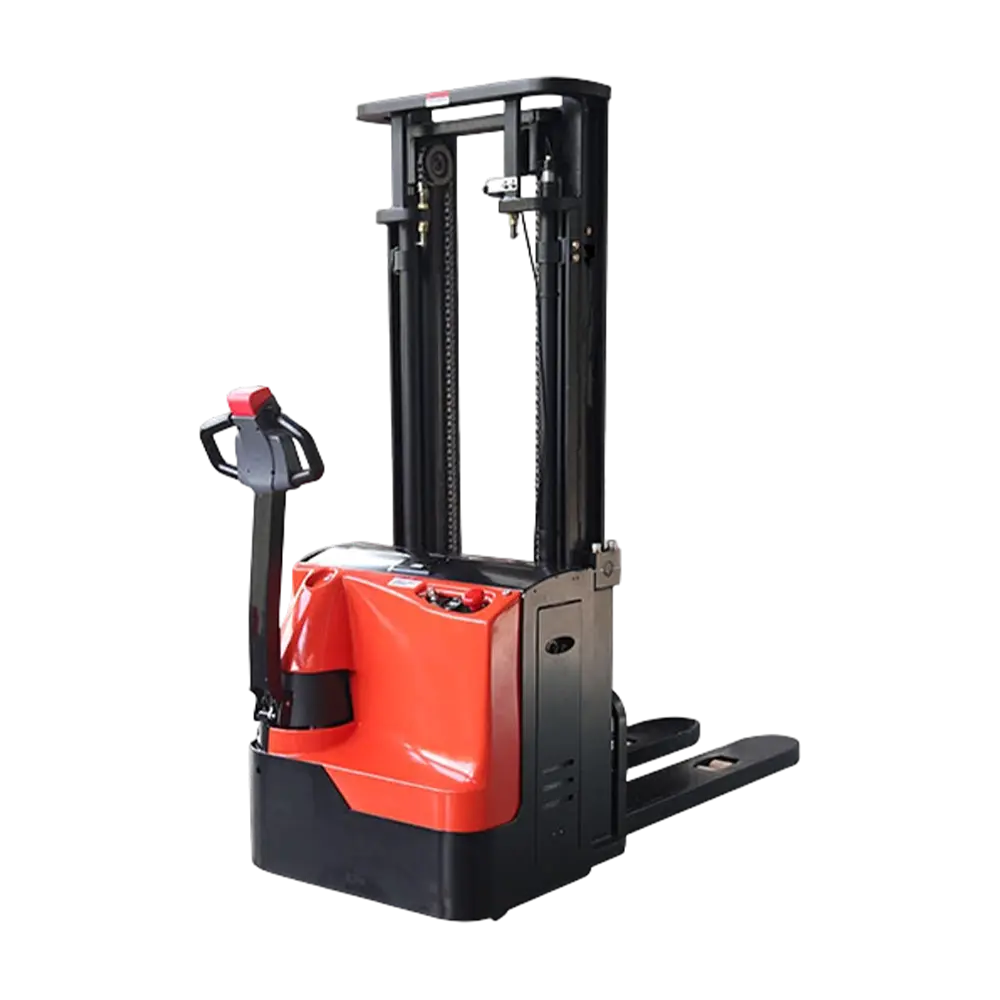
Warehouse Equipment 2 Ton Lithium-ion Battery Electric Stacker
Advanced Manufacturing and Quality Control
Product performance begins with manufacturing discipline. A warehouse machine may be used for thousands of operating cycles each year, so quality must be built into the production process rather than added only during final inspection. The manufacturing approach behind the ES20-WA emphasizes component selection, structural accuracy, electrical protection, hydraulic testing, and functional verification.
High-Strength Component Selection
The mast and chassis require materials with suitable strength, dimensional consistency, and resistance to repeated mechanical stress. Steel sections are formed and assembled to maintain alignment between the mast, carriage, forks, and hydraulic lifting elements. Correct alignment helps distribute loads more evenly and reduces unnecessary wear on moving components.
The C-type mast design provides a strong vertical structure while allowing the lifting mechanism to remain integrated with the main body of the machine. During production, accurate welding, machining, and assembly are important because small deviations can influence fork movement and load positioning. A controlled manufacturing process helps ensure that the finished mast operates smoothly throughout its working range.
Hydraulic System Testing
The hydraulic station is designed for low noise and reduced failure risk. Hydraulic cylinders and pipelines undergo multiple stages of testing to verify sealing performance, pressure resistance, and operating stability. These checks are essential because a hydraulic issue can affect lifting speed, load control, and machine availability.
An explosion-proof hydraulic design provides an additional safety layer. If a hydraulic pipe is damaged, the system is designed to help prevent an uncontrolled rapid descent of the mast. This feature does not replace proper inspection or safe operating procedures, but it can reduce the consequences of a sudden hydraulic fault.
Electrical Assembly and Protection
Electrical reliability depends on more than the controller and battery. Connectors, wiring routes, terminals, protective sleeves, and fixing points all influence long-term performance. The ES20-WA uses waterproof AMP connectors and carefully secured cables to reduce the risk of loose connections, moisture-related issues, and abrasion.
Wiring is firmly fixed and protected from unnecessary movement. This is especially valuable on a machine exposed to vibration, frequent steering input, and repeated lifting cycles. The electrical layout is also designed to support inspection and troubleshooting, helping technicians identify issues without dismantling unrelated systems.
Functional Testing before Delivery
A responsible manufacturing process includes more than visual inspection. Functional testing should cover lifting and lowering, travel response, braking, steering, emergency reverse, emergency power cut-off, speed limitation, warning indicators, and controller diagnostic functions. Testing these systems as a complete machine helps identify interaction problems that may not be visible when individual components are evaluated separately.
For international customers, consistent production is particularly important. Equipment may be shipped to different climates, facilities, and operating patterns. Standardized assembly procedures and documented inspection points help maintain comparable quality across production batches and simplify communication between the factory, distributor, service team, and end user.
Safety Features for Operators, Loads, and Facilities
Safety is a central part of the ES20-WA design. Warehouse accidents can involve moving equipment, falling loads, unexpected travel, poor visibility, or limited stopping space. The machine therefore combines several protective functions rather than relying on a single safety feature.
Emergency Reverse
The emergency reverse function helps the operator move the machine away from the handle area if the stacker approaches too closely during travel.
Emergency Power Cut
A clearly available emergency power cut switch enables rapid shutdown when an operational abnormality occurs.
Lift-Height Speed Reduction
When the forks rise to a specified height, the machine automatically changes to low-speed travel to support safer handling at elevated positions.
Anti-Slip Braking
Braking performance is designed to help prevent sliding during abnormal operation or travel on suitable slopes.
Corner Deceleration
Automatic corner deceleration helps reduce travel speed during turning and supports smoother movement in confined areas.
Dual Steering Monitoring
Dual-monitoring electric steering supports stable control and helps identify steering-related abnormalities during operation.
Safety systems are most effective when combined with suitable training, marked travel lanes, correctly rated pallets, appropriate load positioning, and regular equipment inspections. Operators should always verify that the load is stable, centered, and within the rated capacity for the relevant load center and lifting height.
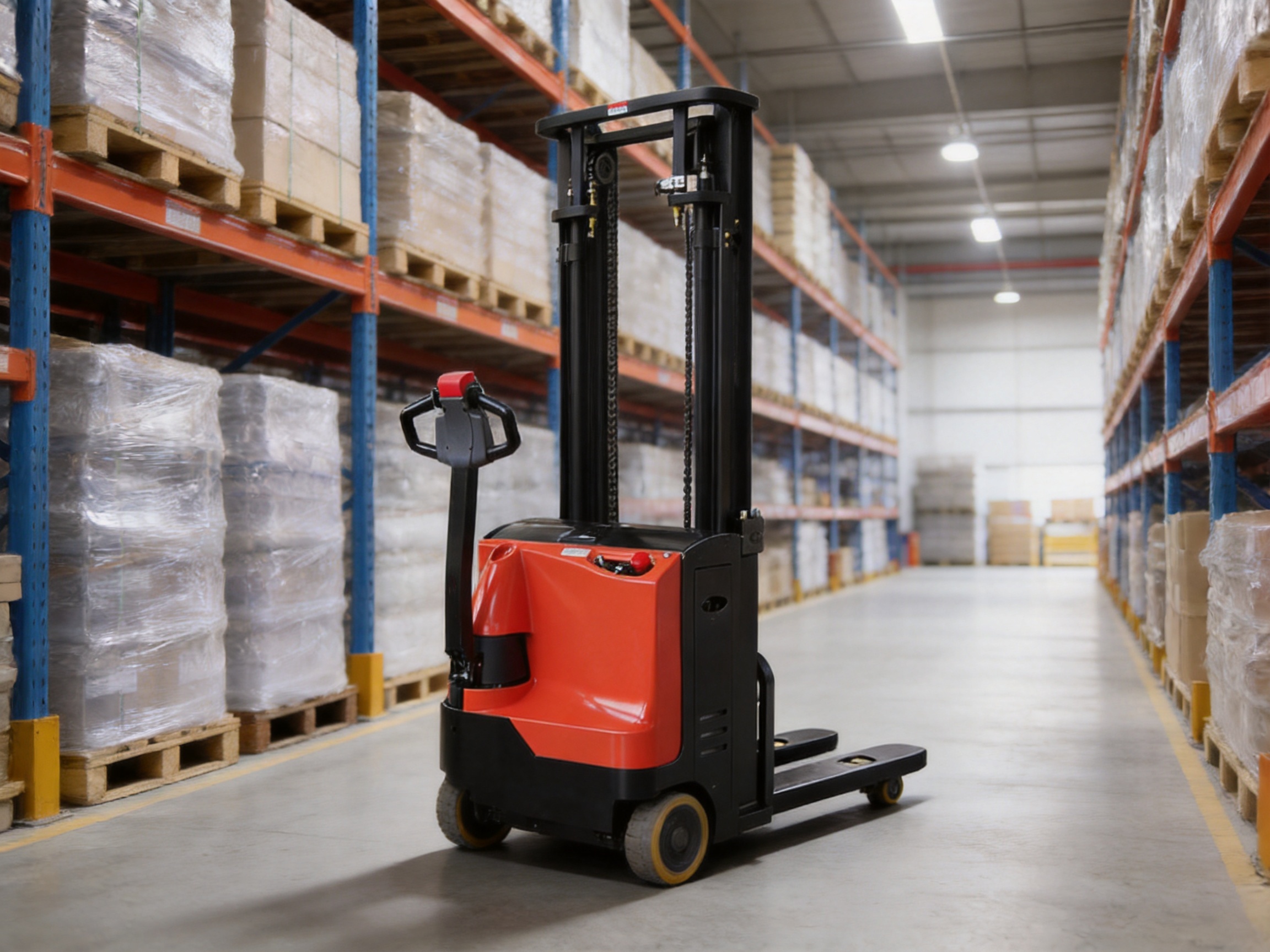
Ergonomic Operation for Repetitive Tasks
Warehouse productivity is strongly influenced by the physical effort required from operators. Repetitive steering, acceleration, button selection, pallet alignment, and walking can contribute to fatigue when equipment is not designed around the user. The ES20-WA includes several features intended to make frequent handling tasks more comfortable and predictable.
Integrated Handle Controls
The ergonomic handle head places the primary operating buttons within convenient reach. This arrangement allows the operator to control travel, lifting, lowering, braking, and related functions without repeatedly changing hand position. A familiar control layout can shorten the learning period for new operators and support consistent operation during busy shifts.
Foldable Shock-Absorbing Platform
The foldable foot platform gives the machine greater flexibility. With the platform folded, the stacker can be used in narrow areas where walking space is limited. When the platform is deployed, the operator can travel more efficiently across longer internal routes. Shock absorption helps reduce the impact of floor joints and minor surface irregularities, supporting comfort during repeated travel.
Proportional Hydraulic Control
Electromagnetic proportional valve control supports smoother lifting and lowering. Precise hydraulic movement is useful when positioning a pallet into a rack, aligning with a production line, or placing goods close to another load. Smooth control can also reduce sudden load movement and help protect products during delicate handling.
Compact Handling in Confined Areas
The compact structure and controlled travel speed make the stacker suitable for staging zones, narrow aisles, loading areas, and production-side storage. Mechanical steering provides direct feedback to the operator, while the turning radius supports practical maneuvering where a larger forklift may require multiple corrections.
Maintenance Efficiency and Serviceability
Equipment availability is directly connected to service design. A machine that is difficult to inspect can consume unnecessary labor and remain out of service longer than necessary. The ES20-WA addresses serviceability through accessible components, a simple body structure, diagnostic support, and reduced daily maintenance requirements.
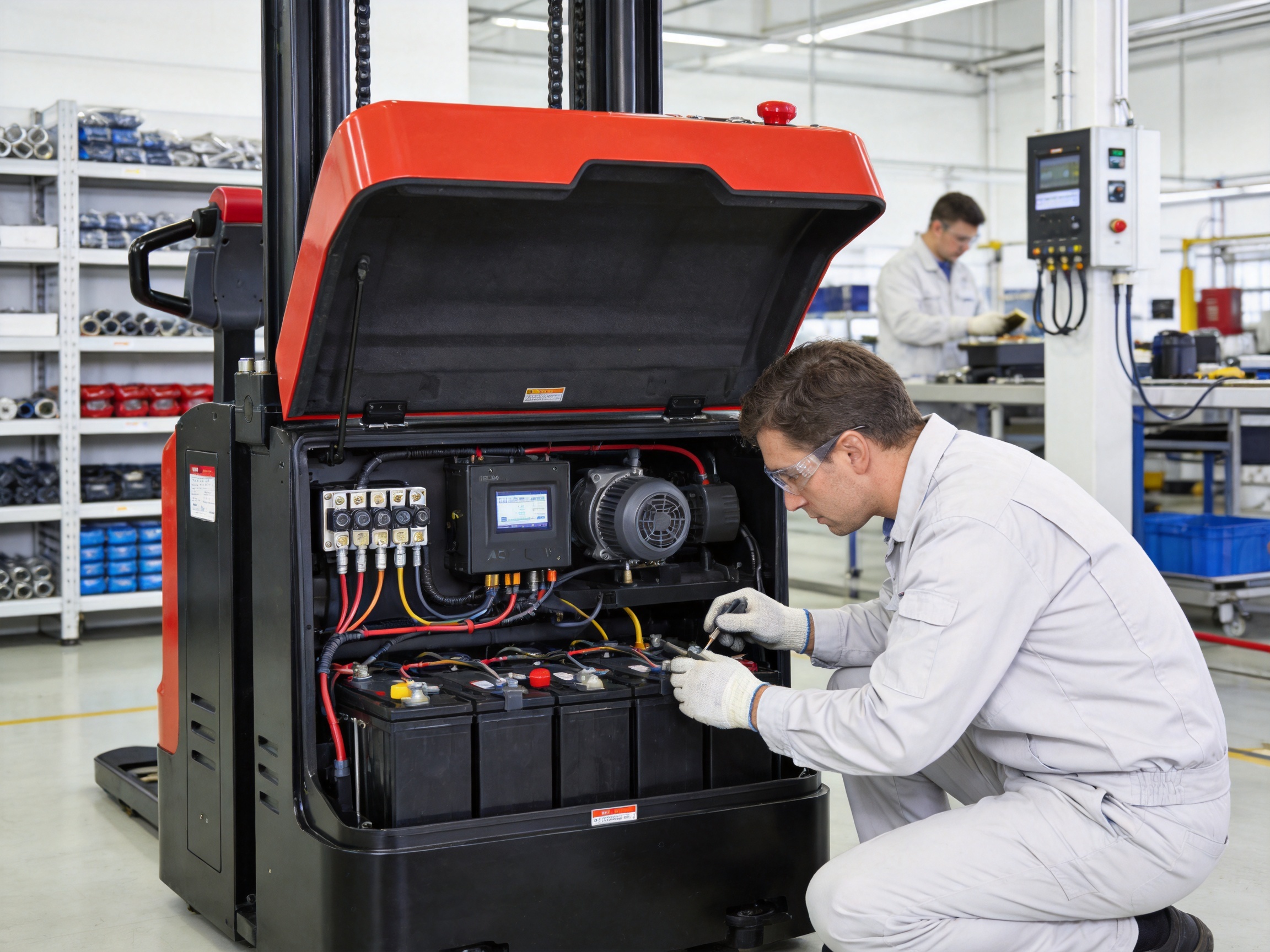
The AC motors are designed to be maintenance-free in normal operating conditions, reducing the routine attention required compared with some older motor designs. The vertical motor layout also allows technicians to inspect the motor and braking system directly. This arrangement can improve access when checking wear, connections, or brake performance.
The machine cover can be opened after removing only two bolts. This simple access arrangement helps technicians reach key components for inspection, adjustment, and replacement. Fewer disassembly steps can reduce service time and make preventive maintenance easier to schedule.
A built-in controller self-diagnosis system displays fault codes through a handheld unit. Diagnostic information can help service personnel identify the affected system more quickly instead of relying only on trial-and-error inspection. Faster fault identification can be particularly valuable for fleets operating multiple machines or facilities with limited maintenance staff.
The timer and battery indicator support daily fleet management. Operators can monitor working time and battery status, while supervisors can use this information to organize charging routines and maintenance intervals. Intelligent low-voltage automatic protection helps prevent operation under damaging battery conditions and may contribute to longer battery service life.
Daily Checks
Inspect forks, wheels, controls, emergency switches, warning functions, visible hydraulic components, and battery condition before operation.
Routine Service
Review fasteners, mast movement, hydraulic performance, steering response, braking, wiring protection, and connector condition according to the service schedule.
Diagnostic Support
Use controller fault codes and operating records to support faster troubleshooting and more accurate maintenance decisions.
Battery Care
Follow the battery manufacturer’s charging, storage, temperature, and inspection requirements to support safe and efficient energy use.
Advantages over Basic Warehouse Handling Equipment
Different warehouse machines serve different purposes. A manual pallet truck may be economical for occasional horizontal movement, while a larger counterbalanced forklift may be better for outdoor yards or very high-capacity operations. The ES20-WA occupies a useful position between these categories by combining substantial lifting capacity with a compact electric format.
| Comparison point |
Basic manual pallet truck |
Basic walkie stacker |
ES20-WA electric stacker |
| Load handling |
Primarily horizontal movement |
Stacking and short-distance travel |
2,000 kg stacking and transport capability |
| Operator effort |
High physical effort for heavy loads |
Lower effort through electric drive |
Electric travel, controlled lifting, and ergonomic operation |
| Control refinement |
Manual |
Varies by configuration |
AC drive and proportional hydraulic control |
| Safety support |
Limited machine-assisted protection |
Basic emergency functions may be available |
Emergency reverse, power cut, speed reduction, corner deceleration, and monitoring systems |
| Maintenance access |
Simple but limited in capability |
Depends on model construction |
Two-bolt cover access and controller self-diagnosis |
| Best application |
Occasional pallet movement |
Light to medium stacking work |
Frequent indoor pallet handling and warehouse replenishment |
Compared with a basic electric stacker, the ES20-WA offers a more complete package of safety, serviceability, and control functions. The benefit is not simply a higher specification list. It is the way these features support one another in daily work. A strong mast supports stable lifting, proportional hydraulics support precise placement, automatic speed management supports safer travel, and diagnostic systems support faster maintenance.
Compared with a larger forklift, the pedestrian stacker format can reduce equipment size, simplify indoor movement, and lower the space required for turning. It may also be a better fit for facilities where the majority of work involves pallet stacking and short-distance transport rather than outdoor loading, long-distance travel, or very high lifts.
Applications across Warehouse and Industrial Environments
The ES20-WA can be configured into workflows where pallets must be lifted, positioned, replenished, or transferred repeatedly. Its application suitability depends on load characteristics, mast height, aisle dimensions, floor quality, battery configuration, and local safety requirements. Typical applications include the following.
Distribution Centers
Move pallets between receiving, staging, storage, and dispatch areas while maintaining controlled travel in busy indoor zones.
Manufacturing Plants
Supply components to production lines, remove finished pallets, and support line-side replenishment without exhaust emissions inside the facility.
Retail Warehouses
Handle mixed inventory, replenish storage locations, and move packaged goods through back-of-house areas.
Packaging Operations
Transfer raw materials, cartons, finished products, and wrapped pallets between process stations and storage positions.
Cold-Chain Preparation
Support indoor pallet movement in temperature-controlled preparation zones, subject to battery and component specifications for the operating environment.
Third-Party Storage Facilities
Provide flexible handling for varied customer goods and changing warehouse layouts where maneuverability and service access are important.
Before selecting the machine, users should evaluate pallet dimensions, maximum load weight, load center, lifting height, aisle width, floor conditions, shift length, charging facilities, ambient temperature, and expected travel frequency. Correct application matching is essential for safety and long-term performance.
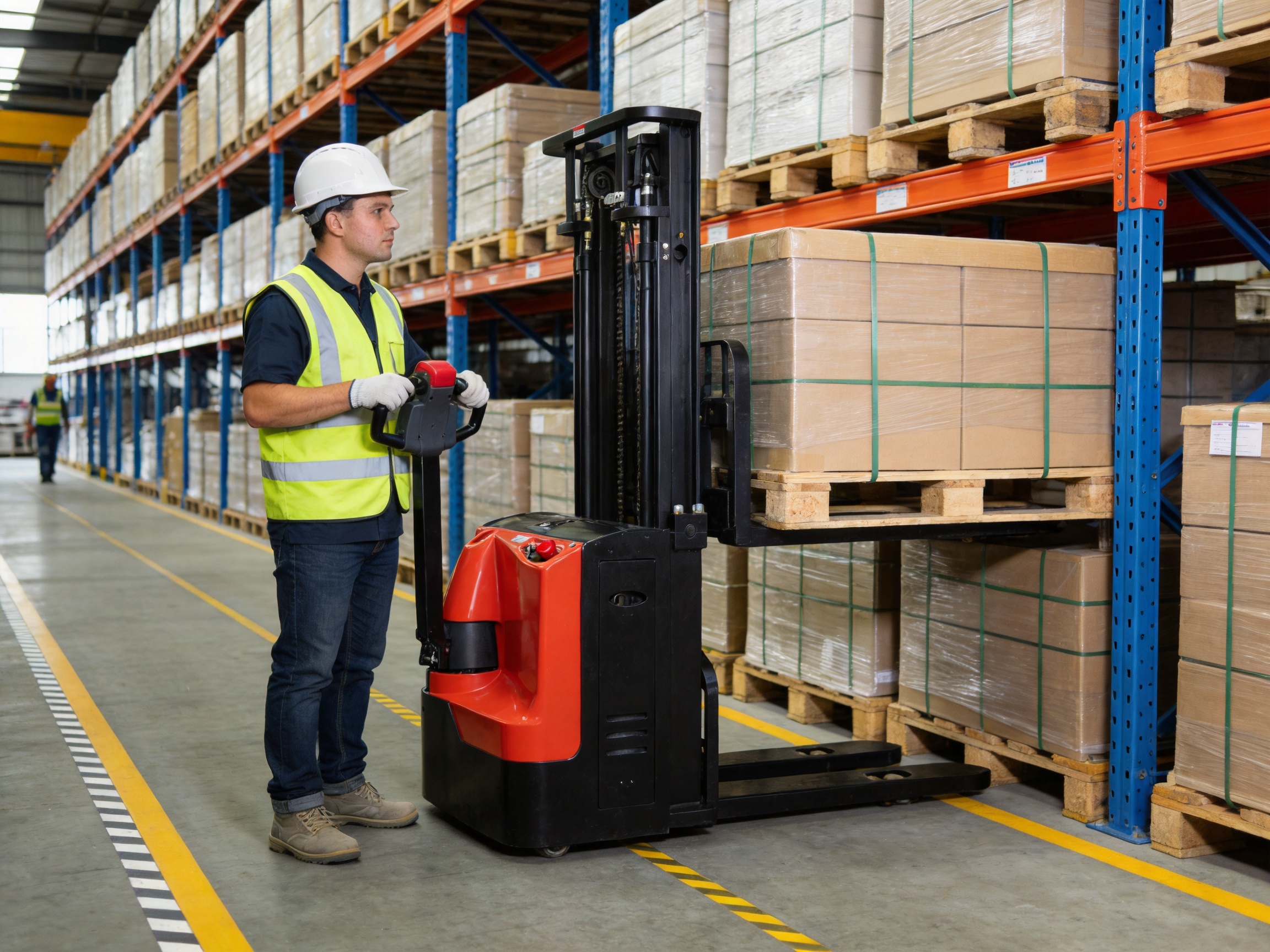
How the Electric Stacker Supports Total Operating Value
The purchase price is only one part of equipment value. A warehouse should also consider energy use, operator productivity, maintenance labor, spare parts, downtime, battery management, safety performance, and expected service life. The ES20-WA is designed to support value across these areas.
Energy and Charging Efficiency
Electric operation allows the machine to work without direct combustion emissions. Lithium-ion battery technology can support opportunity charging during suitable breaks, helping reduce the need for long battery replacement cycles in some operating patterns. The correct charging strategy depends on the battery specification, charger, shift schedule, and manufacturer instructions.
Reduced Downtime
High-quality connectors, protected wiring, tested hydraulic components, and maintenance-free AC motors are intended to reduce avoidable interruptions. No industrial machine is maintenance-free in the broadest sense, but thoughtful engineering can make service more predictable and help prevent minor issues from becoming major failures.
Labor Productivity
Precise travel and lifting controls can reduce unnecessary repositioning. Automatic corner deceleration and speed reduction at raised fork heights support more controlled movements, while the foldable platform gives operators flexibility between narrow-area work and longer travel routes.
Long-Term Equipment Planning
Businesses can use the stacker as part of a layered fleet strategy. Larger forklifts may be reserved for yard work and high-capacity tasks, while electric stackers handle indoor pallet positioning and replenishment. This can help assign the right machine to each task and avoid using oversized equipment for routine warehouse movement.
Operational Value Framework
Productivity
Responsive AC travel, efficient lifting, and compact maneuvering support steady task completion.
Safety
Multiple protective functions help manage emergency conditions, elevated-load travel, braking, and turning.
Serviceability
Accessible components and self-diagnostic capability help simplify inspection and troubleshooting.
Adaptability
Foldable platform operation allows the machine to work in both compact and longer-route indoor applications.
Reliable Supply and Technical Support
Equipment quality is supported by the strength of the organization behind the product. Shanghai HanDavos International Trading Co., Ltd. has more than 20 years of experience in the material-handling equipment industry. Its activities include new and used forklift sales, spare parts, attachments, exports, and forklift leasing services.
The company operates standardized warehouse facilities covering more than 20,000 square meters in Kunshan, China. Inventory support helps customers coordinate equipment, replacement components, and related products through one procurement channel. A broad product portfolio includes equipment associated with established manufacturers such as BYD, Toyota, HELI, HANGCHA, JAC, and LINDE.
For international customers, product selection is only the beginning of the purchasing process. Technical consultation, operating guidance, spare-parts support, maintenance recommendations, and after-sales communication can influence the success of an equipment project. The company’s service model is structured around these stages, helping users evaluate specifications before purchase and manage equipment after delivery.
Professional support is particularly valuable when a customer is introducing electric stackers into an existing fleet. The correct machine must be matched with the facility layout, pallet type, work cycle, charging plan, and operator training program. Technical discussions can help identify these requirements before the equipment is shipped.
Recommended Selection Checklist
Users evaluating a 2-ton electric stacker should collect accurate operating information before confirming a configuration. The following checklist can help organize the decision.
1Confirm the maximum pallet weight and the normal load center used in daily operation.
2Measure aisle width, turning space, rack clearance, door openings, and loading-area access.
3Determine the required lift height and verify that the selected mast configuration suits the rack system.
4Review floor flatness, joints, slopes, drainage areas, and surfaces that may affect polyurethane wheel performance.
5Estimate daily travel distance, lifting frequency, operating hours, and the number of shifts.
6Plan charging locations, electrical supply, battery access, and procedures for opportunity charging.
7Define operator training, pedestrian separation, traffic routes, speed controls, and inspection responsibilities.
8Ask about spare parts, diagnostic support, service intervals, delivery arrangements, and after-sales assistance.
Operating Practices for Best Results
Even a well-engineered electric stacker performs best when it is operated within its rated conditions. Operators should approach pallets squarely, insert the forks fully where appropriate, keep the load centered, and avoid exceeding the specified capacity or load center. Loads should be stable before travel, and the travel route should be free of people and obstructions.
When traveling with a raised load, operators should follow the equipment’s operating instructions and maintain a speed appropriate to the load, floor, visibility, and surrounding traffic. The automatic speed reduction function provides additional support but does not replace operator judgment. Loads should normally be carried at a safe travel height, and elevated loads should not be moved unnecessarily.
Daily inspections should include the forks, mast, chains or lifting components where applicable, hydraulic lines, wheels, steering, travel controls, brake function, emergency reverse, emergency power cut, warning indicators, and battery condition. Any unusual noise, leakage, vibration, delayed response, or fault code should be reported and investigated before continued use.
Warehouse managers should also establish clear pedestrian routes and equipment traffic rules. The stacker’s safety systems are valuable, but facility design, operator awareness, lighting, visibility, and load organization remain essential parts of a complete safety program.
Frequently Asked Questions
What is the rated capacity of the ES20-WA?
The rated load capacity is 2,000 kilograms at a stated load center distance of 600 millimeters. Actual safe capacity may vary according to lifting height, mast configuration, load dimensions, and operating conditions. Users should confirm the capacity chart for the selected configuration before handling loads.
Is this electric stacker intended for indoor use?
Yes. Its electric drive, polyurethane tyres, compact format, and low-noise hydraulic design make it well suited to indoor warehouses, manufacturing plants, distribution areas, and similar facilities. Use in special environments should be reviewed according to temperature, humidity, floor, and battery requirements.
What type of battery does the product use?
The product is described as a lithium-ion battery electric stacker. Battery capacity, voltage, charging equipment, and optional configurations should be confirmed for the specific order and operating schedule.
Can the machine operate in narrow spaces?
The compact structure, 1,589-millimeter turning radius, mechanical steering, and foldable platform support operation in restricted warehouse areas. A site assessment is still required to verify aisle clearance, pallet dimensions, turning space, and rack layout.
How does the machine protect against accidental rapid descent?
The hydraulic system uses an explosion-proof design intended to reduce the risk of rapid mast descent if a hydraulic pipe ruptures. This feature supports safety but does not eliminate the need for hydraulic inspection and correct operating procedures.
What braking system is used?
The service brake is electromagnetic. The machine also provides anti-slip braking performance intended to help prevent sliding during abnormal operation or suitable slope travel.
How does the stacker support operator safety while turning?
Automatic corner deceleration helps reduce speed during turns. Dual-monitoring electric steering supports control stability, while the emergency reverse function helps protect the operator if the machine moves too close to the handle area.
Is maintenance complicated?
The machine is designed to simplify maintenance. AC motors reduce routine motor servicing, the cover can be opened after removing two bolts, and the vertical motor layout provides direct access to the motor and brake system. A controller self-diagnosis system also provides fault codes for troubleshooting.
What should be checked before purchasing?
Customers should confirm load capacity, load center, lift height, aisle width, pallet dimensions, floor conditions, daily operating hours, charging arrangements, ambient conditions, and required after-sales support. These details help ensure that the selected configuration matches the application.
Can the product be included in a wider forklift fleet?
Yes. The electric stacker can complement counterbalanced forklifts, pallet trucks, reach equipment, and other warehouse machines. It is particularly useful for indoor pallet stacking, line-side replenishment, staging, and short-distance movement.
Conclusion: A Practical Platform for Modern Material Handling
The ES20-WA 2-ton lithium-ion electric stacker is designed for warehouses that need reliable lifting, compact maneuvering, controlled operation, and manageable maintenance. Its combination of AC drive technology, a high-strength C-type mast, tested hydraulic components, protected electrical connections, electromagnetic braking, polyurethane wheels, and lithium-ion battery capability gives it a balanced profile for indoor material handling.
Its advantages are reinforced by safety functions such as emergency reverse, emergency power cut, lift-height speed reduction, automatic corner deceleration, anti-slip braking, and dual steering monitoring. Operator comfort is addressed through an ergonomic handle, foldable shock-absorbing platform, proportional hydraulic control, and a compact structure suited to confined spaces.
From a manufacturing perspective, the product reflects the importance of structural accuracy, hydraulic testing, electrical protection, component accessibility, and complete-machine verification. These qualities help transform a specification sheet into equipment capable of supporting repetitive warehouse work. For businesses planning to improve pallet handling, reduce manual effort, or build a more efficient indoor fleet, the ES20-WA offers a strong foundation for dependable daily operation.
References
1. Product technical specification sheet for the ES20-WA electric stacker.
2. Product information and manufacturing notes supplied for the 2-ton lithium-ion battery electric stacker.
3. General industrial guidance on powered pedestrian trucks, warehouse traffic management, and operator training.
4. General battery manufacturer recommendations for lithium-ion charging, inspection, storage, and low-voltage protection.
5. General engineering principles for hydraulic lifting systems, electromagnetic braking, mast structures, and warehouse equipment maintenance.



 English
 中文简体
 русский
 Español
 عربى