How to Select a Heavy-Duty Forklift Battery Charger for Efficient Warehouse Operations
2026-09-10
Content
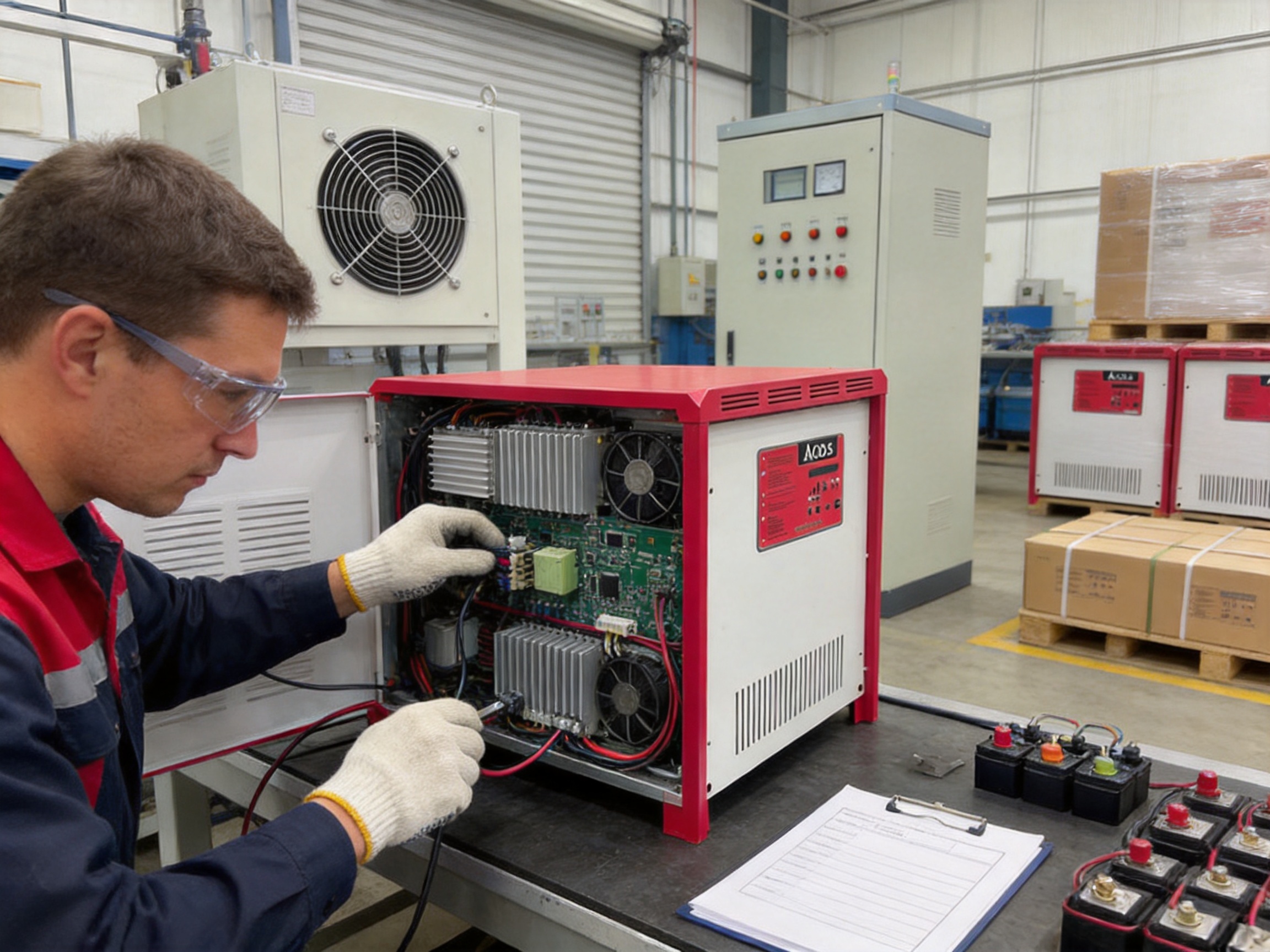
Forklift charging equipment is a critical part of every electric material-handling operation. A charger does more than transfer electrical energy into a battery. It influences charging time, battery service life, energy consumption, operator safety, equipment availability, and the overall reliability of warehouse processes. When the charger is incorrectly matched to the battery, even a high-quality forklift may experience reduced operating hours, premature battery wear, unstable performance, or unnecessary downtime.
The LED Indicator Light Forklift Battery Charger is designed to provide a dependable charging solution for electric forklifts, warehouse trucks, and other industrial vehicles. It supports selected lead-acid and lithium battery applications, uses intelligent charging control, and offers multiple protection functions for demanding working environments. Available in 48-volt, 72-volt, and 80-volt configurations with a broad range of output currents, the series can be matched to different battery capacities and operating schedules.
This article explains how the charger works, which technical factors should be reviewed before purchase, and why its control system, thermal design, safety architecture, manufacturing workflow, and service support can provide practical advantages over basic or poorly matched alternatives.
Wide Voltage Coverage
Configurations cover 48V, 72V, and 80V battery systems, supporting different forklift sizes and duty requirements.
Intelligent Charging
Automatic battery-status recognition helps manage charging stages and supports automatic stopping after charging is complete.
Industrial Protection
Protection against over-voltage, over-current, overheating, short circuits, reverse connection, and leakage improves charging safety.
Operational Visibility
LED and LCD indicators provide useful information about operating status and charging progress.
Understanding the Role of a Forklift Charger
Electric forklifts are often used in cycles. A truck may move pallets during one shift, return to a charging area during a scheduled break, and then resume work later in the day. In multi-shift warehouses, several trucks may need charging at the same time. Under these conditions, the charger becomes part of the production system rather than an accessory used occasionally.
A suitable charger must deliver the correct voltage and current while responding to the actual condition of the battery. It should manage the early charging stage efficiently, regulate the current as the battery approaches full capacity, and avoid excessive charging after the battery has reached its intended state. It should also remain stable when the surrounding environment contains dust, vibration, temperature changes, or electrical interference.
Basic chargers may operate with a fixed charging pattern. This can be acceptable for limited applications, but it may not be suitable for a mixed fleet or for facilities that use different battery capacities. A fixed-output design can produce slow charging when the current is too low, excessive stress when the current is too high, or inefficient energy use when charging is not adjusted to battery status.
The LED Indicator Light Forklift Battery Charger addresses these challenges through intelligent control, selectable configurations, and a range of output-current options. This makes it possible to choose a charger that better fits the battery voltage, cell count, capacity, and operating schedule of a particular forklift.
Fleet availability depends on more than the number of forklifts owned by a warehouse. It also depends on how quickly and safely each vehicle can be returned to service. A charger with a suitable current rating can reduce unnecessary waiting time between shifts. Automatic charging control can lower the risk of charging errors. Clear status indicators can help operators recognize whether charging has started, paused, completed, or encountered a fault.
These features are especially valuable in distribution centers, manufacturing plants, cold-chain facilities, logistics hubs, and storage buildings where forklift usage is continuous. When a truck is unavailable, another vehicle may need to be assigned, which can affect labor planning and material flow. A stable charging system helps reduce this operational uncertainty.
It is important to note that charging performance is determined by the complete system. Battery chemistry, battery capacity, ambient temperature, cable length, connector type, ventilation, and charger settings all influence the result. For this reason, the charger should be selected according to verified battery data rather than by output current alone.
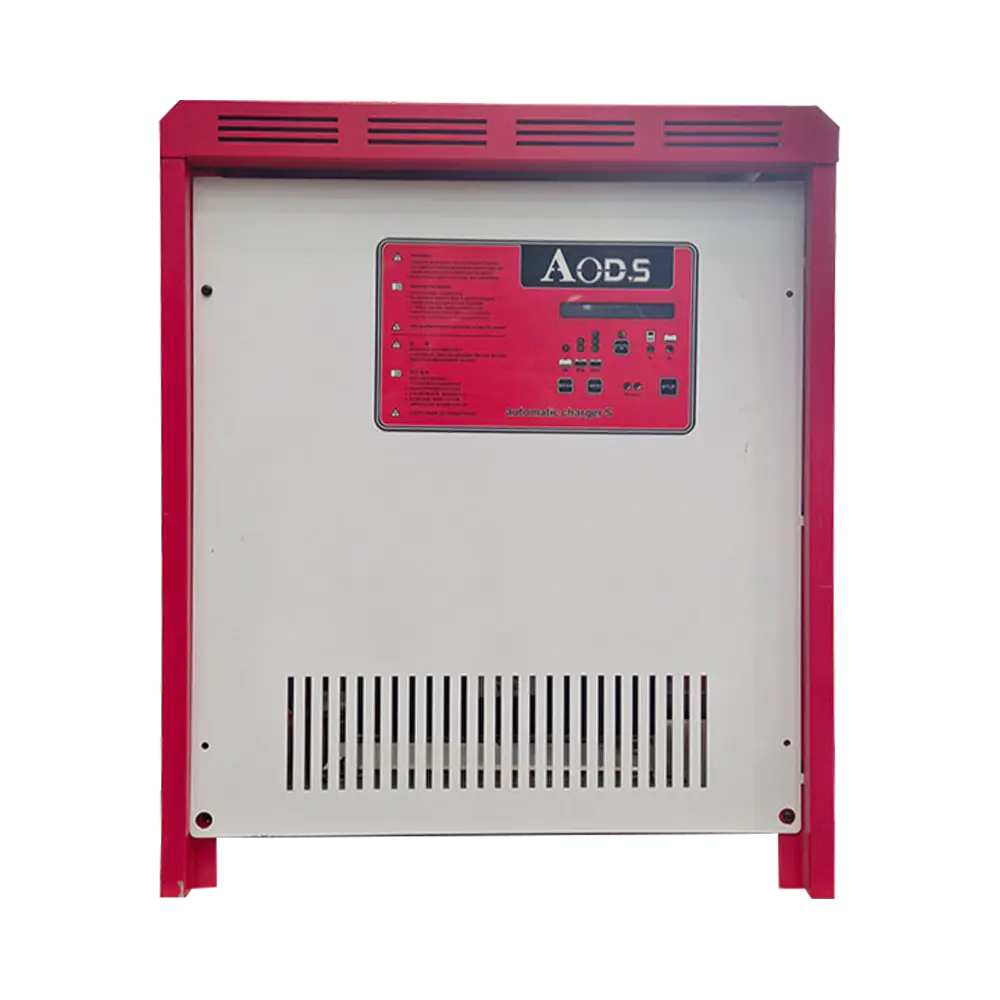
LED Indicator Light Forklift Battery Charger
Product Architecture and Main Advantages
The charger series combines power conversion, intelligent control, status display, cooling, and electrical protection in one industrial housing. Its design focuses on practical use: simple connection, visible operating information, automatic charging management, and reduced maintenance requirements.
The available models are designed around common industrial battery voltages of 48V, 72V, and 80V. The corresponding configurations use 24, 36, and 40 battery cells respectively. Output current options extend from 30A to 150A, depending on the voltage platform and model selection.
This range allows the same product family to serve compact electric forklifts, larger warehouse trucks, and higher-capacity industrial vehicles. Instead of relying on one oversized charger for every application, a fleet manager can select a model that aligns more closely with the battery specification and required charging period.
The product information identifies support for lead-acid and lithium battery applications. However, the correct charging profile must always be confirmed before installation. Different battery chemistries can require different voltage limits, control logic, communication functions, and safety procedures. A professional selection process should verify the battery manufacturer’s requirements and the charger’s configured parameters.
The control system is designed to identify battery status and manage the charging sequence in stages. During the initial stage, the charger can provide controlled current to restore a significant portion of the battery’s energy. As the battery voltage rises and the charging process approaches completion, the control system can adjust the charging behavior to reduce the risk of overcharging.
Automatic stopping after the charging cycle is complete is an important advantage in busy workplaces. Operators do not need to remain beside the charger to disconnect it at a precise moment. This reduces the chance of prolonged charging caused by schedule changes, shift handovers, or simple human oversight.
Intelligent control also provides a more consistent charging process than manual switching between charging stages. Consistency is valuable for fleets because each battery can be treated according to the charger’s programmed operating logic rather than depending entirely on individual operator judgment.
Clear status information helps simplify daily operation. LED indicators can show whether the charger is powered, charging, complete, or reporting a fault. The product description also identifies an LCD display that indicates operating status and charging progress. This combination gives operators a quick visual reference without requiring specialized diagnostic equipment for routine checks.
In a warehouse environment, visibility matters because chargers may be installed in dedicated charging rooms, maintenance areas, or production zones. A clear display can help staff confirm that a charging cycle has begun and identify abnormal conditions sooner. It can also support maintenance personnel when they are checking whether a problem originates from the battery, the connection, or the charger itself.
Industrial charging equipment must be designed for unexpected operating conditions. The charger includes protection functions for over-voltage, over-current, over-temperature, short circuit, reverse connection, and leakage. These functions work together to reduce the consequences of common charging errors and electrical abnormalities.
Reverse-connection protection is particularly useful because battery connectors may be connected incorrectly during maintenance or after a battery replacement. Over-current and short-circuit protection help limit the impact of a damaged cable, connector problem, or abnormal load. Over-temperature protection can respond when internal heat rises beyond a safe operating range. Leakage protection adds another layer of protection for people and equipment.
Protection functions are not a substitute for correct installation. The charging area should still have suitable ventilation, appropriate electrical supply, proper grounding, correctly rated cables, and safe operating procedures. Nevertheless, integrated protection can provide a valuable additional barrier against equipment damage and unsafe conditions.
Power conversion creates heat, especially when a charger operates at high output current for extended periods. If heat accumulates inside the housing, electronic components may experience increased stress, reduced efficiency, or shortened service life. The charger uses an optimized heat-dissipation structure and fan cooling to move heat away from key components.
Thermal management is important for facilities that operate multiple shifts or require repeated charging cycles throughout the day. A charger that can maintain stable internal temperatures is more suitable for continuous industrial use than a unit designed only for occasional charging.
Ventilation openings and fan systems should be kept clear. Dust buildup can reduce airflow, while a blocked installation space can cause heat to remain around the charger. Routine inspection of the housing, fan, cable connections, and ventilation area is recommended even when the charger is described as low-maintenance.
The charger uses a robust housing intended to protect internal electronic components during daily operation. High-quality electronic components, stable circuit design, and anti-interference capability help support consistent performance in environments where other electrical equipment may be operating nearby.
Selected configurations may also be available with waterproof and dustproof protection. The exact protection level should be confirmed for each order because environmental ratings can vary by configuration. When a charger is installed outdoors or in a harsh industrial location, the enclosure rating, mounting position, drainage, cable entry, and maintenance access should all be evaluated together.
Practical Advantages Compared with Basic Fixed-Pattern Chargers
Battery matching
One or a few fixed configurations
48V, 72V, and 80V platforms with multiple current options
Charging control
May rely on a fixed charging routine
Intelligent status recognition and multi-stage management
Safety response
Protection may be limited
Integrated electrical, thermal, connection, and leakage protections
Operator feedback
Limited or unclear indication
LED and LCD information for operating status and charging progress
Long-duration use
Cooling may be less suitable for demanding duty
Fan cooling and optimized heat-dissipation structure
Technical Selection Guide
Model selection should begin with the battery label, technical manual, or information supplied by the battery manufacturer. The charger output voltage must match the nominal battery voltage. The number of cells should also correspond to the battery system. A 48V charger, for example, is designed for a different system from a 72V or 80V charger and should not be substituted without technical confirmation.
The available 48V models correspond to 24 cells, while 72V models correspond to 36 cells and 80V models correspond to 40 cells. These values help identify the correct electrical platform. A mismatch can prevent charging, create fault conditions, or damage the battery and charger.
Nominal voltage is only one part of the selection process. The full charging voltage, battery chemistry, battery capacity, and charging profile must also be checked. For lithium batteries, the battery management system and communication requirements may be important. For lead-acid batteries, ventilation and charging-area procedures may require additional attention because charging can produce gas.
Output current influences charging speed. A higher-current charger can reduce the time required to replenish a suitable battery, but higher current is not automatically better. The battery must be rated for the selected charging current, and the electrical supply must be capable of supporting the charger’s input requirements.
A useful general principle is to select a current that fits the battery capacity and the available charging window. If a forklift is used for one shift and charged overnight, a lower or moderate current may be sufficient. If the same truck operates through several shifts and has only a short opportunity to charge, a higher-current model may be appropriate, provided that the battery manufacturer permits it.
The listed models use a 380V input specification and have different input-current and input-power requirements. As output current increases, the charger’s input demand also increases. Before installation, the facility should confirm that the distribution board, protective devices, cables, isolators, and connectors are rated for the selected model.
Electrical installation should be completed by qualified personnel. The charger should be connected according to local electrical regulations and the manufacturer’s installation instructions. If multiple chargers are installed in one room, the combined load should be calculated rather than checking each charger in isolation.
| Voltage platform | Battery cells | Available output-current examples | Typical selection focus |
| 48V | 24 cells | 40A to 150A | Electric forklifts and warehouse trucks with 48V battery systems |
| 72V | 36 cells | 30A to 150A | Higher-capacity industrial vehicles and demanding operating cycles |
| 80V | 40 cells | 30A to 150A | Heavy-duty electric trucks and high-energy warehouse applications |
| Input supply | Applicable models | 380V listed input | Confirm site power capacity and installation requirements |
The following table presents selected configurations from the product range. It is intended to help users compare voltage, current, and power relationships. The final model should be confirmed against the battery specification and site conditions.
| Product model | Input current | Battery voltage | Output current | Input power |
| AODS-S/E-D-48V/40A | 4.6A | 48V | 40A | 3kW |
| AODS-S/E-D-48V/80A | 9.1A | 48V | 80A | 6kW |
| AODS-S/E-D-48V/150A | 17.1A | 48V | 150A | 11.3kW |
| AODS-S/E-D-72V/50A | 8.5A | 72V | 50A | 5.6kW |
| AODS-S/E-D-72V/100A | 17.1A | 72V | 100A | 11.3kW |
| AODS-S/E-D-80V/50A | 9.5A | 80V | 50A | 6.3kW |
| AODS-S/E-D-80V/100A | 19A | 80V | 100A | 12.5kW |
| AODS-S/E-D-80V/150A | 28.5A | 80V | 150A | 18.8kW |
Manufacturing and Quality Approach
Industrial charger quality depends on the complete manufacturing and supply process. The finished housing may appear simple from the outside, but the product must coordinate power electronics, control logic, thermal management, display functions, protection circuits, wiring, connectors, and mechanical structure. Each part of the process affects safety and service life.
A dependable production process begins with application analysis. The required battery voltage, output current, input supply, duty cycle, environmental conditions, and user interface should be reviewed before the configuration is finalized. This application-led approach reduces the risk of supplying a technically unsuitable charger simply because its output rating appears similar.
For forklift applications, engineering review should include the charging schedule, battery chemistry, forklift operating pattern, installation location, ambient temperature, ventilation, cable route, connector arrangement, and protection requirements. This information helps determine whether a standard configuration is suitable or whether additional options should be considered.
Power electronics are exposed to electrical load and thermal stress during operation. Component selection therefore needs to consider voltage tolerance, current capacity, switching performance, temperature range, and expected operating hours. High-quality components can contribute to stable output and reduce the chance of premature failure when the charger is used regularly.
Control components are equally important. The charger must measure electrical conditions accurately enough to manage charging stages and respond to abnormal conditions. A stable control board helps coordinate automatic identification, current regulation, protection functions, display information, and charging completion.
Assembly quality affects both electrical performance and maintenance safety. Internal wiring should be routed securely, terminals should be properly tightened, and high-current connections should be protected against vibration and heat. Clear internal organization also supports future inspection and service work.
A structured assembly process may include component preparation, mechanical installation, power-module fitting, control-board installation, cable routing, connector installation, grounding connection, housing closure, and final inspection. Each step should follow documented work instructions so that the product remains consistent across different production batches.
Thermal performance should be evaluated under representative load conditions. Tests may focus on the behavior of the power module, heat sink, fan, air path, housing, and temperature protection circuit. The objective is to confirm that heat is removed effectively and that the charger can maintain stable operation during extended charging.
Fan cooling is useful only when airflow is properly managed. For this reason, the position of the fan, ventilation openings, internal barriers, and heat-producing components should be considered as a complete system. A strong thermal design can help protect electronic components and maintain charging efficiency.
Final testing should verify the functions that matter to the user. These may include input response, output voltage, output current, charging-stage transition, automatic stopping, display operation, alarm behavior, protection functions, cooling response, and insulation or leakage performance as applicable.
Testing should also consider different output configurations. A 48V/40A charger and an 80V/150A charger do not experience the same electrical and thermal conditions. Model-specific test parameters help confirm that each configuration performs according to its intended design.
Chargers may travel long distances before installation. Packaging should protect the housing, display, connectors, fan, and cable assemblies from impact, moisture, and movement during transport. Product identification should remain visible so that the receiving team can match the shipment to the purchase order and technical specification.
A well-organized delivery process can include model verification, quantity checking, accessory confirmation, document preparation, packaging inspection, and shipment tracking. These steps reduce the possibility of receiving the wrong voltage configuration or an incomplete installation package.
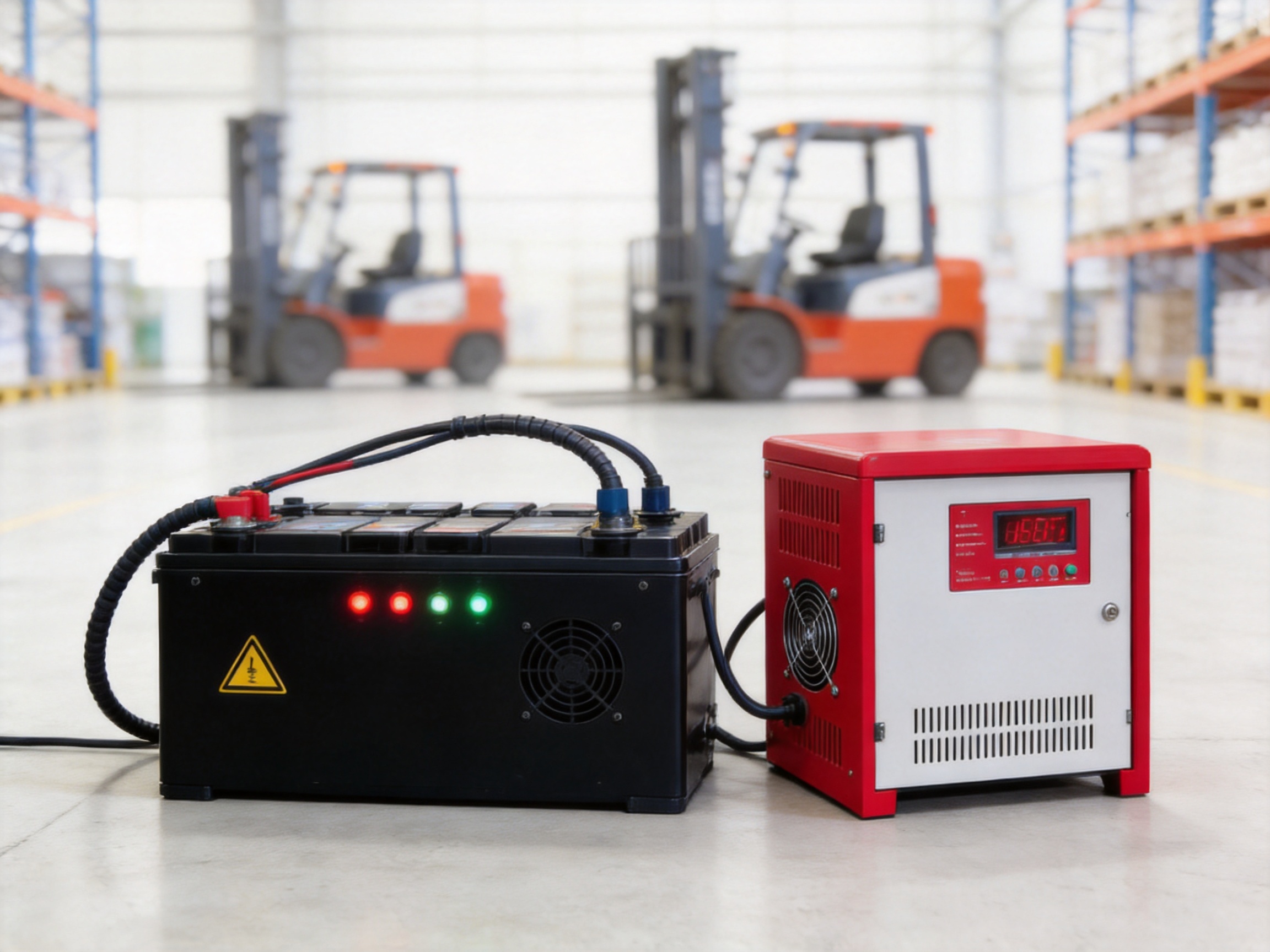
Efficiency, Energy Use, and Operating Cost
Energy cost is an important part of forklift fleet management. The electricity consumed during charging includes the energy stored in the battery and the conversion losses produced by the charger. A charger with high conversion efficiency reduces unnecessary loss, which can contribute to lower operating expenditure over time.
Efficiency also affects heat generation. When less energy is lost as heat, the cooling system has less thermal load to manage. This can support more stable operation and reduce stress on components. The actual efficiency achieved in the field depends on load level, battery condition, input quality, ambient temperature, and charging profile, so users should evaluate performance under their own operating conditions.
A basic charging-time estimate can be made by dividing battery capacity in ampere-hours by charger output current. In practice, the result is affected by charging efficiency, the battery’s initial state of charge, the final charging stage, temperature, and the control system. The final stage may take additional time because the charger reduces or adjusts current as the battery approaches full charge.
For example, a battery with a nominal capacity of 600Ah connected to a 100A charger will not necessarily reach a complete charge in exactly six hours. The calculation provides a starting estimate, while the actual cycle depends on the battery and charging strategy. Operators should use the battery manufacturer’s guidance when planning shift schedules.
Charging equipment can influence downtime in several ways. The correct output current can support an appropriate charging window. Automatic stopping can prevent unnecessary idle operation. Status displays can help operators identify a completed cycle or a fault condition. Protection functions can reduce damage caused by common electrical errors.
These benefits do not eliminate the need for battery maintenance. Battery terminals, connectors, cables, ventilation, and battery condition should still be inspected. However, a charger that manages the process consistently can make routine operation more predictable.
Key Areas Influenced by Charger Selection
Charging consistency
High importance
Protection coverage
High importance
Thermal stability
High importance
Operator visibility
Important
Installation flexibility
Important
The chart illustrates selection priorities rather than laboratory test results. Actual performance depends on the chosen model, battery, installation, and operating conditions.
Installation and Maintenance Guidance
The charger should be installed in a location that allows air circulation, safe access, and convenient cable management. The surrounding area should be free from materials that could block ventilation or create a fire risk. If lead-acid batteries are used, the charging room should follow the applicable ventilation and workplace safety requirements.
The installation surface should be stable and capable of supporting the charger. The unit should be protected from direct water exposure unless the selected configuration has been verified for the required environmental conditions. Outdoor installation should include appropriate shelter, drainage, and protection from excessive sunlight or standing water.
Electrical connection should be completed by qualified technicians. The supply voltage, phase arrangement, protective device, cable size, grounding, and isolation method must be checked before energizing the charger. The battery connector should be compatible with the forklift battery, correctly polarized, and rated for the selected output current.
Before the first charging cycle, the technician should confirm that the battery voltage and cell count match the charger. The display and indicators should be checked during startup. Any unusual sound, smell, heat, display behavior, or repeated fault should be investigated before normal use begins.
Routine inspection can include checking the power cable, output cable, plug, connector, housing, cooling fan, ventilation openings, display, and indicator lights. Dust should be removed using a method suitable for electronic equipment. Loose connectors, damaged insulation, or abnormal heating should be addressed promptly.
A maintenance record can help identify recurring issues. Useful information may include the date of inspection, charger model, battery used, fault code, operating hours, observed temperature, and corrective action. This information supports preventive maintenance and helps distinguish charger issues from battery problems.
If the charger does not start, the operator should check the input supply, isolator, connector, battery voltage, and visible fault indication. If charging starts but stops unexpectedly, possible causes may include over-temperature, abnormal battery condition, loose connection, incorrect configuration, or a protection response.
If charging appears unusually slow, the battery may be deeply discharged, aging, cold, damaged, or incorrectly matched to the charger. Cable resistance and connector condition should also be reviewed. Replacing the charger without checking the complete charging system may not solve the underlying problem.
Repeated protection events should never be bypassed. They indicate that the charger has detected a condition requiring investigation. Qualified service personnel should review the fault and confirm that the equipment is safe before returning it to operation.
Application Examples
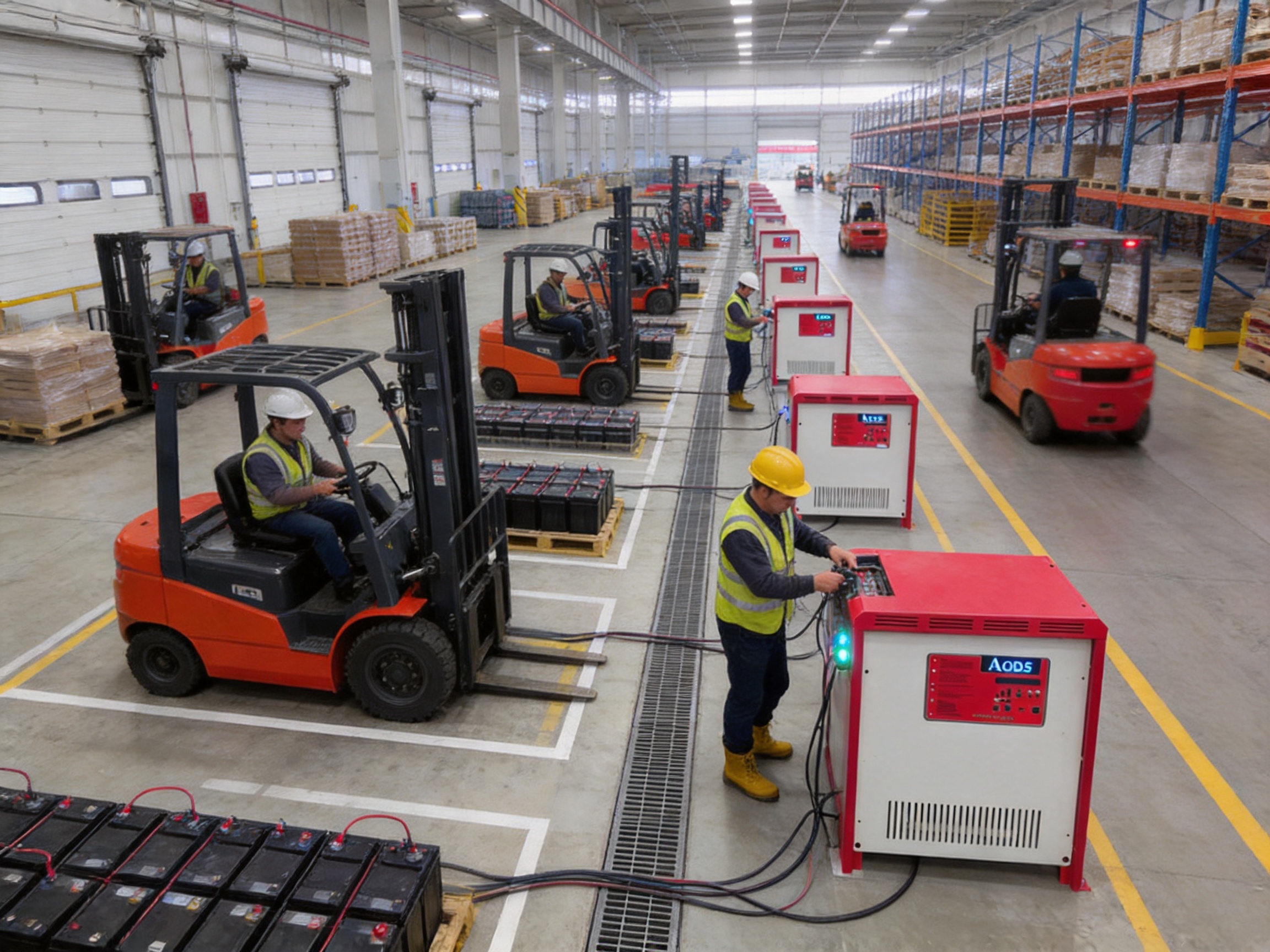
Distribution centers often operate large numbers of electric forklifts and pallet-handling vehicles. Charging schedules may be organized around shift changes, loading peaks, and overnight periods. A selection of 48V, 72V, and 80V models allows the charging area to support different vehicle classes without using the same charger for every application.
Clear LED and LCD information can help supervisors understand whether equipment is ready for service. Intelligent charging and automatic stopping can reduce the number of manual actions required during shift transitions.
Manufacturing plants may use forklifts to move raw materials, work-in-process goods, finished products, and packaging. Vehicle availability can affect the flow of production, especially when materials must be delivered to specific workstations at scheduled times.
In this setting, charger durability, thermal management, and protection coverage are important. The charger may operate in an environment with dust, vibration, electrical equipment, and repeated daily charging. A robust configuration and suitable installation plan can support more dependable material movement.
Cold storage environments can present additional challenges for batteries and electronic equipment. Low temperatures may affect battery performance and charging behavior. The charger should be installed according to its specified operating range, and the battery manufacturer’s guidance should be followed.
Where temperature changes may produce condensation, the charging area should be planned to protect electrical equipment. Waterproof or dustproof options may be considered when the environment requires them, subject to confirmation of the actual protection grade.
Rental fleets and mixed fleets may include forklifts with different voltage platforms or battery capacities. A structured charger selection process helps ensure that each unit is assigned to a compatible charging configuration. Clear model labeling is especially important when multiple chargers are installed in the same area.
Fleet operators can improve control by recording each charger’s model, voltage, output current, assigned battery type, connector, installation location, and inspection date. This simple information system can reduce connection errors and support faster troubleshooting.
Service and Supply Strengths
Industrial equipment purchasing often involves more than selecting a model from a table. Customers may need help comparing voltage platforms, calculating input power, checking compatibility, arranging connectors, planning installation, and organizing spare parts. A supplier with experience in forklifts and material-handling equipment can provide more useful support because the charger is considered within the wider fleet environment.
Shanghai HanDavos International Trading Co., Ltd. operates in the material-handling equipment sector and provides new and used forklift products, spare parts, attachments, exports, leasing services, technical consultation, operation guidance, maintenance coordination, and after-sales support. Its connection with forklift equipment gives customers a broader procurement channel when they need charging equipment together with vehicles or related components.
The company operates standardized warehouse facilities in Kunshan, Jiangsu, with inventory resources intended to support product preparation and delivery. This can be useful for customers seeking coordinated supply rather than purchasing a charger from an unrelated electrical-equipment source without forklift application knowledge.
Product matching should consider the customer’s actual forklift fleet. A professional inquiry may include the forklift model, battery voltage, battery capacity, battery chemistry, charger location, input power, connector type, daily operating hours, and desired charging window. With this information, the supplier can help narrow the available configurations and identify information that still needs confirmation.
This approach is more reliable than recommending the highest-current model by default. Oversizing can increase installation cost and power demand, while undersizing can extend charging time beyond the operational schedule. Matching the charger to the application provides a more balanced result.
International customers may require different documentation, packaging arrangements, electrical specifications, labeling, and delivery coordination. Product model, voltage, input requirement, output current, connector, protection option, and destination conditions should be confirmed before shipment.
Clear technical communication is particularly important when the customer’s local electrical system differs from the listed input specification. The buyer should confirm compatibility with local regulations and arrange installation by qualified personnel. A well-prepared order reduces delays at customs, installation, and commissioning stages.
Because the company’s product portfolio includes forklifts, parts, attachments, and related services, customers may be able to coordinate several procurement requirements through one channel. This can simplify fleet expansion, replacement planning, maintenance preparation, and equipment matching.
A charger should not be treated as an isolated item. Its performance affects the battery, the forklift, the charging area, and the work schedule. A supplier that understands these connections can help customers make decisions based on total operating needs rather than a single specification.
Frequently Asked Questions
The listed configurations include 48V, 72V, and 80V battery systems. The corresponding cell counts are 24, 36, and 40 cells. The selected voltage must match the forklift battery specification exactly.
Depending on the voltage platform, output-current options range from 30A to 150A. The correct current depends on battery capacity, chemistry, charging time, and the battery manufacturer’s permitted charging rate.
The product information identifies compatibility with lead-acid and lithium batteries of various forklifts. The exact charging profile and configuration should be confirmed for the specific battery. Lithium batteries may require communication with a battery management system, while lead-acid batteries may require different charging and ventilation procedures.
The intelligent control system is designed to manage charging stages and stop automatically when the charging cycle is complete. Operators should still check the display and indicators and follow the recommended operating procedure.
The listed protection functions include over-voltage, over-current, over-temperature, short circuit, reverse connection, and anti-leakage protection. These functions improve safety but do not replace correct installation, grounding, ventilation, and routine inspection.
The LED and LCD displays indicate operating status and charging progress. Depending on the configuration, they may also help identify a fault or protection response. The operating manual supplied with the selected model should be used for detailed indicator meanings.
The charger is designed for stable industrial operation and includes a heat-dissipation structure and fan cooling system to reduce heat accumulation. Continuous operation still depends on correct model selection, installation, ventilation, ambient temperature, and maintenance.
Selected configurations may be available with waterproof and dustproof protection. The required protection grade must be confirmed before outdoor installation. The charger should also be protected from standing water, direct exposure beyond its rated conditions, and blocked ventilation.
Start with the battery capacity and the available charging window. A higher output current may shorten charging time, but only when the battery, cables, connectors, and electrical supply are rated for it. The battery manufacturer’s charging recommendation should take priority.
Useful information includes the forklift type, battery voltage, battery capacity, battery chemistry, required output current, input voltage, connector type, charging environment, quantity, destination, and preferred delivery schedule. Photos of the battery label and existing connector can also help with technical confirmation.
Keep ventilation openings clear, inspect cables and connectors, prevent dust buildup, avoid water exposure, and record unusual sounds, heat, or display messages. Maintenance should be performed by qualified personnel, and protection functions should never be bypassed.
Recommended Purchasing Checklist
Battery Information
Confirm nominal voltage, cell count, capacity, chemistry, manufacturer, permitted charging current, and charging profile.
Electrical Information
Confirm input voltage, phase arrangement, input current, input power, grounding, protective devices, and cable requirements.
Mechanical Information
Confirm charger dimensions, installation position, ventilation space, connector type, cable length, and mounting requirements.
Operating Information
Confirm daily operating hours, charging window, number of shifts, ambient conditions, indoor or outdoor use, and required protection level.
Purchasers should also request the product manual, wiring information, charging instructions, model identification, and any available inspection or test documentation. If several chargers are being ordered, each unit should be identified by voltage and current so that installation teams can assign them correctly.
For a mixed fleet, it is useful to create a charging map that connects each forklift to its approved charger. This can reduce the risk of using an incorrect voltage configuration and make it easier for operators to locate an available charger.
Conclusion
The LED Indicator Light Forklift Battery Charger is designed for facilities that require stable, visible, and well-protected charging for electric material-handling equipment. Its 48V, 72V, and 80V platforms cover a range of forklift applications, while multiple output-current options help users match charging performance to battery capacity and operating schedules.
Its main advantages include intelligent multi-stage charging, automatic stopping, high conversion efficiency, LED and LCD status information, broad electrical protection, fan-assisted cooling, durable construction, and optional environmental protection. These characteristics provide practical benefits over basic fixed-pattern chargers that may offer limited matching flexibility, less information, or fewer protection functions.
Product performance also depends on the quality of the engineering, assembly, testing, packaging, and technical support behind the equipment. A structured manufacturing and supply process helps ensure that the selected charger is prepared for its intended voltage, current, thermal load, and operating environment. Application-based product matching is therefore essential.
Before ordering, users should verify the battery specification, input supply, output current, connector, charging schedule, installation location, and environmental requirements. When these factors are reviewed carefully, the charger can become a dependable part of the fleet’s energy-management system and help support safer, more efficient warehouse operations.
References
1. Product technical information for the LED Indicator Light Forklift Battery Charger, including model configurations, input specifications, output ratings, and protection functions.
2. General industrial guidance on traction-battery charging, battery matching, charging-area ventilation, and electrical safety practices.
3. General principles of power-electronic thermal management, cooling-system design, and industrial charger reliability.
4. Manufacturer guidance for lead-acid and lithium battery charging profiles used in electric forklifts and warehouse vehicles.
5. Internal product-selection and material-handling application guidance for forklift fleets, warehouse operations, and industrial charging installations.
Recommended Products
Recommended NEWS



 English
 中文简体
 русский
 Español
 عربى