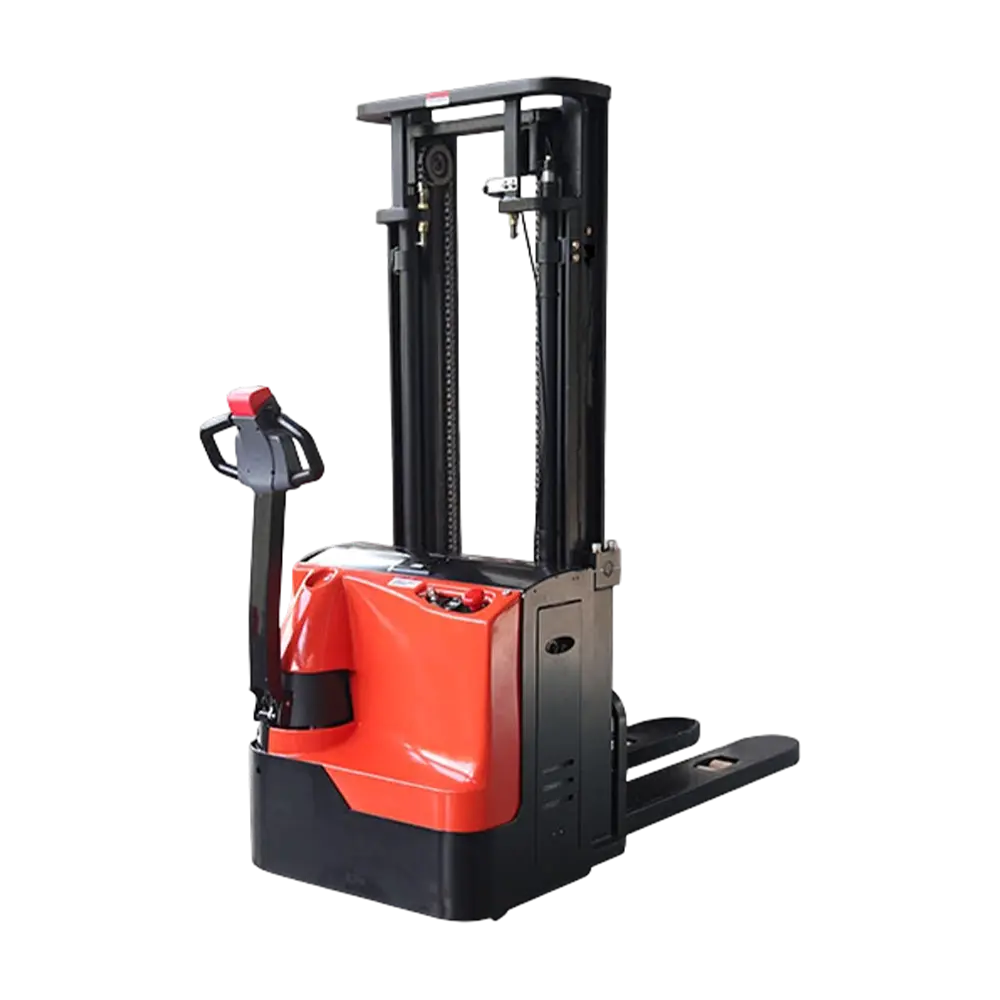
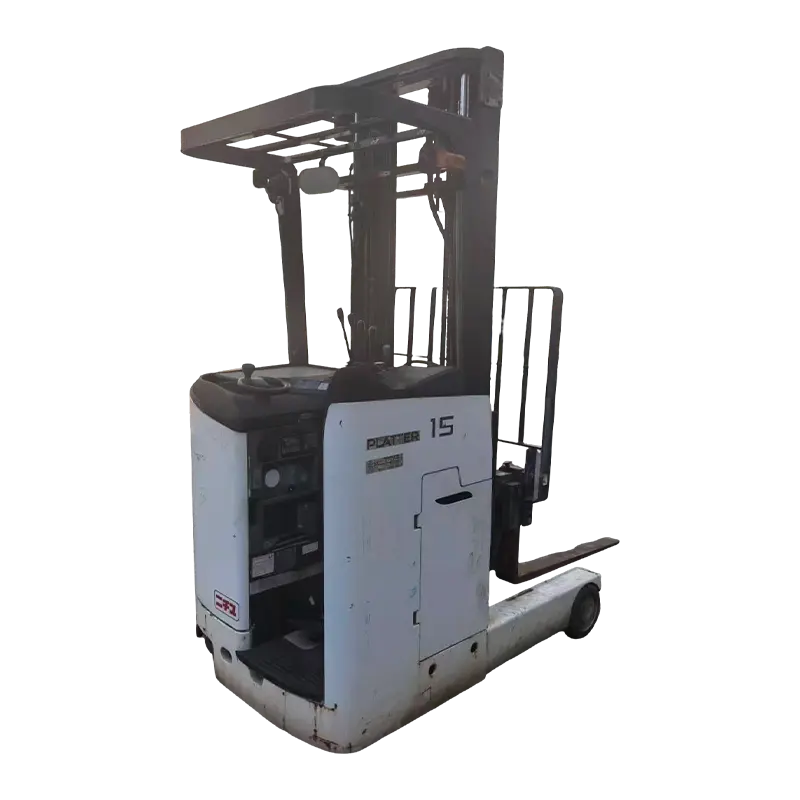
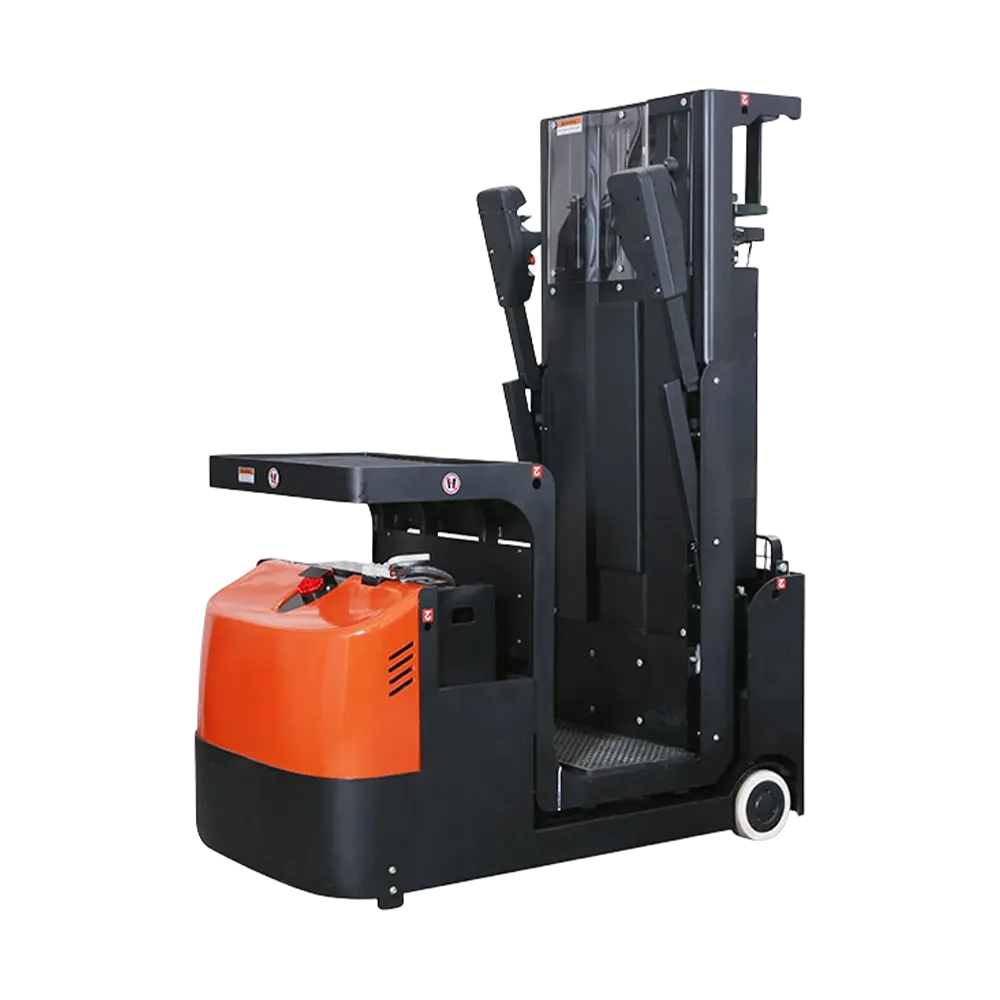
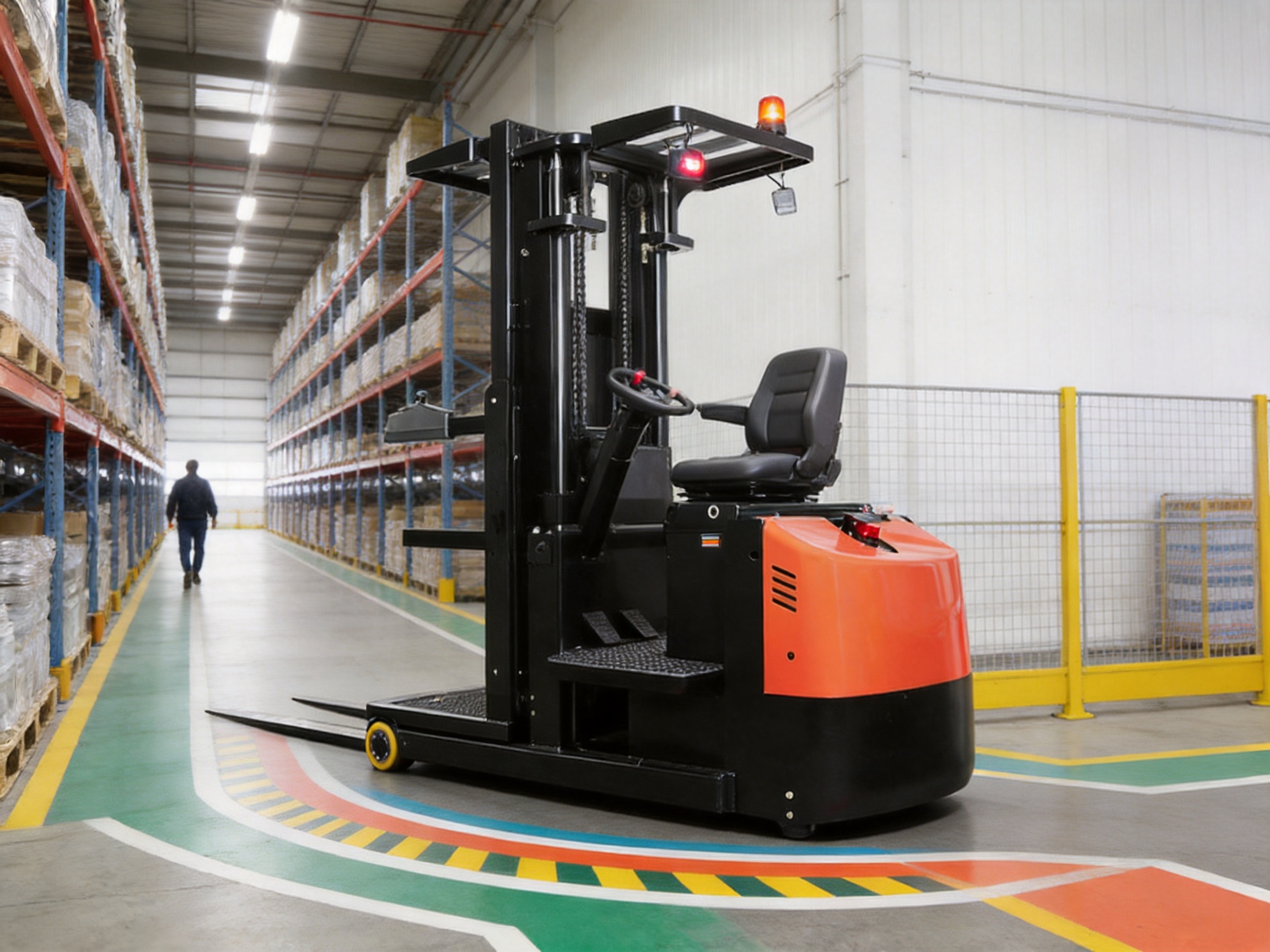
Modern warehouses are under constant pressure to move more inventory through less floor space while maintaining safe, accurate, and comfortable working conditions. Narrow aisles, higher storage density, frequent order changes, and rising labor expectations have made equipment selection a strategic decision rather than a simple purchasing task. The JX2-4 Narrow Aisle Warehouse Forklift 1 Ton Stand-On Electric Order Picker is designed for this operating environment, combining compact dimensions, electric travel, elevated picking capability, and a safety-focused control architecture.
This stand-on electric order picker is intended for warehouse order-picking applications in which operators need to travel repeatedly, access goods from different storage levels, and work efficiently in restricted spaces. Its 860 mm overall width, 1,600 mm turning radius, electronic steering, electromagnetic service brake, and 24 V/360 Ah battery configuration provide a practical balance between maneuverability, operating endurance, and control.
The equipment is more than a basic warehouse truck. It is a coordinated material-handling platform in which the mast, forks, drive system, operator station, braking functions, battery compartment, hydraulic system, and electronic controls work together. This integrated approach allows the truck to support repetitive picking work while helping reduce unnecessary operator movement, avoidable turning hazards, and maintenance interruptions.
Product at a Glance
The JX2-4 is a stand-on electric order picker for narrow-aisle warehouse operations. It is suitable for applications that require frequent travel, controlled lifting, dependable order access, and a compact turning envelope.
1,000 kgRated load specification listed for the lifting system
136 kgOperator-platform or picking-related specification shown in the supplied data
860 mmOverall vehicle width for space-conscious operation
1,600 mmTurning radius for controlled aisle maneuvering
24 V / 360 AhBattery voltage and nominal capacity
2,020 kgService weight listed for the complete truck
Application Context
Why Narrow-Aisle Order Picking Requires Specialized Equipment
Order picking is one of the most labor-intensive activities in a warehouse. Unlike long-distance pallet transport, picking work involves many short movements, frequent stops, repeated acceleration, steering corrections, height adjustments, and close interaction with shelves or storage racks. A truck selected only for its rated capacity may not deliver the best results if it is too wide, difficult to control, uncomfortable for long shifts, or slow to reposition.
A stand-on order picker is designed around the operator’s workflow. The operator remains close to the load and can travel between picking locations without repeatedly climbing in and out of a seated cabin. A spacious standing platform, a backrest, a shock-absorbing foot mat, and an integrated control handle are intended to support sustained use. These features are especially valuable in distribution centers where the same operator may complete hundreds of travel and picking cycles during a shift.
Narrow aisles also magnify the consequences of poor steering or delayed braking. When storage positions are close together, even a small steering error can result in contact with racks, pallets, products, or neighboring equipment. The JX2-4 addresses this challenge through electronic steering, automatic corner deceleration, electromagnetic braking, reverse-current braking, and a dual-circuit monitored steering system.
The result is a vehicle concept focused on controlled movement rather than simply maximum speed. The truck is designed to help operators position the vehicle accurately, approach picking locations smoothly, and maintain better awareness of the surrounding storage environment.
Designed for Repetitive Warehouse Cycles
Warehouse equipment must perform consistently during repeated start-stop operation. The JX2-4 combines an electric drive system, a durable vertical gearbox, low-noise hydraulic power, electronic steering, and a battery system sized for demanding warehouse routines. This combination is intended to support predictable daily performance rather than occasional peak use only.
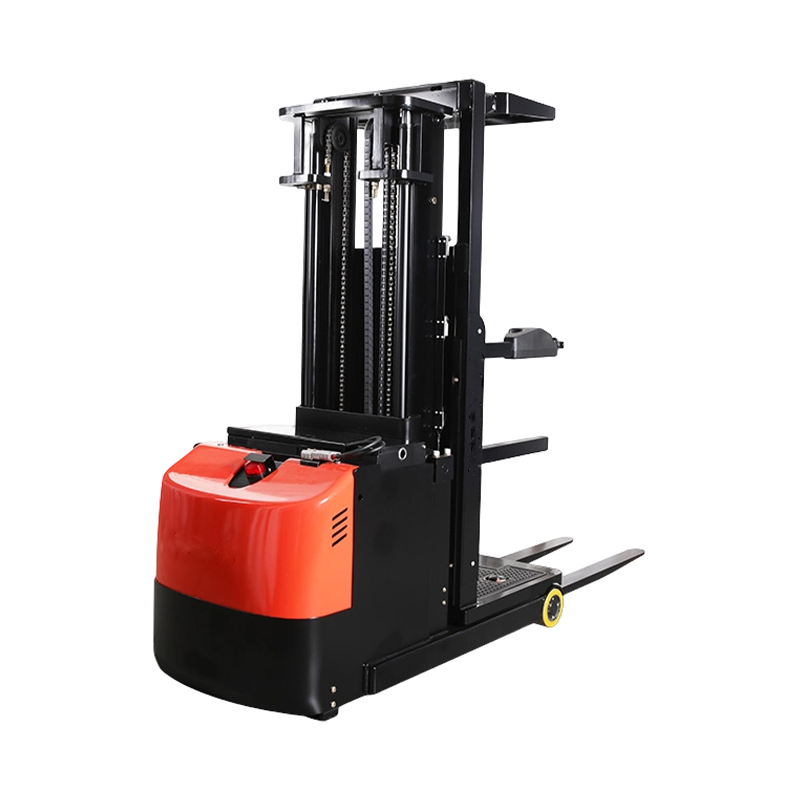
Narrow Aisle Warehouse Forklift 1 Ton Stand on Electric Order Picker
Core Product Specifications and What They Mean in Practice
Technical specifications are most useful when they are connected to actual operating conditions. The following values describe the main configuration supplied for this electric order picker. Final configuration, lifting height, fork dimensions, platform arrangement, and operating limits should be confirmed against the selected truck and the requirements of the installation.
| Product type | Electric order picker |
| Operator position | Stand-on order-picking platform |
| Drive system | Electric drive with DC drive control listed |
| Load specification | 136 kg / 1,000 kg as supplied in the product data |
| Load center distance | 600 mm |
| Service weight | 2,020 kg |
| Overall width | 860 mm |
| Overall vehicle length | 2,750 mm |
| Turning radius | 1,600 mm |
| Tire type | Polyurethane or rubber |
| Service brake | Electromagnetic |
| Battery | 24 V / 360 Ah |
| Steering | Electronic |
Compact Width for Storage-Dense Facilities
An overall width of 860 mm can be valuable in warehouses where every aisle contributes to storage capacity. A compact body can make it easier to plan travel lanes, approach rack openings, and reduce the amount of unused space around the vehicle. It may also provide more flexibility when the warehouse layout includes transfer points, cross aisles, staging areas, and mixed pedestrian traffic.
Width alone does not determine whether a truck is suitable for a specific aisle. Rack design, pallet dimensions, load overhang, floor condition, turning geometry, operator visibility, and local safety clearances must also be considered. However, a narrow vehicle creates a useful foundation for space-efficient planning when matched with the correct application data.
1,600 mm Turning Radius for Controlled Maneuvering
The listed turning radius supports maneuverability in confined working areas. A smaller turning envelope can reduce the number of steering corrections required at aisle entrances and intersections. It can also help operators reposition more efficiently when moving between adjacent picking locations.
In practical use, maneuverability is influenced by the load center, fork position, steering angle, tire condition, floor friction, and operator technique. The truck’s automatic corner deceleration function adds another layer of control by reducing travel speed when steering or cornering movement is detected.
Electric Drive for Indoor Material Handling
Electric power is well suited to enclosed warehouse environments. Compared with combustion-powered equipment, an electric order picker produces no exhaust emissions at the point of use and can operate with lower noise. This supports cleaner indoor air, improved communication between workers, and a more comfortable environment for facilities that handle packaged goods, consumer products, food-related materials, or temperature-sensitive inventory.
The electric drive system is also appropriate for frequent short-distance travel. Acceleration and braking can be controlled electronically, allowing the operator to make smooth movements instead of relying on repeated mechanical corrections. Lower noise is particularly useful in facilities where several picking teams work simultaneously.
Integrated Control and Safety Architecture
One of the most important advantages of the JX2-4 is its integrated protective control mode. Operating buttons and safety modules are brought together within one control arrangement. This reduces the need for the operator to manage separate, confusing controls and helps create a more consistent operating sequence.
Integration is especially useful when a truck is shared by multiple operators or when new employees are being trained. A clear control layout can reduce the likelihood of accidental activation, improve response time during abnormal situations, and make standard operating procedures easier to teach.
Automatic Corner Deceleration
The system detects steering or cornering movement and reduces travel speed automatically. This helps limit excessive momentum when the truck changes direction in a narrow aisle.
Emergency Power Cut-Off
An emergency power cut-off switch allows the operator to disconnect the power supply quickly if operation becomes uncontrolled or an immediate hazard occurs.
Monitored Electronic Steering
The dual-circuit monitored steering arrangement is designed to improve steering reliability and provide an additional layer of system supervision.
Braking Functions for Frequent Stop-and-Go Work
Order picking involves repeated starting, stopping, reversing, and positioning. The JX2-4 uses automatic braking and reverse-current braking when the travel switch is released. This can make the truck easier to control during short movements and reduce dependence on manual braking input.
The electromagnetic service brake is another important component. It is designed to provide controlled stopping and secure holding when the truck is not traveling. The anti-slip brake function helps prevent unintended movement on slopes or when control is lost. Actual performance depends on floor conditions, gradient, load, tire selection, and compliance with operating procedures.
Hydraulic Safety and Mast Protection
The hydraulic system incorporates an explosion-proof or hose-burst protection design. If a hydraulic tube fails, the mast is designed not to drop rapidly. This feature is particularly important when operators work near raised forks or when goods are being positioned at different heights.
Safety protection should always be combined with correct operating practice. Operators should never place themselves beneath elevated forks, exceed the approved load chart, transport unstable goods, or use the truck on unsuitable surfaces. The hydraulic protection system is a risk-reduction feature, not a substitute for training and safe work procedures.
Progressive Height-Based Deceleration
A continuous height sensor control system allows the vehicle to decelerate gradually within preset lifting intervals. This avoids abrupt speed changes and helps the operator maintain a more natural feel while working at different lift heights. Gradual control can be useful in high-density storage areas where sudden movement may disturb the load or reduce operator confidence.
Productivity Advantages Compared with Conventional Warehouse Trucks
The JX2-4 is designed to compete not only through its individual components but also through the way those components support the total workflow. A conventional low-level pallet truck may move loads efficiently across the floor but may not provide the same elevated access. A seated forklift may offer lifting capability but require more aisle space and more time for repeated mounting and dismounting. A manual order-picking platform may reduce investment cost but increase physical effort and limit travel productivity.
The stand-on electric order picker occupies a useful middle ground for operations that need both order access and powered travel. Its standing platform keeps the operator close to the load, while the electric drive and lift system reduce the physical effort required for repeated movement.
Where the Stand-On Electric Order Picker Creates Value
- More direct operator access to picked goods than a conventional seated truck.
- Less manual pushing and pulling than a non-powered picking platform.
- More compact maneuvering than many larger counterbalance forklifts.
- Lower indoor noise and no direct exhaust emissions during operation.
- Better support for repeated short travel cycles and frequent direction changes.
- Improved control in corners through automatic speed reduction.
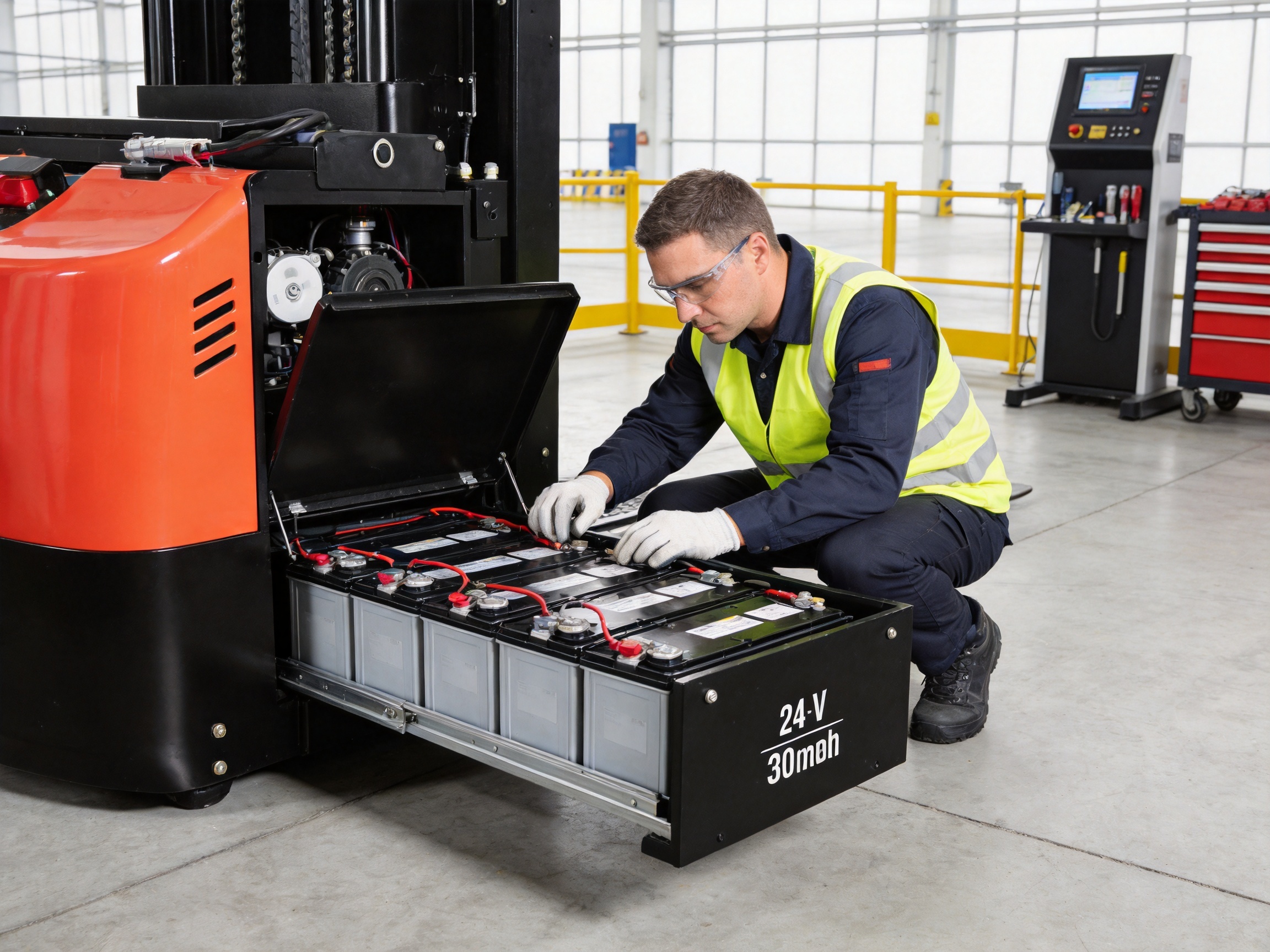
- Faster battery access through the side pull-out battery compartment.
Operator Position and Picking Efficiency
The operator station is central to productivity. The JX2-4 provides a spacious standing area, a backrest, an unobstructed forward view, and a 20 mm shock-absorbing foot mat. These details are intended to reduce fatigue during long periods of standing and repetitive travel.
The flush-mounted foot switches help the operator maintain a natural stance while driving or lifting. A natural posture can make it easier to move between travel and picking tasks without excessive body adjustment. The integrated control handle places key functions within reach and is designed according to ergonomic principles.
Comfort should not be considered separate from productivity. An operator who can maintain a stable posture and clear visibility is more likely to work consistently, make fewer positioning errors, and follow safe operating procedures throughout the shift.
Independent Fork Lifting and Dual Mast Design
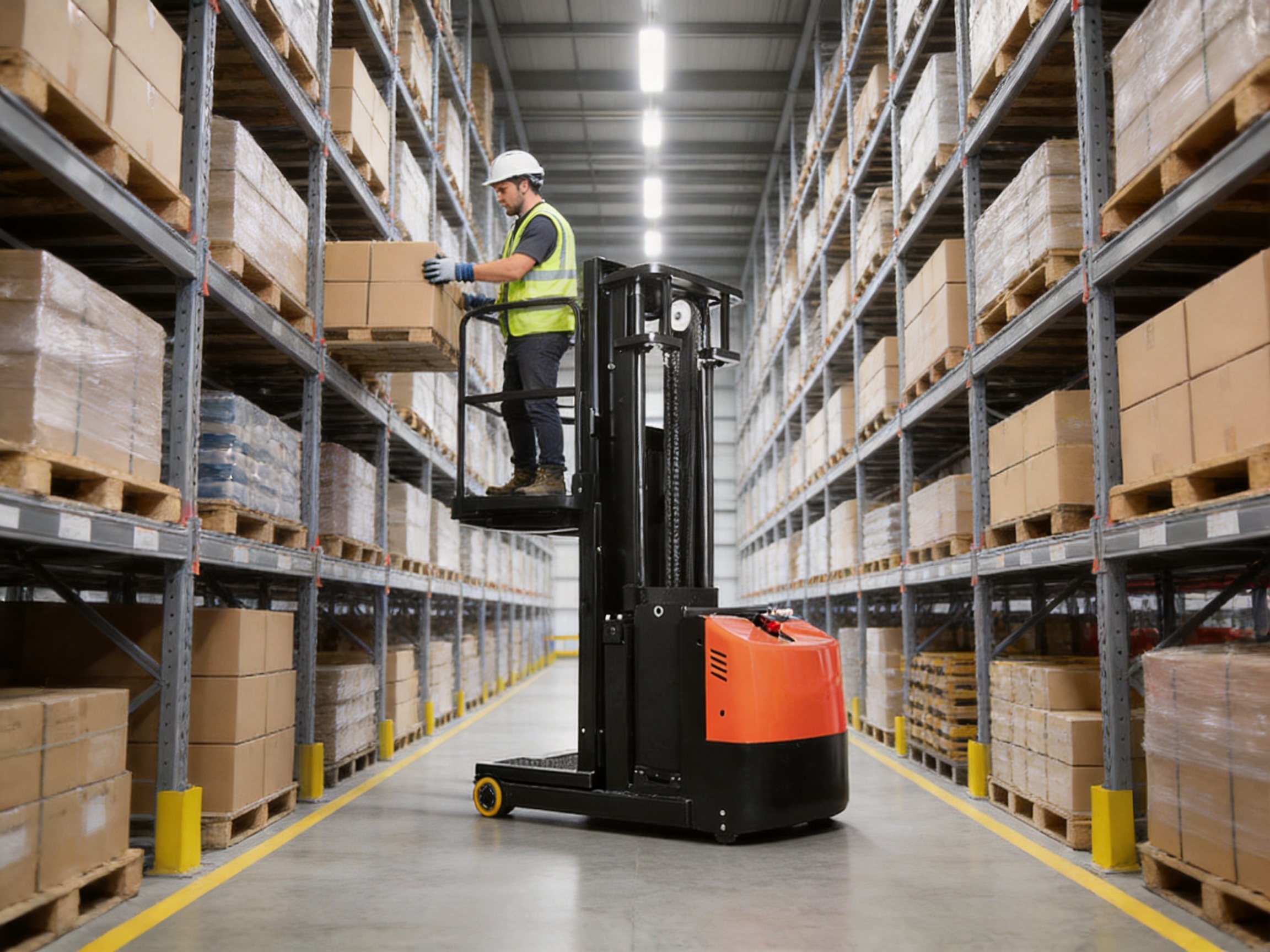
The dual mast design supports goods picking and storage work by providing a stable lifting structure and independent fork-lifting capability. This arrangement can make it easier to position goods at different levels and organize products within storage locations.
The H-type channel steel mast is designed for strong bending resistance. A rigid mast helps preserve alignment under working loads and contributes to stable fork movement. Structural stability is particularly important in narrow aisles, where the operator has limited room to correct a misaligned load.
Engineering and Manufacturing Strengths
Reliable warehouse equipment depends on more than the final paint finish or a list of installed components. Manufacturing quality is built through material selection, structural design, component inspection, electrical protection, assembly discipline, and end-of-line testing. The product information for the JX2-4 reflects an engineering approach that focuses on durability, serviceability, and controlled operation.
High-Strength Structural Components
The mast uses H-type channel steel to improve resistance to bending and deformation. The vehicle body is described as ultra-rigid, supporting stability during heavy-load work. These design choices are important because warehouse trucks experience repeated dynamic forces, including acceleration, braking, turning, uneven floor contact, pallet engagement, and lifting.
A strong structure helps protect critical components and maintain predictable handling. It can also reduce the risk of premature wear caused by frame flexing or poor alignment. During manufacturing, structural parts should be checked for dimensional accuracy, weld integrity, surface quality, and correct assembly before the truck proceeds to later stages.
Durable Drive and Gearbox Arrangement
The high-strength vertical gearbox is selected for frequent start-stop operation. Unlike a machine used for occasional movement, an order picker may accelerate and stop hundreds of times per working day. The gearbox, drive wheel, bearings, and mounting points must therefore work together under repeated torque changes.
A vertical motor layout also supports maintenance access. The arrangement makes it easier to inspect the motor, brake, and related assemblies compared with a less accessible horizontal installation. Practical service access can reduce the time required to diagnose faults and return the equipment to work.
Electrical Protection and Connector Reliability
The JX2-4 uses American AMP waterproof connectors and protected, securely fixed wiring. Electrical reliability is a major consideration in warehouse equipment because vibration, dust, moisture, repeated movement, and maintenance activities can affect connectors and cable routes.
Water-resistant connectors can help reduce the risk of corrosion and intermittent electrical faults. Proper cable routing and firm fixation are equally important because loose wires may rub against the frame or become exposed to mechanical damage. A disciplined assembly process should include connector engagement checks, cable protection inspection, and functional verification of all control circuits.
Hydraulic Unit Inspection and Durability Testing
The hydraulic power unit is designed for low noise and dependable operation. Cylinders and pipelines undergo multiple inspections and durability tests according to the supplied product information. Such testing is important for identifying leakage, pressure loss, abnormal noise, or inconsistent lifting behavior before the machine reaches the customer.
A dependable hydraulic system supports both productivity and safety. Smooth lifting allows operators to position goods accurately, while controlled lowering helps avoid impacts on racks, pallets, and products. Hydraulic components should be kept clean, inspected at scheduled intervals, and operated only within the approved load and height limits.
Process-Oriented Quality Control
Advanced manufacturing is best understood as a process rather than a single machine or production step. A professional equipment factory typically coordinates several quality checkpoints:
1. Engineering ReviewApplication requirements, load center, aisle width, battery configuration, mast arrangement, and control functions are reviewed before production.
2. Material PreparationStructural steel, electrical parts, hydraulic components, tires, batteries, and fasteners are checked against production requirements.
3. Precision FabricationFrame and mast components are formed, welded, finished, and inspected for geometry and structural consistency.
4. Subassembly TestingDrive, steering, braking, hydraulic, lifting, and control assemblies are checked before final installation.
5. Final AssemblyComponents are installed with protected wiring, secure fasteners, correctly routed pipelines, and calibrated controls.
6. Functional ValidationThe completed truck is operated to verify travel, braking, steering, lifting, emergency shut-off, and fault-display functions.
This kind of process control supports product consistency across different production batches. It also gives users a clearer basis for evaluating equipment quality: not just whether the truck works when new, but whether its structure, controls, and service systems are prepared for repeated industrial use.
Battery, Charging, and Shift Planning
The listed 24 V/360 Ah battery provides the energy source for the electric drive, hydraulic lifting, steering, and control systems. Battery capacity should always be evaluated against the actual duty cycle rather than considered in isolation. Travel distance, load weight, lift frequency, floor conditions, temperature, charging practice, and operator behavior all influence energy consumption.
The side pull-out battery compartment is designed for faster battery replacement. This is useful for facilities that run multiple shifts or need to minimize downtime during peak periods. Battery exchange procedures should be performed in a designated area with suitable lifting or handling equipment and clear safety instructions.
An hour meter and battery level gauge help operators monitor usage and charging needs. Timely charging can reduce the risk of unplanned stoppages and help extend battery service life. The automatic low-voltage protection function is designed to prevent excessive discharge, which can damage a storage battery and reduce its effective operating capacity.
Recommended Energy-Management Practices
Plan charging around operating cycles instead of waiting for a complete loss of power. Inspect the battery and connectors regularly, keep charging areas clean and ventilated, and use the correct charger for the installed battery. Avoid allowing operators to continue working after low-voltage protection has activated. Record operating hours and charging behavior so that the fleet can be scheduled according to real usage data.
Maintenance Design for Lower Downtime
Maintenance access directly affects the total cost of ownership of warehouse equipment. A truck that is technically reliable but difficult to inspect may still create avoidable downtime. The JX2-4 is designed with a removable lower cover that can be taken off after loosening two screws. This provides access for inspection, servicing, and replacement of key components.
The maintenance-free AC motor reduces routine service requirements. The vertical layout of the motor, brake, and related assemblies supports visual inspection and easier access. A built-in controller self-diagnosis function displays fault codes on the handheld control unit, allowing technicians to identify the general source of a problem more quickly.
Fault-code information does not replace professional diagnosis. It should be used together with inspection of wiring, connectors, sensors, fuses, hydraulic components, brakes, tires, and mechanical fasteners. A structured maintenance program should distinguish between daily operator checks, weekly inspections, scheduled preventive maintenance, and repairs performed by trained technicians.
Before Each Shift
Check the emergency stop, travel controls, steering response, braking, horn, battery level, tires, forks, mast, guards, and visible hydraulic connections.
During Operation
Monitor unusual noise, vibration, steering resistance, hydraulic leakage, warning codes, reduced travel performance, or abnormal battery behavior.
Scheduled Service
Inspect structural fasteners, brake performance, gearbox condition, electrical connectors, mast components, battery connections, and hydraulic seals.
How the Product Supports Warehouse Safety Culture
Safety is strongest when equipment design and workplace procedures reinforce each other. The JX2-4 incorporates several design features intended to reduce operational risk, but safe results also depend on site layout, operator training, load stability, pedestrian control, and regular maintenance.
The foot-operated safety switch helps prevent unintended travel. The emergency power cut-off provides a direct response option in abnormal situations. Automatic braking engages when the travel switch is released, while anti-slip braking helps reduce unintended movement on slopes. Automatic corner deceleration supports safer turning behavior in narrow aisles.
Visibility is another key factor. The standing operator position and open forward view of the cargo rack are intended to provide better awareness of the load and travel path. Operators should still travel at a speed appropriate to the environment, keep the load stable, sound warnings at blind intersections where required, and maintain safe separation from pedestrians.
Training Topics for Operators
- Understanding the rated load, load center, lifting height, and application limitations.
- Starting, stopping, reversing, steering, and cornering in narrow aisles.
- Correct use of the foot switch, emergency cut-off, and braking functions.
- Safe approach to pallets, shelves, transfer points, and charging areas.
- Recognition of battery warnings, fault codes, hydraulic leaks, and abnormal noise.
- Rules for working near pedestrians and other warehouse vehicles.
- Procedures for parking, isolating, charging, and reporting defects.
Applications and Suitable Operating Environments
The JX2-4 can be considered for distribution centers, retail warehouses, spare-parts storage, light industrial facilities, consumer-goods logistics, e-commerce fulfillment, and other indoor environments that require frequent picking and short-distance travel.
It is particularly relevant where goods are stored in organized rack locations and operators need to access products at different heights. The compact width and electric configuration can support facilities where aisle space, noise, and indoor air quality are important considerations.
Before selecting the truck, users should provide the equipment supplier with accurate information about rack spacing, pallet size, aisle width, floor flatness, maximum load, required lift height, daily operating hours, shift pattern, charging facilities, and temperature conditions. This ensures that the final configuration is matched to the actual warehouse rather than selected from a specification sheet alone.
Retail Distribution
Useful for frequent case and carton picking where operators travel between many storage locations during one shift.
Spare-Parts Warehousing
Suitable for organized inventories that require accurate product access and controlled movement around shelving systems.
E-Commerce Fulfillment
Supports repetitive order preparation where compact maneuvering and fast repositioning can influence daily throughput.
Industrial Storage
Can assist with component handling and internal logistics when the load, floor, and aisle conditions match the truck specification.
Selection Guidance: Questions to Answer Before Purchase
Choosing a warehouse truck should begin with the work process. The following questions help determine whether a stand-on electric order picker is suitable:
- What is the heaviest load, and where is its center of gravity?
- What is the narrowest aisle and turning area in the facility?
- How often will the operator lift, lower, stop, reverse, and change direction?
- What height must the operator reach for picking or storage?
- Will the equipment operate in one shift, multiple shifts, or continuous rotation?
- Is a charging station available, and is battery exchange required?
- Are there slopes, thresholds, ramps, floor joints, or uneven surfaces?
- Will the truck work near pedestrians or in mixed-traffic zones?
- Which tire material is most suitable for the floor and traction conditions?
- What service response, spare parts, training, and technical support are required?
These questions also help clarify the meaning of the listed 136 kg/1,000 kg load data. Because warehouse trucks may have separate operator-platform, fork, auxiliary, or rated-capacity values, the customer should request the official load chart and configuration confirmation for the intended lifting height and load center.
Service, Spare Parts, and International Supply Capability
Equipment reliability is supported by the availability of parts and technical assistance throughout the service life. The supplier’s business covers new and used forklifts, spare parts, attachments, exports, leasing services, technical consultation, operation guidance, maintenance, and after-sales support. This broad product and service scope can simplify procurement when a warehouse needs more than one type of material-handling solution.
A large standardized warehouse and an extensive inventory can help support faster product preparation and parts fulfillment. For international customers, effective supply also requires accurate documentation, export coordination, packaging control, and communication regarding voltage, charger requirements, replacement parts, operating manuals, and local service arrangements.
Customers should evaluate not only the initial equipment quotation but also the supplier’s ability to support commissioning, operator instruction, preventive maintenance, troubleshooting, and replacement components. A responsive support structure can reduce the operational impact of wear items or unexpected technical issues.
Frequently Asked Questions
What type of equipment is the JX2-4?
It is a stand-on electric order picker designed for warehouse picking, short-distance travel, controlled lifting, and work in relatively narrow aisles.
Is this truck suitable for indoor warehouses?
Yes. Its electric drive, low-noise operation, compact width, and maneuverability are suited to indoor material-handling environments. Floor condition, ventilation, temperature, aisle dimensions, and load requirements should be checked before use.
What battery does the truck use?
The supplied specification lists a 24 V/360 Ah battery. The correct charger, charging procedure, and battery technology should be confirmed with the supplier for the final configuration.
How does automatic corner deceleration work?
The control system detects steering or cornering movement and reduces travel speed automatically. This helps manage momentum during turns and supports safer travel in narrow warehouse areas.
What braking systems are included?
The specification lists an electromagnetic service brake. The safety description also includes automatic braking, reverse-current braking, and anti-slip braking functions.
How does the design reduce maintenance time?
The truck includes a maintenance-free AC motor, accessible vertical motor layout, a lower cover that can be removed by loosening two screws, an hour meter, a battery gauge, controller self-diagnosis, and automatic low-voltage protection.
Can the battery be replaced between shifts?
The side pull-out battery compartment is designed to make battery replacement faster and easier. The facility should use a safe battery-handling method and follow the approved replacement procedure.
What does the 600 mm load center mean?
The 600 mm value indicates the specified horizontal distance from the load’s center of gravity to the fork face or related reference point. Capacity must be checked against the official load chart, load height, and truck configuration.
What should be confirmed before ordering?
Confirm the required lift height, fork dimensions, load chart, battery type, charger, tire material, aisle width, floor conditions, shift pattern, delivery requirements, training, spare parts, and after-sales support.
Conclusion: A Practical Platform for Controlled Warehouse Picking
The JX2-4 Narrow Aisle Warehouse Forklift 1 Ton Stand-On Electric Order Picker is designed for warehouses that need compact maneuvering, dependable electric travel, elevated product access, and operator-focused controls. Its 860 mm width and 1,600 mm turning radius support space-conscious operation, while electronic steering, automatic corner deceleration, electromagnetic braking, and monitored control systems contribute to safer handling.
Its value also comes from the supporting engineering details: a rigid H-type channel steel mast, durable vertical gearbox, low-noise hydraulic power unit, protected electrical connectors, accessible service layout, battery replacement design, and controller self-diagnosis. Together, these features address the practical challenges of repetitive warehouse work, including fatigue, start-stop wear, limited aisle space, maintenance access, and operational consistency.
For the best result, the equipment should be matched to the warehouse layout and verified against the exact load chart and operating conditions. With correct selection, trained operators, preventive maintenance, and a suitable charging plan, a stand-on electric order picker can help improve picking flow while supporting a cleaner, quieter, and more organized material-handling environment.
References
1. Supplied product specification sheet for the JX2-4 Electric Order Picker.
2. Supplied equipment information concerning integrated controls, safety systems, structural design, maintenance, and battery management.
3. General principles of industrial truck capacity, load-center evaluation, warehouse aisle planning, and operator training.
4. General preventive-maintenance practices for electric warehouse trucks and hydraulic lifting equipment.



 English
 中文简体
 русский
 Español
 عربى