2026-09-04
Content
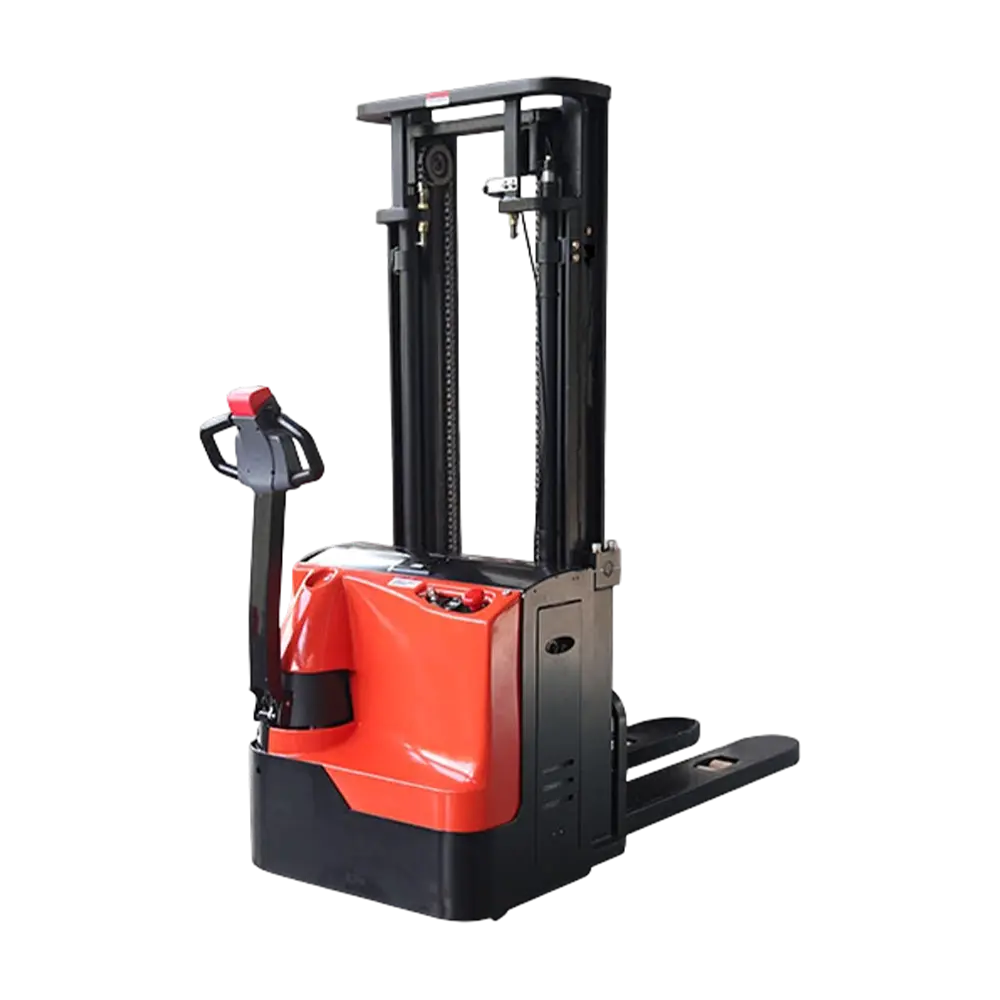
Modern warehouses require equipment that can lift, transport, position, and store goods safely while using floor space efficiently. As storage facilities become denser and order cycles become faster, businesses need material-handling machines that combine dependable lifting ability, precise control, low operating complexity, and excellent maneuverability. The Warehouse Forklift 1.5 Ton Electric Stacker, model EST152Z, is designed to meet these requirements in warehouses, distribution centers, production areas, retail back rooms, and other indoor handling environments.
This electric stacker is a pedestrian-operated machine with a rated load capacity of 1,500 kilograms and a 500-millimeter load center distance. It uses an electric drive system, a DC drive unit, polyurethane wheels, and mechanical steering. These specifications make it a practical solution for businesses that need the lifting performance of a warehouse forklift without the size, emissions, noise, and operating complexity associated with many internal-combustion machines.
The EST152Z is not simply a compact lifting device. It is the result of a design approach that combines structural reinforcement, stability testing, carefully matched electrical components, practical ergonomics, and controlled manufacturing. Its chassis, mast, drive system, braking protection, wiring, connectors, and battery system are all intended to support reliable daily operation. For companies that prioritize safety, uptime, ease of maintenance, and efficient use of warehouse space, the electric stacker provides a balanced and cost-effective material-handling option.
An electric stacker is designed to lift and stack palletized loads while being guided by a pedestrian operator. Unlike a sit-down counterbalance forklift, the operator walks behind or beside the machine and controls its movement through the steering and operating controls. This arrangement allows the equipment to work in narrower spaces and makes it especially suitable for indoor warehouse applications.
The 1,500-kilogram capacity places the EST152Z in a useful range for many common warehouse tasks. It can support pallet movement, low- and medium-level stacking, production-line replenishment, loading-area transfers, and short-distance transportation between storage locations. The rated capacity is matched to a 500-millimeter load center distance, which is a widely used reference point for palletized goods.
Electric stackers are often selected when a company needs more lifting capability than a manual pallet truck can provide but does not require a large counterbalance forklift. They occupy less space, are easier to maneuver, and are generally better suited to enclosed areas where exhaust emissions and excessive engine noise would be undesirable. The result is a machine that can support productivity without requiring major changes to a facility’s layout.
The EST152Z can be particularly valuable in warehouses with narrow aisles, compact staging zones, limited turning areas, and frequent short-distance handling cycles. Its compact and practical design allows operators to move between racks, workstations, pallets, and production areas with less repositioning than may be required with larger equipment.
The following specifications define the primary operating characteristics of the Warehouse Forklift 1.5 Ton Electric Stacker.
| Specification | Value |
|---|---|
| Product type | Electric stacker |
| Model | EST152Z |
| Drive type | Electric |
| Operator type | Pedestrian |
| Load capacity | 1,500 kilograms |
| Load center distance | 500 millimeters |
| Carrying length | 801 millimeters |
| Wheelbase | 1,204 millimeters |
| Service weight | 510 kilograms |
| Axle load, full load, front/rear | 760/1,250 kilograms |
| Axle load, no load, front/rear | 380/130 kilograms |
| Tire type | Polyurethane |
| Drive unit | DC |
| Steering type | Mechanical |
These figures show that the machine has been designed around a compact warehouse footprint while maintaining a useful industrial lifting capacity. The 801-millimeter carrying length and 1,204-millimeter wheelbase support a relatively short and maneuverable configuration. At the same time, the 510-kilogram service weight provides a stable foundation for pedestrian-operated handling work.
Safety and reliability begin with the machine’s structure. A warehouse stacker must withstand repeated loading, unloading, braking, turning, mast movement, and contact with the uneven surfaces that may exist in active industrial facilities. If the frame or mast lacks sufficient rigidity, repeated stress can lead to deformation, vibration, reduced lifting precision, and premature component wear.
The EST152Z uses a specially designed high-strength chassis. Its structure integrates plates, beams, and box sections to help reduce deformation under heavy loads. Instead of relying only on individual flat components, the integrated configuration distributes forces throughout the chassis. This approach helps the machine maintain its geometry during repeated lifting and travel cycles.
A rigid chassis is important for more than long-term durability. It also contributes to operator confidence. When a machine feels stable during acceleration, braking, steering, and lifting, the operator can work with greater control. Reduced frame flex can also support more consistent load positioning and help protect the mechanical and electrical systems from unnecessary vibration.
The mast incorporates a specially designed crossbeam structure. Key strength points were evaluated through finite element stability testing, and the frame was reinforced with a box structure. Finite element analysis is commonly used in industrial equipment design to identify areas of concentrated stress, assess deformation, and refine the shape and thickness of structural components before production.
Using this type of analysis allows engineers to focus reinforcement where it delivers the greatest practical value. The result is not simply a heavier frame. It is a more intelligently designed structure intended to improve rigidity while preserving the compact dimensions needed for warehouse operation.
Compared with lower-cost machines that may depend on lightly reinforced frames or less systematic structural design, the EST152Z offers a stronger foundation for repeated industrial use. Its construction is aimed at reducing heavy-load deformation and supporting stable mast performance over the service life of the equipment.
Warehouse lifting equipment must protect operators, loads, pedestrians, racks, and surrounding infrastructure. The EST152Z is described as having passed the national safety stability test standards GB/T 26949.1-2012. Stability compliance is an important indicator because it relates directly to the machine’s ability to resist tipping risks under defined operating conditions.
Stability is influenced by several factors, including wheelbase, service weight, load center, chassis geometry, mast design, load distribution, and steering behavior. The EST152Z combines these factors in a compact pedestrian-operated platform. Its axle-load values show how the machine distributes weight under loaded and unloaded conditions, while its reinforced chassis and mast help support structural stability.
However, no forklift or stacker can eliminate all operating risks. The rated load, load center distance, floor conditions, mast position, turning speed, and load quality must always be considered. Operators should follow the equipment manual, observe facility traffic rules, keep loads properly centered, and avoid carrying loads that exceed the specified capacity.
The electric design also contributes to a safer indoor working environment. Unlike internal-combustion forklifts, an electric stacker does not produce tailpipe exhaust during operation. This makes it more appropriate for enclosed warehouses, food-related storage areas where applicable regulations permit, retail logistics facilities, and production environments where air quality is important.
Noise reduction is another practical benefit. Electric drive systems generally produce less operating noise than combustion engines, making it easier for operators and nearby workers to communicate. A quieter working environment can support concentration and reduce disruption in facilities that operate close to offices, retail areas, or inspection stations.
The electric drive system is one of the most important advantages of the EST152Z. Electric stackers are well suited to duty cycles involving frequent starting, stopping, maneuvering, and lifting. These activities are common in warehouses, where travel distances may be short but operating frequency is high.
Electric operation removes the need for engine fuel, engine oil, exhaust after-treatment, and many of the maintenance tasks associated with internal-combustion equipment. This can simplify routine service and help lower operating costs over time. The facility also avoids the need to store fuel for the stacker, which can be valuable in compact warehouses.
The DC drive unit provides a straightforward and proven configuration for material-handling applications. It is designed to deliver dependable traction for warehouse travel and positioning. For applications that require predictable movement rather than high-speed outdoor transportation, this type of drive can provide a practical balance between performance and service simplicity.
Electric stackers can also provide precise low-speed control. In warehouse work, the ability to approach a pallet smoothly and position the forks accurately is often more important than maximum travel speed. Fine control can reduce contact with pallets, racks, doors, and other equipment while helping operators complete tasks efficiently.
The electrical system includes anti-torsion robot cable technology and imported waterproof connectors. These components are intended to protect wiring during repeated movement and help maintain dependable electrical connections in demanding operating conditions. Cable routing is especially important around steering assemblies and moving mast sections, where flexing and torsion can place stress on conductors and connectors.
Waterproof connectors can help reduce the risk of electrical faults caused by dust, moisture, cleaning activities, or environmental exposure. Their effectiveness still depends on correct installation, inspection, and maintenance, but their inclusion reflects a design emphasis on long-term electrical reliability.
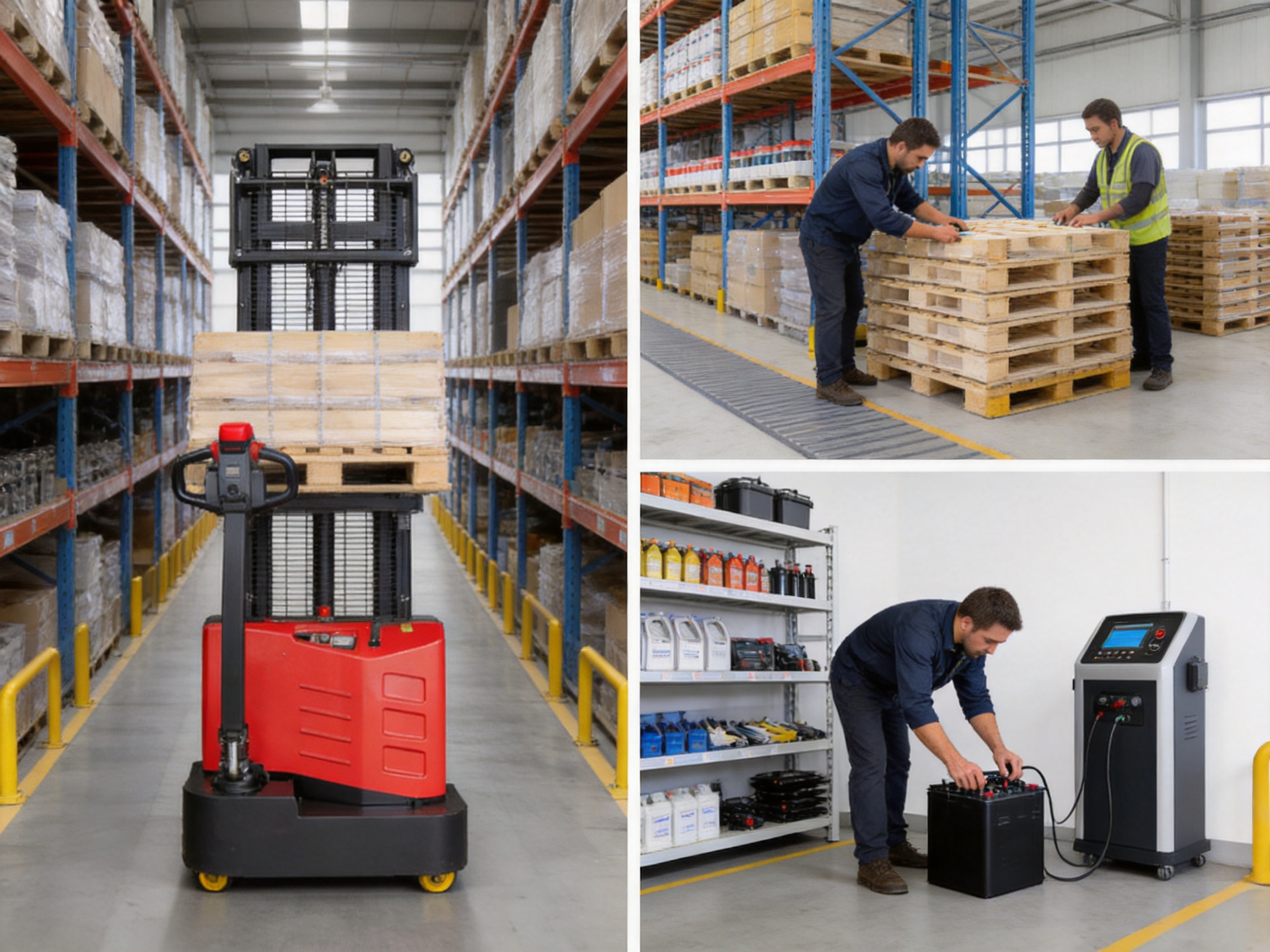
Warehouse space is expensive, and many companies try to increase storage density by reducing aisle width or using taller racking. Equipment that is too large can limit this strategy by requiring excessive clearance for turning and positioning. A compact stacker can help businesses use available floor space more effectively.
The EST152Z has a carrying length of 801 millimeters and a wheelbase of 1,204 millimeters. These dimensions support maneuverability in confined warehouse environments. The pedestrian operating configuration also gives the operator a direct view of the working area and allows the machine to be guided through spaces that may be unsuitable for a larger seated forklift.
In narrow aisles, maneuverability reduces the number of corrective movements required to align with pallets. Fewer corrections can improve productivity and decrease the likelihood of accidental contact with racking or stored goods. The compact format is also useful in receiving areas, dispatch zones, production aisles, and temporary staging areas where space changes throughout the day.
A small machine does not automatically mean limited capability. The value of a compact stacker comes from combining a small operating footprint with an appropriate load capacity, stable chassis, controlled steering, and dependable lifting structure. The EST152Z is designed around this combination.
Before purchasing, facility managers should measure aisle widths, rack clearances, door openings, lift-gate dimensions, floor conditions, and turning areas. The stacker should be evaluated together with the pallets and loads it will handle. Proper application matching ensures that compact dimensions become a genuine productivity advantage rather than a compromise.
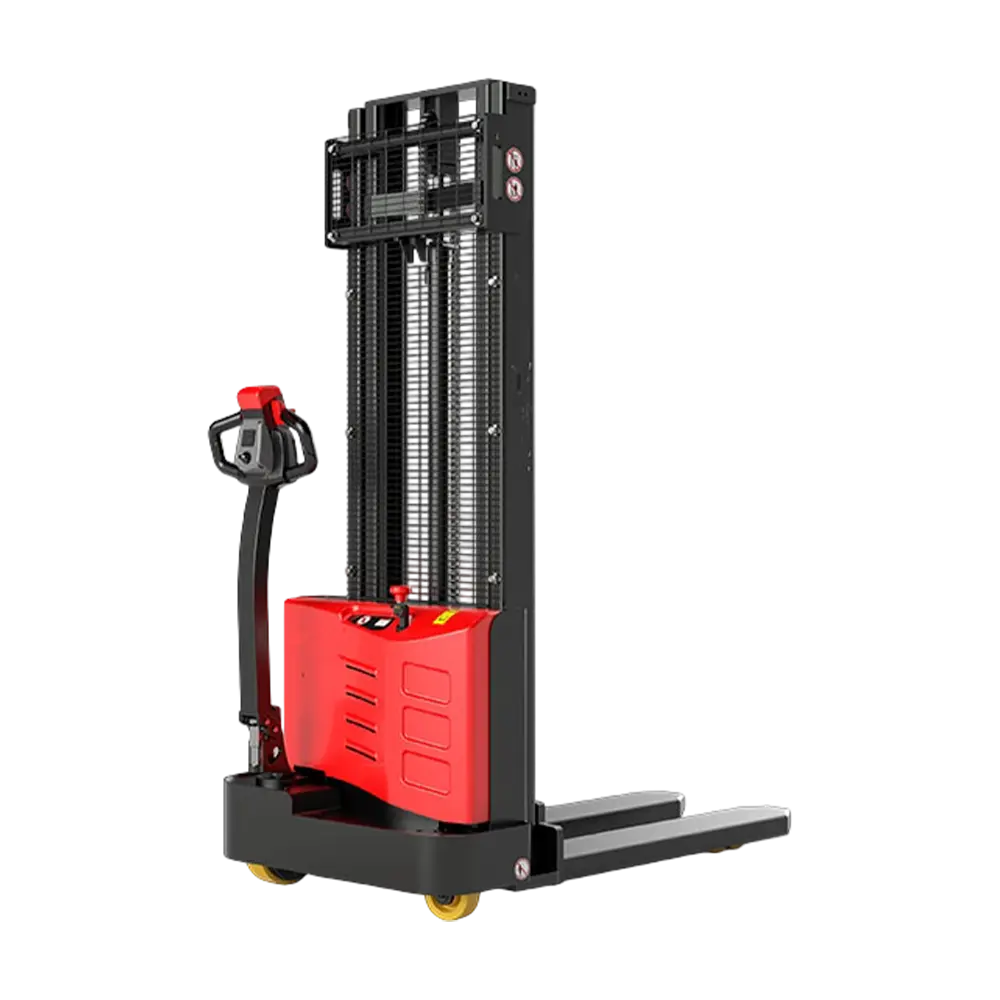
Warehouse Forklift 1.5 Ton Electric Stacker
The EST152Z uses polyurethane wheels for the drive and carrier positions. Polyurethane is widely used in indoor material-handling equipment because it provides a useful balance of wear resistance, load support, rolling performance, and floor friendliness.
In a warehouse, wheel material affects more than traction. It influences noise, floor marking, vibration, turning behavior, and the long-term condition of concrete or coated surfaces. Polyurethane wheels are generally suitable for smooth indoor floors and can reduce the risk of black marks that may be associated with some rubber compounds.
They can also support smooth movement over finished warehouse surfaces. This is helpful when handling fragile goods, liquids, cartons, components, or products that may be affected by sudden movement. As with any wheel type, the operating environment must be considered. Sharp debris, deep cracks, excessive moisture, uneven outdoor surfaces, and chemical exposure can influence wheel life.
Regular inspection should include checking for flat spots, cuts, embedded debris, abnormal wear, and changes in rolling resistance. Keeping travel paths clean is an inexpensive way to extend wheel life and protect both the equipment and the facility floor.
The pedestrian configuration gives the operator close control over the stacker. This is useful when loads must be picked from different pallet positions, when travel paths are shared with other workers, or when the machine must be positioned precisely beside racks and workstations.
Mechanical steering offers a direct and familiar control method. It does not depend on a complex electronic steering interface, which can make the machine easier to understand for operators who are accustomed to conventional warehouse equipment. Simple controls can reduce training time, provided that operators receive appropriate instruction on load handling, stability, braking, and battery procedures.
Ease of operation is especially important in facilities with multiple shifts or changing personnel. A machine that can be operated smoothly and predictably helps maintain consistent work practices. Operators should be trained to perform pre-use inspections, check the condition of forks and wheels, confirm the load rating, and report unusual sounds, steering resistance, braking changes, or electrical faults.
The compact design also allows the operator to control the machine in both narrow aisles and wider work areas. This flexibility is valuable for companies that use the same equipment across several zones rather than dedicating it to one highly specialized task.
Operator convenience should not be confused with reduced responsibility. Pedestrian stackers require careful awareness of foot traffic, blind corners, doorways, ramps, and load visibility. Safe operation depends on the combined performance of the machine, the operator, the warehouse layout, and the company’s operating procedures.
The EST152Z is equipped with a maintenance-free battery and a battery-charging system that is precisely matched to the electrical configuration. A maintenance-free battery can reduce routine service requirements compared with battery types that require regular electrolyte checks or water replenishment.
Reduced maintenance is particularly beneficial in busy warehouses where equipment may be used across several shifts. Fewer routine battery tasks can simplify fleet management and reduce the risk of service errors. Nevertheless, maintenance-free does not mean maintenance-free in every respect. Operators and technicians should still inspect battery condition, charging connections, cables, ventilation arrangements, and warning indicators according to the applicable service schedule.
Correct charging practices are essential to battery life. The machine should be charged using the specified charging system and in an area suitable for the battery technology. Charging schedules should be planned around the facility’s operating cycle. Avoiding unnecessary deep discharge, preventing unauthorized charger changes, and keeping connectors clean can all support more consistent battery performance.
A precisely matched battery and charging system can also help protect the drive and control components. Incorrect voltage, unsuitable charging profiles, damaged cables, or poor connections may result in reduced operating time and avoidable electrical stress. The factory’s approach of matching the battery and charger reflects the importance of treating the electrical system as an integrated package rather than as a collection of unrelated parts.
Equipment quality depends not only on the final assembly but also on the consistency of the manufacturing process. The EST152Z is presented as a product developed with strict quality controls, structural analysis, carefully selected components, and attention to detailed assembly.
The chassis and mast design demonstrate a manufacturing philosophy based on engineered strength rather than appearance alone. Plates, beams, and box sections are configured to reduce deformation. The mast crossbeam is reinforced based on finite element stability tests. These decisions require accurate fabrication, consistent welding, reliable dimensional control, and inspection during assembly.
The product information also refers to major components sourced from manufacturers with annual production exceeding 100,000 units. High-volume component production can provide advantages in process maturity, repeatability, quality documentation, and replacement availability. It does not eliminate the need for incoming inspection, but it can support a more stable supply chain and more predictable component performance.
Anti-torsion robot cables, imported waterproof connectors, and independently designed brake protection reflect additional attention to detail. These are not merely cosmetic features. They address common areas of stress in electric handling equipment, including cable movement, connector exposure, braking safety, and long-term reliability.
Advanced manufacturing is most valuable when it produces practical results for the customer. In this case, the goal is to reduce structural deformation, protect electrical connections, improve braking safety, simplify maintenance, and maintain dependable performance during repeated warehouse work.
Strict quality control should cover material inspection, welding quality, mast alignment, wheel installation, steering operation, electrical connection, brake response, lifting behavior, load testing, and final appearance. Each stage contributes to the finished machine. A well-designed stacker can perform poorly if assembly tolerances are inconsistent, while a carefully controlled manufacturing process helps convert engineering concepts into reliable field performance.
The best equipment choice depends on the application, but the EST152Z has several advantages over common alternatives.
Manual pallet trucks are inexpensive and useful for short-distance horizontal movement. However, they require physical effort and generally cannot provide powered lifting for stacking loads at elevated levels. The electric stacker reduces operator fatigue by providing powered travel and lifting capability.
For businesses handling 1,500-kilogram pallets, repeated manual movement can become inefficient and physically demanding. The EST152Z is better suited to regular stacking and replenishment tasks where powered lifting delivers a clear productivity benefit.
Counterbalance forklifts offer strong versatility and can handle many outdoor and heavy-duty applications. However, they are often larger, require more turning space, and may be less convenient in narrow indoor aisles. Internal-combustion versions also produce exhaust emissions and may require more engine-related maintenance.
The electric stacker is not intended to replace every counterbalance forklift. Instead, it offers a more focused solution for indoor warehouse work. Its pedestrian configuration, compact dimensions, electric drive, and polyurethane wheels make it efficient for applications where a larger truck would be excessive.
Reach trucks are designed for high-level racking and often provide excellent performance in narrow aisles. They may be the better choice for operations requiring substantial lift heights, frequent high-level pallet storage, or seated operator productivity over long shifts.
The electric stacker can be more economical and simpler for businesses whose storage heights and travel distances are moderate. It is an attractive option when the main requirement is reliable pallet stacking without the investment and complexity of a larger reach-truck fleet.
Basic stackers may appear attractive because of their initial purchase price. However, the total cost of ownership depends on more than the purchase figure. Frame rigidity, mast strength, wheel quality, brake protection, connector reliability, battery matching, parts availability, and after-sales support can all affect long-term value.
The EST152Z differentiates itself through its reinforced chassis, finite element-informed mast design, stability testing, electrical protection features, maintenance-free battery configuration, and structured quality-control approach. These features are intended to provide more dependable performance during regular industrial use.
The 1.5-ton electric stacker can serve a broad range of material-handling applications. Its most suitable uses include pallet movement, rack replenishment, order preparation, production-line supply, finished-goods transfer, and short-distance loading-area work.
In distribution centers, it can move palletized products from receiving areas to temporary storage or from storage locations to dispatch staging. In manufacturing plants, it can replenish components at workstations and transport finished goods between production and warehouse zones.
Retail warehouses may use the stacker to move cartons and pallets through back-room storage areas. Smaller logistics facilities can use it as a flexible general-purpose machine for multiple daily tasks. Because it is electrically powered and relatively compact, it can be used in indoor areas where emissions, noise, or space limitations would restrict other forklift types.
The machine may also be useful in businesses that have variable handling requirements. During peak periods, it can support receiving and dispatch operations. During normal periods, it can assist with replenishment, stock rotation, and internal transport. This multi-purpose role can improve equipment utilization and reduce the need to purchase several specialized machines.
Application suitability should always be confirmed by reviewing load dimensions, pallet condition, lift height, aisle width, floor quality, travel distance, duty cycle, temperature, and charging availability. The rated 1,500-kilogram capacity should not be treated as a universal value for every lift height or load configuration. Operators must follow the applicable capacity chart and equipment documentation.
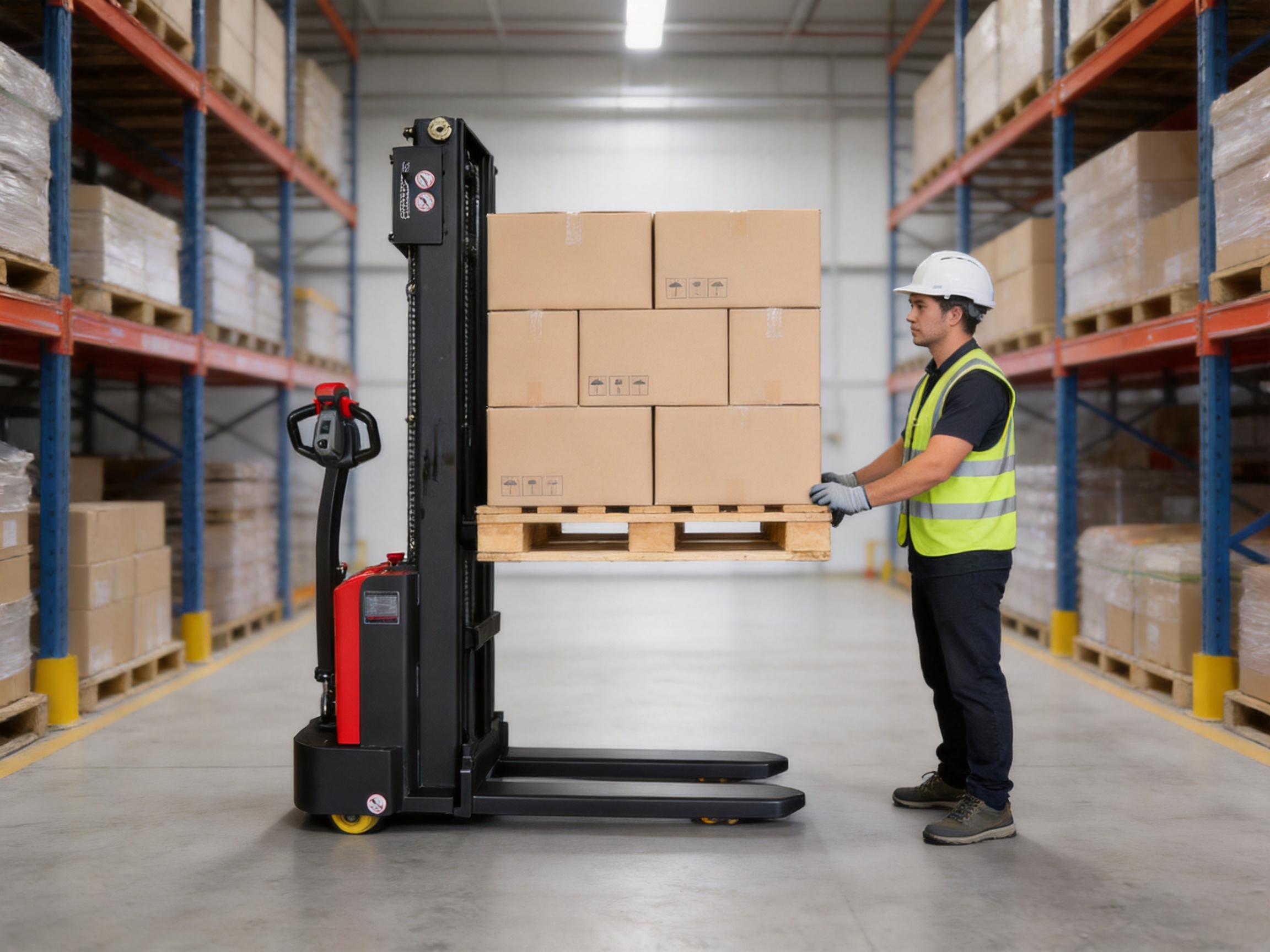
Reliable equipment is not defined only by how it performs when new. It must remain serviceable throughout its working life. The EST152Z is designed with features that can support practical maintenance, including a maintenance-free battery, robust structural components, accessible electrical architecture, and protection for cables, connectors, and braking systems.
Daily inspections should include the forks, mast, chains or lifting components, wheels, steering system, braking function, battery condition, charger connection, warning labels, and visible structural parts. Any hydraulic, electrical, or mechanical abnormality should be reported before the machine is returned to service.
Periodic maintenance should be carried out by trained personnel. It may include checking fasteners, inspecting welds, examining mast alignment, testing brake response, verifying steering operation, checking cable routing, and reviewing battery and charger performance. Service intervals should be determined by the operating environment and the manufacturer’s recommendations.
Polyurethane wheels should be inspected for wear and damage. The drive wheel should be checked for traction-related problems, while carrier wheels should be examined for smooth rotation and correct alignment. Uneven wear may indicate a floor problem, load imbalance, axle issue, or steering-related concern.
The mast deserves particular attention because it carries repeated lifting loads. Operators should look for unusual noise, jerky movement, visible deformation, damaged fasteners, or signs of abnormal wear. Early detection can prevent a small issue from becoming a costly failure.
Electrical maintenance should focus on connectors, cables, battery terminals, charger interfaces, control components, and warning indicators. Waterproof connectors and anti-torsion cables help improve reliability, but they should not be pulled, bent beyond their design limits, contaminated, or repaired using unsuitable parts.
Preventive maintenance has a direct effect on total operating cost. It can extend component life, reduce unplanned downtime, improve safety, and preserve the resale or replacement value of the machine. A planned maintenance program is especially important in multi-shift warehouses where equipment utilization is high.
Purchase price is only one part of the financial decision when selecting warehouse equipment. Total cost of ownership includes energy, maintenance, parts, labor, downtime, training, facility adaptation, and equipment replacement.
The electric drive can help reduce fuel-related expenses and engine maintenance. Indoor electric operation may also reduce ventilation requirements compared with combustion equipment. The compact format can lower the need for aisle modifications and make it possible to use existing warehouse areas more efficiently.
A maintenance-free battery can reduce routine service labor, while matched charging equipment can help avoid performance problems caused by unsuitable charging practices. Durable structural components and protected electrical connections may reduce the frequency of repairs when the equipment is operated correctly.
Productivity also contributes to ownership value. Smooth maneuvering, easy operation, and reliable lifting can reduce the time required for each pallet movement. Even small time savings become significant when multiplied across hundreds of daily handling cycles.
Businesses should evaluate the stacker according to their real work pattern. A machine that is perfectly matched to short-distance indoor handling may deliver better value than a larger and more expensive forklift with capabilities that are rarely used. Conversely, operations involving outdoor travel, extreme floor conditions, or high lift heights may require a different equipment category.
Shanghai HanDavos International Trading Co., Ltd. has more than 20 years of experience in the material-handling equipment industry. Its business scope includes new and used forklift sales, forklift spare parts, attachments, exports, and professional forklift leasing services. This broad experience can be valuable for customers that need more than a single equipment purchase.
The company operates more than 20,000 square meters of standardized warehouses in Kunshan, China. A substantial warehouse infrastructure can support equipment inventory, spare-parts availability, order preparation, and delivery coordination. For international customers, access to organized inventory can help simplify procurement and reduce unnecessary delays.
The company’s product portfolio includes equipment from brands such as BYD, Toyota, HELI, HANGCHA, JAC, and LINDE. This multi-brand capability allows customers to compare different fuel types, capacities, configurations, and budget levels. It also supports the development of fleet solutions rather than limiting buyers to one product category.
Professional support can include product selection, technical consultation, equipment operation guidance, spare-parts supply, maintenance, and after-sales service. These services are important because warehouse equipment performance depends on correct selection, correct operation, and timely maintenance.
For overseas customers, a supplier with export experience can assist with communication, specifications, documentation, packaging, shipping coordination, and parts support. The company’s location in Jiangsu Province provides access to established industrial and logistics networks in eastern China.
Before ordering an electric stacker, the purchaser should identify the heaviest regular load and confirm whether the load center matches the rated specification. Pallet dimensions, load overhang, packaging stability, and center of gravity should also be reviewed.
Lift height is another essential factor. The required mast configuration should be selected according to rack height, ceiling clearance, doorway dimensions, and any overhead obstructions. A stacker that is suitable for one facility may require a different mast arrangement in another.
Aisle width should be measured using the actual pallets and handling method rather than relying only on a general warehouse plan. The turning area must provide enough space for the machine, the load, and the operator. Shared pedestrian zones should be assessed carefully, especially near corners and loading areas.
Floor conditions affect wheel life, stability, and operator comfort. Smooth, level, clean indoor floors are generally ideal for polyurethane-wheeled electric stackers. If the equipment must travel over ramps, expansion joints, rough concrete, wet areas, or outdoor surfaces, the application should be discussed with a qualified supplier.
Duty cycle determines battery requirements. Buyers should estimate operating hours per shift, lifting frequency, travel distance, average load, and charging opportunities. A machine used occasionally may need a different battery strategy from one used continuously across multiple shifts.
Finally, the company should consider operator training, maintenance resources, spare-parts support, warranty terms, and delivery requirements. A complete evaluation produces better results than focusing only on capacity or price.
Operators should complete a pre-shift inspection before using the stacker. The inspection should confirm that the forks, mast, wheels, steering, brakes, controls, battery, charger, and warning systems are in acceptable condition. Defects should be reported immediately.
Loads must be centered on the forks and positioned according to the manufacturer’s instructions. Operators should not exceed the rated capacity or attempt to handle unstable, poorly wrapped, damaged, or improperly arranged loads.
Travel speed should be appropriate for the environment. Slow operation is especially important near intersections, blind corners, doorways, ramps, people, and areas with limited visibility. The operator should maintain a clear view of the travel path and use a spotter or alternative procedure when necessary.
The stacker should be operated on suitable surfaces and should not be used on slopes or in conditions beyond its design limits. Loads should be kept low during travel when appropriate, and the mast should be positioned according to the operating instructions.
Pedestrians should be separated from equipment routes wherever possible. Floor markings, barriers, mirrors, warning signs, and traffic procedures can reduce the risk of contact between people and moving equipment.
At the end of a shift, the machine should be parked in a designated location, the forks lowered, the controls secured, and the battery connected to the approved charging system if charging is required. Good parking and charging habits help protect both the equipment and the facility.
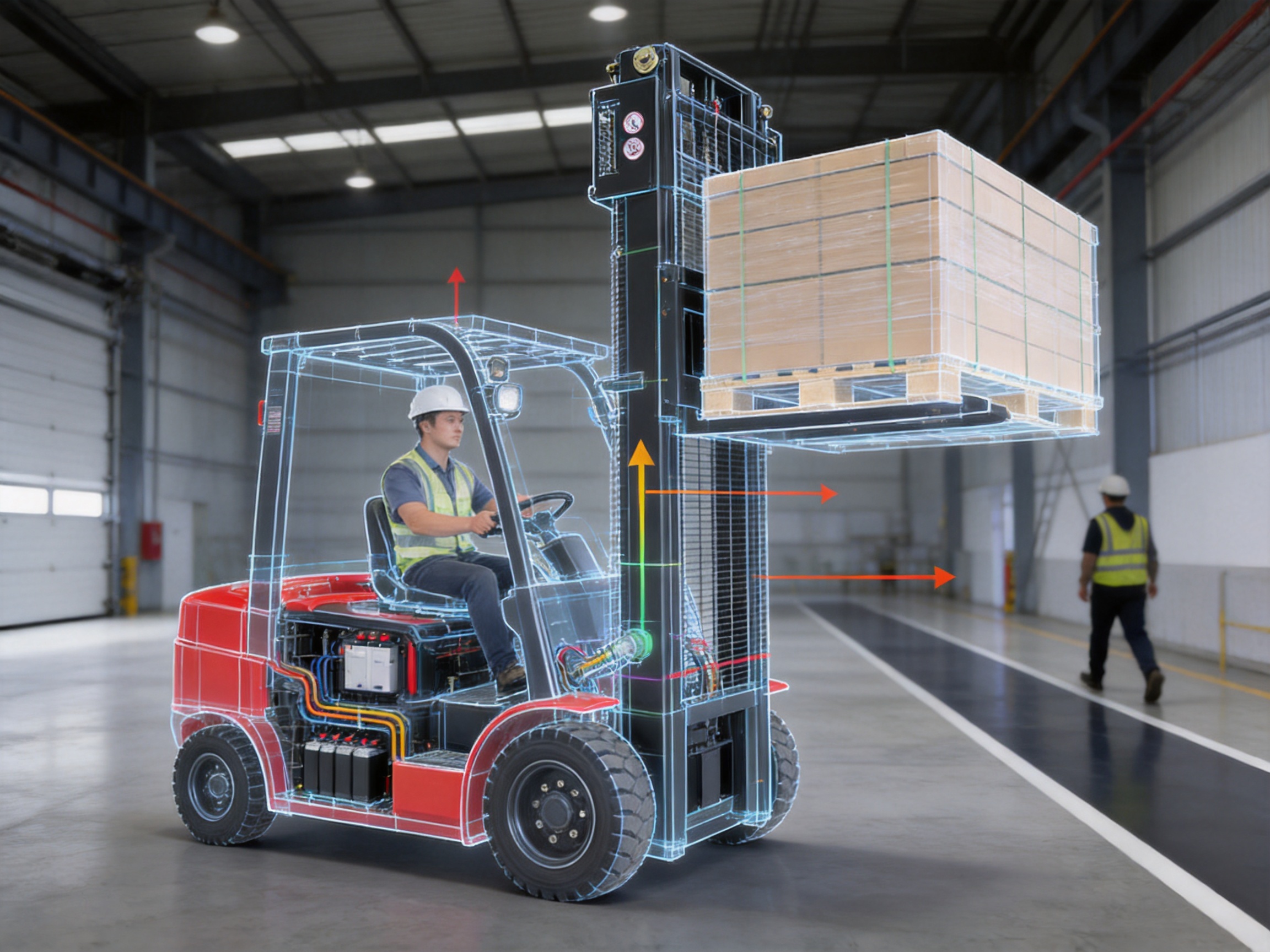
Electric warehouse equipment can support workplace sustainability goals by reducing direct emissions during operation. This is especially relevant to enclosed facilities where air circulation and worker comfort are important. Lower noise levels can also contribute to a more pleasant working environment.
The stacker’s compact design may help businesses improve storage density without expanding the building. Better use of existing floor space can reduce the need for additional construction and can make warehouse processes more efficient.
Energy performance depends on battery condition, load weight, travel distance, operator behavior, tire condition, floor quality, and charging practices. Efficient operation is therefore a combination of equipment design and disciplined management.
Companies seeking to reduce their environmental impact should also establish appropriate procedures for battery handling, end-of-life recycling, damaged components, and packaging materials. Environmental responsibility extends beyond the machine’s operating emissions.
The EST152Z competes effectively by combining the features most important to indoor material handling. It offers a 1,500-kilogram load capacity in a pedestrian-operated format, making it more capable than basic manual equipment while remaining more compact than many larger forklifts.
Its electric drive avoids the emissions and fuel requirements associated with internal-combustion trucks. The DC drive unit provides a practical configuration for warehouse travel. Polyurethane wheels support indoor maneuverability and can help protect finished floors. Mechanical steering gives the operator direct control and a familiar operating method.
Structural advantages are equally important. The high-strength chassis is designed to reduce deformation under heavy loads, while the reinforced box-structure mast is based on finite element stability testing. These features provide a stronger technical foundation than designs that focus only on low initial cost.
The machine also incorporates details intended to protect long-term performance. Anti-torsion robot cables help manage repeated cable movement. Imported waterproof connectors support electrical connection reliability. Independently designed brake protection provides an additional safety-focused feature. The maintenance-free battery and matched charging system simplify routine ownership.
Quality is supported by controlled manufacturing and component selection. Major components sourced from high-volume manufacturers can contribute to consistency and supply stability, while strict inspection and assembly procedures help ensure that the final machine meets its intended design requirements.
When supported by proper operator training and preventive maintenance, these advantages make the electric stacker a strong choice for companies seeking a dependable indoor pallet-handling machine with manageable ownership costs.
For a single-machine buyer, the main question is whether the stacker matches the facility’s capacity, aisle, lift-height, and duty-cycle requirements. For a larger fleet, the evaluation should also include standardization, spare-parts planning, operator training, charging infrastructure, and maintenance scheduling.
Standardizing equipment across similar warehouse zones can reduce training complexity and make parts management easier. However, different departments may require different capacities or mast configurations. A fleet review should identify which tasks are common and which are specialized.
Used forklifts and attachments may be appropriate for selected applications, but new equipment can provide greater certainty regarding structural condition, battery history, maintenance records, and component wear. Businesses should compare the expected service life and productivity of each option rather than assuming that the lowest purchase price represents the lowest cost.
Leasing can be considered when a company wants to preserve capital, manage seasonal demand, or test a new handling solution before committing to ownership. The suitability of leasing depends on usage hours, contract terms, maintenance coverage, replacement arrangements, and expected operational growth.
A professional material-handling supplier can help evaluate these choices. The supplier should be able to discuss technical specifications, application conditions, replacement parts, service arrangements, shipping requirements, and operator guidance.
The rated load capacity is 1,500 kilograms at a 500-millimeter load center distance. Actual safe capacity can depend on the load configuration, mast arrangement, lifting height, and operating conditions, so the equipment rating information must always be followed.
Yes. Its electric drive, compact pedestrian-operated design, and polyurethane wheels make it particularly suitable for indoor warehouses, distribution centers, production areas, and retail storage facilities. Application conditions should still be reviewed if the machine will be used outdoors or on rough, wet, or uneven surfaces.
A pedestrian stacker is guided by an operator who walks behind or beside the machine. It is generally more compact and maneuverable in narrow areas. A sit-down forklift usually offers a different combination of travel speed, lift height, outdoor capability, and operator comfort for longer or heavier-duty cycles.
The drive and carrier wheels use polyurethane. This material is commonly selected for indoor material-handling applications because of its wear resistance, smooth rolling characteristics, and suitability for finished warehouse floors.
The EST152Z uses mechanical steering. This provides direct control for the pedestrian operator and supports straightforward operation in narrow aisles and wider warehouse areas.
The drive unit is DC and is used with the electric drive system to provide powered movement for warehouse handling operations.
Yes. The product information identifies a long-life maintenance-free battery matched with a suitable charging system. The battery and electrical connections should still be inspected and charged according to the recommended procedures.
The high-strength chassis integrates plates, beams, and box sections to reduce deformation under heavy loads. The mast includes a specially designed crossbeam and reinforced box structure developed with support from finite element stability testing.
The product information states that the machine passed the national safety stability test standards GB/T 26949.1-2012. Operators must still follow the rated capacity, load-center requirements, and safe operating instructions.
Its compact dimensions and pedestrian operating configuration make it suitable for many narrow-aisle warehouse applications. The facility should be measured using the actual pallet dimensions, rack layout, turning requirements, and load-handling process before purchase.
The product information refers to anti-torsion robot cables, imported waterproof connectors, and independently designed brake protection. These features are intended to support cable durability, electrical connection reliability, and safe braking performance.
Yes. Typical applications include pallet movement, stacking, rack replenishment, production-line supply, order preparation, receiving, dispatch staging, and internal transport. The machine should only be used for tasks within its rated capacity and design conditions.
Operators should inspect the forks, mast, wheels, steering, brakes, controls, battery, charging connection, warning labels, and visible frame components. Any unusual noise, damage, leakage, electrical warning, or steering or braking problem should be reported before operation.
Shanghai HanDavos International Trading Co., Ltd. provides product selection, technical consultation, operation guidance, spare parts, maintenance, after-sales support, new and used forklift sales, attachments, exports, and forklift leasing services.
The Warehouse Forklift 1.5 Ton Electric Stacker is designed for businesses that need dependable pallet handling in compact indoor environments. Its 1,500-kilogram load capacity, 500-millimeter load center, electric drive, pedestrian operation, mechanical steering, and polyurethane wheels provide a practical foundation for everyday warehouse work.
Its strongest advantages come from the combination of compact usability and engineered durability. The high-strength chassis is intended to reduce heavy-load deformation, while the reinforced mast structure supports rigidity and stability. Stability testing, protected electrical connections, anti-torsion cables, brake protection, and a matched maintenance-free battery system add further value.
Compared with manual equipment, the stacker delivers powered lifting and reduced operator effort. Compared with larger counterbalance forklifts, it offers a more compact and emission-free solution for indoor applications. Compared with basic low-cost stackers, its structural design, component protection, and manufacturing controls support a stronger long-term value proposition.
The best results will come from matching the machine to the correct load, aisle, floor, lift-height, and duty-cycle requirements. With suitable training, preventive maintenance, responsible battery management, and professional supplier support, the EST152Z can contribute to safer handling, better warehouse space utilization, and more consistent daily productivity.
1. Product specification and technical information for the EST152Z Warehouse Forklift 1.5 Ton Electric Stacker.
2. GB/T 26949.1-2012, national safety stability testing requirements for industrial trucks.
3. General principles of industrial truck load-center and rated-capacity assessment.
4. Standard warehouse forklift operator training and pre-use inspection practices.
5. General engineering applications of finite element analysis in chassis and mast design.
6. General maintenance principles for electric warehouse handling equipment, batteries, wheels, braking systems, and lifting structures.
Recommended Products
Recommended NEWS



 English
 中文简体
 русский
 Español
 عربى