2026-09-22
Content
Heavy loads, uneven surfaces, long transport routes, and changing weather conditions can make ordinary warehouse pallet trucks unsuitable for outdoor logistics. A dedicated off-road electric pallet truck provides a practical solution for businesses that need to move palletized materials across construction sites, manufacturing yards, agricultural facilities, loading areas, distribution centers, and industrial compounds.
The 3 Ton Off-Road All-Electric Pallet Truck is engineered for this demanding operating environment. It combines a rated load capacity of 3,000 kilograms with large anti-slip drive wheels, a powerful electric drive system, electromagnetic braking, reinforced forks, shock-absorbing load rollers, and a corrosion-resistant steel structure. The result is a compact but highly capable handling machine that can transport heavy goods without relying on internal combustion power.
Unlike a standard indoor pallet truck, this model is designed around ground clearance, traction, structural strength, and operator control. Its 350-millimeter drive wheel helps the truck travel over rougher ground, while the polyurethane load rollers reduce vibration beneath the pallet. The 48-volt electrical system provides sufficient power for heavy-duty transportation, and the walking operation format allows operators to maintain a clear view of the load and surrounding area.
For companies looking to improve material movement while reducing fuel use, routine engine maintenance, exhaust emissions, and noise, this electric pallet truck offers a balanced alternative. It is especially suitable for operations that need a high load rating but do not require the lifting height or turning radius of a conventional counterbalance forklift.
Heavy-duty electric handling equipment
3 Ton Off-Road All-Electric Pallet Truck
This walk-behind electric pallet truck is built to transport loads weighing up to 3,000 kilograms. Its compact dimensions, strong traction system, and reinforced pallet forks support reliable movement in outdoor and semi-outdoor environments.
| Product category | Electric pallet truck |
| Rated load capacity | 3,000 kilograms |
| Operating type | Walking operator |
| Drive system | Electric, DC brushless control |
| Drive motor | 1.2 kilowatts |
| Lifting motor | 0.8 kilowatts |
| Battery configuration | 48 volts / 32 ampere-hours |
| Battery type in listed configuration | Maintenance-free lead-acid |
| Maximum lift height | 200 millimeters |
| Drive wheel | 350 x 100 millimeters |
| Load rollers | Four rollers, 80 x 70 millimeters |
| Travel speed, loaded / unloaded | 4 / 5 kilometers per hour |
| Gradeability, loaded / unloaded | 6% / 10% |
| Braking system | Electromagnetic braking |
The listed technical data describes a machine focused on horizontal transportation and low-level pallet lifting. The 200-millimeter lift height is suitable for raising a pallet clear of the floor and moving it safely over short distances. It is not intended to replace a reach truck, stacker, or high-lift forklift when goods must be placed on elevated warehouse racking.
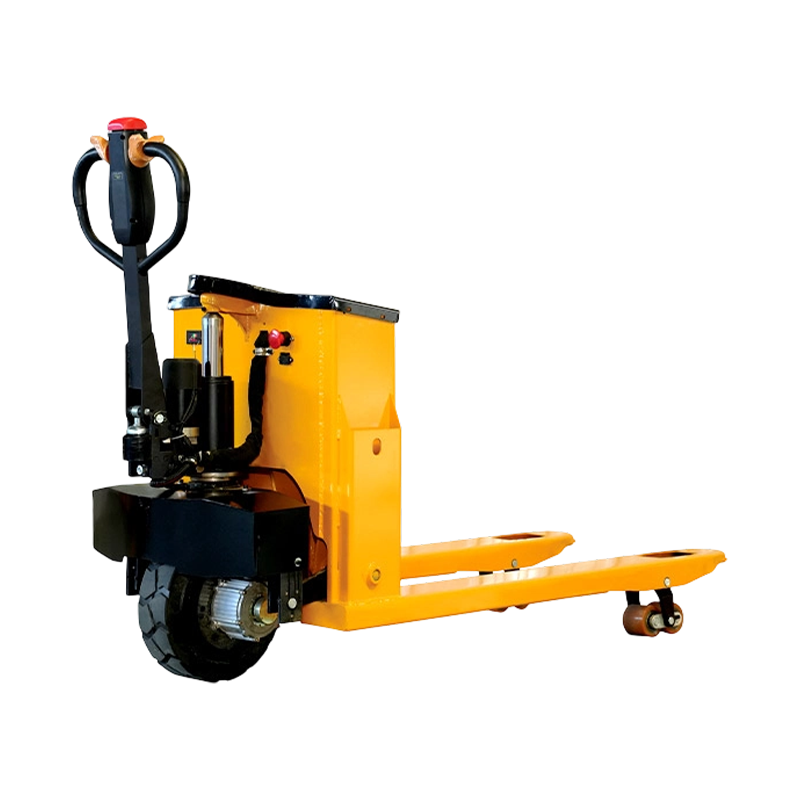
3 Ton Off road all electric Pallet Truck
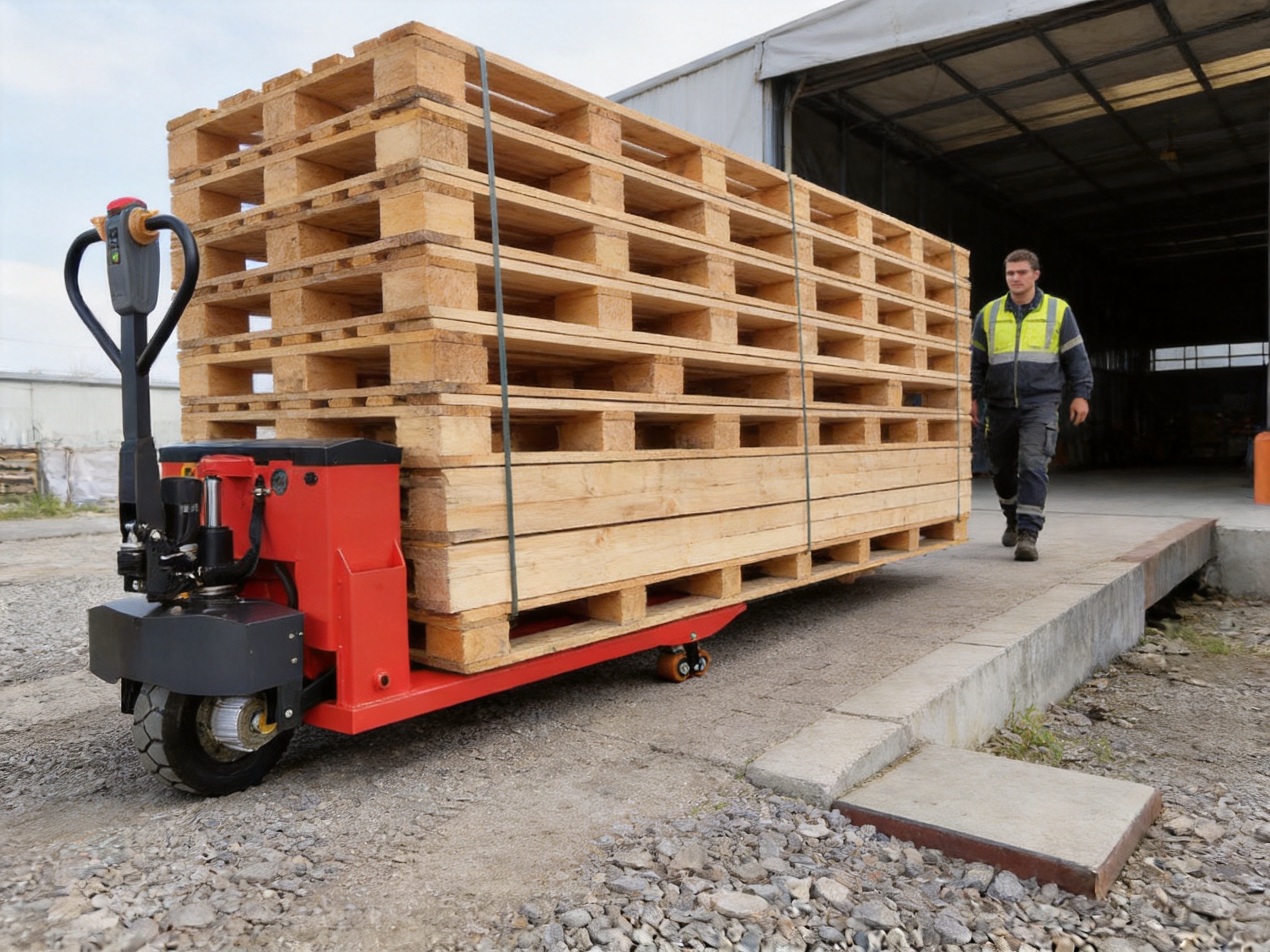
Many material handling operations are not confined to smooth concrete floors. Pallets may need to travel between a production building and a loading zone, across a stone yard, over a construction surface, or through an agricultural storage area. Small cracks, loose gravel, damp ground, expansion joints, and uneven thresholds can reduce the performance of equipment designed only for indoor use.
The key to off-road pallet handling is not simply increasing motor power. A suitable machine must combine traction, wheel size, frame stability, braking control, and load support. If one of these elements is weak, the operator may experience wheel spin, excessive vibration, unstable loads, or difficulty stopping on a slope.
This 3-ton model addresses these conditions through a large 350-millimeter drive wheel with an anti-slip injected rubber tire. The larger wheel diameter helps the truck pass over surface irregularities more smoothly than small indoor wheels. The integrated rubber construction also provides useful grip and wear resistance when the machine operates on demanding outdoor ground.
The 350-millimeter drive wheel improves contact with uneven ground and helps the truck pass over thresholds and surface changes with less impact.
Four polyurethane load rollers distribute the pallet load and reduce vibration during transportation across rougher surfaces.
The electric drive system provides smooth low-speed travel, which is useful when positioning heavy pallets near vehicles, ramps, and workstations.
An electrophoretic anti-rust coating helps protect the frame from moisture, dust, mud, and industrial contaminants.
Although the pallet truck is designed for off-road use, operators should still assess the working surface before deployment. Deep mud, standing water, loose slopes, severe potholes, and surfaces exceeding the rated gradeability can affect safety and performance. Proper load distribution and compliance with the rated capacity remain essential.
A 3,000-kilogram rated capacity gives this electric pallet truck a useful position between ordinary warehouse pallet trucks and larger forklift vehicles. Many standard electric pallet trucks are optimized for lighter loads and indoor movement. A counterbalance forklift can handle substantial weights, but it generally requires more operating space, greater maintenance planning, and a trained seated operator.
The walk-behind format keeps the overall vehicle compact. With a listed vehicle length of 1,650 millimeters and a height of 1,270 millimeters, the machine can be used in areas where a larger forklift may be inconvenient. Its listed width options of 550 and 685 millimeters allow users to select a configuration suitable for different pallet formats and access routes.
Compact size does not mean light-duty construction. The pallet forks use thickened steel and integrated bending molding. Removing welding seams from key load-bearing areas helps create a more continuous fork structure. This design approach can reduce stress concentration in critical areas and improve resistance to bending and cracking when the equipment is regularly used near its rated capacity.
The 1,200-millimeter fork length is suitable for common pallet handling applications. Before purchase, users should confirm pallet entry dimensions, pallet material, load center, and the required fork spacing. The rated capacity applies under specified operating conditions and should not be interpreted as unlimited capacity at every load center or on every surface.
Move raw materials, metal components, fabricated parts, packaging supplies, and finished goods between production lines, storage zones, and dispatch areas.
Transport bagged materials, tiles, tools, fixtures, and palletized building products across suitable jobsite surfaces without producing exhaust fumes indoors or under covered areas.
Handle palletized products between covered storage, loading docks, container areas, and vehicle staging zones.
Move feed, fertilizer, containers, packaged produce, and supplies around storage compounds where the ground may not be perfectly smooth.
Support short-distance loading and unloading tasks when a compact machine is preferred for frequent pallet transfers.
Provide customers with a durable, easy-to-understand electric handling solution for temporary projects and changing site requirements.
The equipment is particularly valuable when a business performs repeated horizontal transfers rather than high-level storage. A pallet can be lifted just enough to clear the ground, transported under controlled electric power, and lowered into position with minimal handling steps.
The drive system uses a 1.2-kilowatt motor designed to provide useful torque for heavy cargo movement. Torque is important when the truck starts from a stationary position, approaches a ramp, or travels over a less consistent surface. A motor that is appropriately matched to the vehicle and load can reduce hesitation and improve controllability during normal operating cycles.
The 0.8-kilowatt lifting motor raises the forks to the listed 200-millimeter height. Because this is a low-lift pallet truck, the lifting function is intended for pallet clearance and transport rather than stacking. The division between the drive motor and lift motor supports straightforward operation: the drive system moves the truck, while the lift system positions the forks.
Travel speed is listed at 4 kilometers per hour with a full load and 5 kilometers per hour without a load. These speeds are appropriate for controlled warehouse and yard movement. Lower loaded speed can help the operator maintain stability and stopping distance when the machine is carrying a heavy pallet.
The listed gradeability is 6% with a full load and 10% without a load. Gradeability depends on the actual surface, tire condition, load center, battery state, and environmental conditions. Operators should approach slopes directly, keep the load stable, avoid sudden changes in direction, and use the braking system correctly.
The electromagnetic brake is designed to hold the drive wheel promptly when the travel control is released or braking is activated. This is especially useful when handling heavy pallets on inclined sections of a worksite. A controlled braking response can help prevent unwanted rolling and give the operator greater confidence during positioning.
Safety depends on more than the brake alone. The operator should inspect the load, confirm that the forks are fully inserted, keep pedestrians outside the travel path, and avoid carrying unstable or poorly secured goods. The truck should not be used beyond the approved load rating or in conditions that exceed its operating specifications.
The intelligent operating handle supports switching between fast and slow travel modes. Slow mode can be useful in narrow aisles, near loading docks, around machinery, or when the pallet is close to a rack or vehicle. Fast mode can improve productivity during longer straight-line travel where there is sufficient clearance.
An emergency reverse function helps the operator respond if the machine approaches an obstacle or if the operator becomes positioned too close to the handle. This feature should be treated as a protective control rather than a replacement for route planning and safe operating procedures.
| Operating situation | Recommended control approach |
| Heavy pallet on level ground | Use controlled loaded travel speed and maintain a clear route. |
| Narrow passage | Select slow travel mode and keep the forks at a safe low height. |
| Approaching a ramp | Check grade, surface condition, load stability, and available stopping distance. |
| Loading or unloading a vehicle | Confirm dock strength, vehicle stability, and alignment before entry. |
| Uneven outdoor ground | Reduce speed and inspect for potholes, loose materials, and standing water. |
| Emergency condition | Use the emergency reverse or braking control while keeping people clear. |
The listed configuration uses a 48-volt, 32-ampere-hour maintenance-free lead-acid battery with a stated battery weight of 36.4 kilograms. This battery arrangement provides a practical power source for short-distance and medium-duty operating cycles. Maintenance-free construction reduces the need for routine electrolyte servicing compared with conventional serviceable lead-acid batteries.
Battery performance depends on ambient temperature, load frequency, travel distance, terrain, operator behavior, and charging practice. A truck that repeatedly climbs slopes or moves close to its rated load will use more energy than one operating on level ground with lighter pallets. Businesses should evaluate the number of daily shifts and the required duty cycle before selecting a battery configuration.
The battery compartment dimensions are listed as 320 by 278 by 208 millimeters. These dimensions are important when planning battery replacement, charging equipment, or possible configuration changes. If a customer requires a lithium battery option, the exact voltage, capacity, charging method, battery dimensions, and controller compatibility should be confirmed before ordering. The standard specification supplied for this product identifies a maintenance-free lead-acid battery.
Good charging discipline extends battery service life. Operators should use the correct charger, keep the charging area dry and ventilated, avoid damaging the battery casing, and follow the battery manufacturer’s charging instructions. The battery should be secured correctly before the truck returns to service.
For operations with multiple shifts, fleet managers can compare the cost of opportunity charging, scheduled charging, spare batteries, or a higher-capacity configuration. The correct approach depends on available downtime, operating intensity, site layout, and local electrical infrastructure.
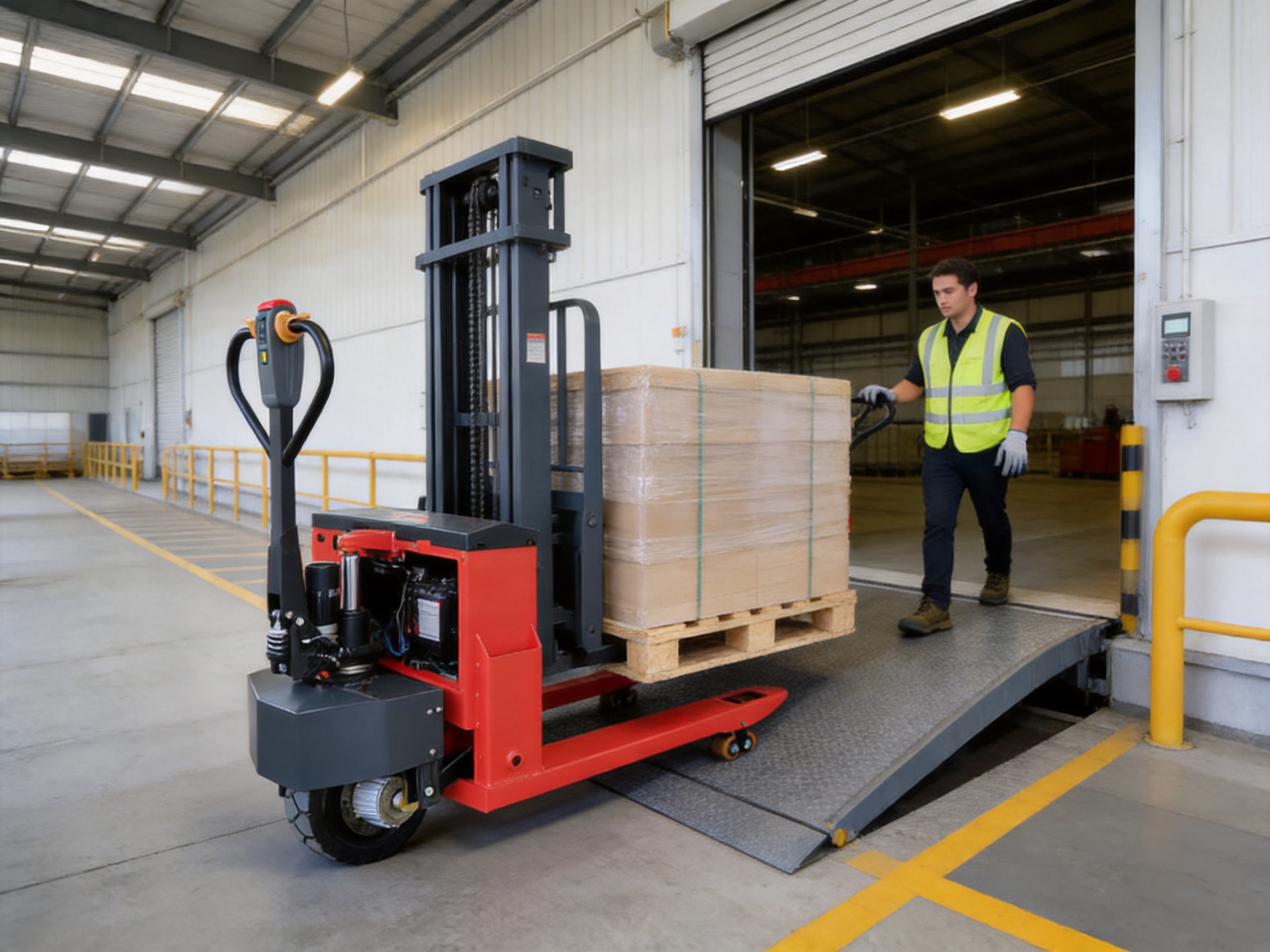
The durability of a heavy-duty pallet truck is determined by the relationship between its frame, forks, wheels, motor mounts, battery compartment, and control components. The 3-ton model uses an all-metal frame with an electrophoretic anti-rust coating. This type of coating is applied to create a more uniform protective layer over the metal surface, including areas that may be difficult to cover consistently with conventional painting alone.
Corrosion resistance is important for outdoor handling equipment because moisture, mud, dust, fertilizer residue, industrial oil, and temperature changes can accelerate surface deterioration. A protective coating does not eliminate the need for cleaning, but it can improve the frame’s resistance to everyday environmental exposure.
The fork structure is produced with reinforced, thickened steel and integrated bending molding. A continuous formed fork can provide a clean load-bearing profile and reduce dependence on welded joints in areas subject to repeated stress. This approach is especially relevant for a truck rated to move heavy pallets across uneven ground, where shock loads may be higher than on a smooth indoor floor.
The frame design is also supported by CAE structural simulation. Computer-aided engineering allows designers to evaluate stress distribution, deformation tendencies, and load paths before physical production. By examining the interaction between the forks, load rollers, drive wheel, frame, and pull rods, engineers can make informed decisions about reinforcement and material placement.
Simulation is not a substitute for physical testing. A responsible manufacturing process combines design analysis with prototype evaluation, load testing, braking checks, travel testing, dimensional inspection, and component verification. This combination helps identify possible issues before equipment reaches the customer.
01
Load capacity, pallet dimensions, operating environment, travel routes, battery preferences, and wheel requirements are reviewed before the configuration is finalized.
02
Frame geometry, fork dimensions, wheel position, handle layout, and load paths are assessed with engineering tools and production experience.
03
Steel parts, wheels, motors, controllers, braking components, batteries, and fasteners are checked against the selected specification.
04
Forming, machining, welding where required, surface preparation, and coating are completed according to the equipment design.
05
The drive unit, lift mechanism, battery, handle, wheels, electrical controls, and safety systems are assembled and adjusted.
06
Travel, lifting, braking, steering response, noise, dimensions, and general appearance are checked before packing and shipment.
This process supports consistent production while allowing the manufacturer to prepare equipment for different customer environments. An international supplier with established warehouses, spare parts resources, technical consultation, and after-sales support can also help customers reduce the uncertainty associated with equipment selection and long-term operation.
The most suitable handling machine depends on the application, but the 3-ton electric pallet truck offers several advantages over common alternatives.
Electric travel and lifting reduce physical effort, especially when moving heavy loads over longer distances or across slight inclines. The powered system can improve productivity and reduce operator fatigue during repeated cycles.
The larger drive wheel, reinforced frame, higher capacity, and stronger traction system make this model more suitable for demanding surfaces and heavier palletized goods.
The electric system produces no direct exhaust emissions at the point of use, operates with lower noise, and can be more convenient in covered or semi-enclosed work areas.
The walk-behind design is more compact and can be easier to position in restricted spaces. It is well suited to horizontal movement where elevated stacking is not required.
The low-lift pallet truck focuses on stable transportation and ground-level loading rather than mast lifting. This can provide a simpler solution for dedicated transfer routes.
Electric operation can also support a cleaner workplace. Reduced noise may improve communication near loading and production areas, while the absence of tailpipe exhaust can be beneficial in covered spaces. However, every site should still provide proper ventilation, traffic management, operator training, and battery charging controls.
Heavy-duty equipment must be productive without being unnecessarily difficult to operate. The ergonomic control handle places primary movement functions within the operator’s reach. Fast and slow travel selection allows the operator to adapt the machine to changing conditions rather than using one speed for every task.
Walking operation gives the operator a direct relationship with the pallet and the travel route. This can be helpful when maneuvering near racks, trucks, doors, machinery, or other workers. The operator can walk beside or behind the truck while maintaining a practical view of the load.
Good ergonomics also depend on handle positioning, control force, vibration, noise, and response smoothness. The optimized wheel and motor assembly is designed to reduce running friction and operating noise. Lower mechanical noise can make extended shifts more comfortable and may help workers communicate more easily in busy handling areas.
Operators should receive instruction on start-up checks, pallet entry, load balance, travel direction, slope management, emergency controls, braking, battery charging, and parking. Training should also cover local site rules, pedestrian separation, speed limits, and the correct response to unusual sounds, reduced power, or control irregularities.
| Inspection area | Check before operation |
| Forks | Look for bending, cracks, deformation, sharp damage, or contamination that could affect pallet entry. |
| Drive wheel | Inspect the rubber surface, embedded debris, visible damage, and traction condition. |
| Load rollers | Confirm that all four rollers rotate correctly and are free from excessive wear or obstruction. |
| Battery | Check secure mounting, casing condition, connector condition, and available charge. |
| Handle and controls | Test travel selection, lifting, lowering, emergency reverse, horn if fitted, and braking response. |
| Frame | Check for loose fasteners, impact damage, corrosion, or fluid contamination. |
| Work area | Confirm that the route is clear, the floor or ground is suitable, and the load is stable. |
A short inspection can identify issues before they become costly failures. If a safety control, fork, wheel, brake, or electrical component does not operate correctly, the truck should be removed from service until it has been evaluated by an authorized technician.
Preventive maintenance helps preserve performance and protects the investment in material handling equipment. The maintenance schedule should be adapted to operating hours, ground conditions, load intensity, weather exposure, and the manufacturer’s service recommendations.
Daily tasks may include cleaning the frame, removing debris from the wheels, checking the forks, inspecting the battery connection, and testing the handle controls. Periodic tasks may include checking fasteners, examining wheel bearings, inspecting brake performance, checking electrical connectors, and reviewing the condition of the coating and frame.
Outdoor use can introduce sand, mud, moisture, and small stones into moving areas. These contaminants should be removed before they cause excessive wear. Cleaning should be performed using methods that do not force water into electrical components, bearings, connectors, or the control handle.
Wheel wear deserves special attention because the drive wheel and load rollers directly influence traction, vibration, noise, and braking behavior. A damaged or excessively worn wheel can increase the risk of slipping, reduce travel comfort, and affect load stability. Replacing wear parts with compatible components helps maintain the intended performance of the truck.
Fleet managers should keep maintenance records that include operating hours, battery service, wheel replacement, brake inspection, electrical faults, and repairs. These records can reveal usage patterns and help determine whether a different configuration is needed for a particular site.
Before ordering a 3-ton electric pallet truck, users should evaluate more than the rated capacity. The actual operating environment determines whether the truck will deliver the expected productivity.
Confirm the maximum weight, average weight, load center, pallet construction, and whether the goods are evenly distributed.
Describe concrete, asphalt, compacted soil, gravel, ramps, thresholds, drainage, and any areas with mud or standing water.
Estimate one-way distance, daily cycles, average travel time, and the number of operating shifts.
Measure doorways, aisles, truck beds, loading docks, turning areas, and the required fork width.
Identify charging locations, available electrical supply, charging intervals, and whether additional battery capacity is required.
Confirm spare parts availability, technician access, warranty terms, training, and response procedures before placing an order.
Clear technical communication helps the supplier recommend an appropriate configuration. Photos of the operating surface, pallet type, loading route, and typical cargo can be useful during the selection process. Customers should also confirm whether they need the listed maintenance-free lead-acid battery or a different approved battery system.
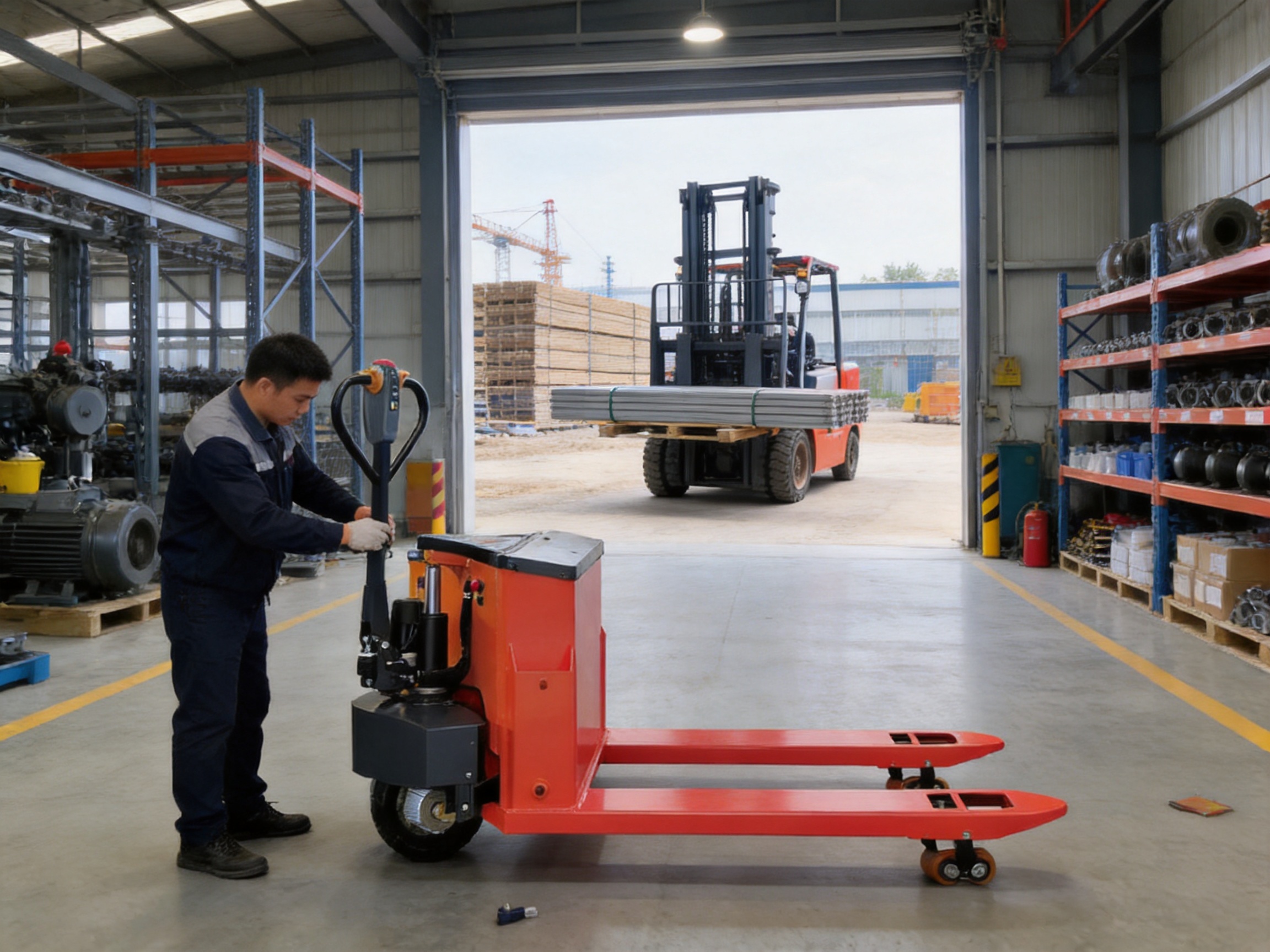
Shanghai HanDavos International Trading Co., Ltd. has more than 20 years of experience in the material handling equipment industry. Its business covers new and used forklifts, electric pallet trucks, spare parts, attachments, exports, leasing services, equipment selection, technical consultation, operation guidance, maintenance, and after-sales support.
The company operates more than 20,000 square meters of standardized warehouse facilities in Kunshan, China. Warehouse capacity supports product preparation, spare parts availability, inspection, and faster response for customers who need equipment or components for ongoing operations.
Its broader product portfolio includes equipment associated with established manufacturers such as BYD, Toyota, HELI, HANGCHA, JAC, and LINDE. This range allows customers to compare different capacities, fuel systems, lifting arrangements, and application requirements through one experienced supplier.
For the 3-ton off-road electric pallet truck, support may include application review, specification confirmation, export documentation, shipping coordination, operating guidance, replacement component recommendations, and service communication. Customers can contact the company through forklift-05@aliyun.com or +86 150 6265 1609 for product consultation.
The company’s offices and warehouse operations are located in Jiangsu Province, China, with facilities in Kunshan City. Its location provides access to manufacturing resources, logistics networks, technical personnel, and a broad material handling supply chain.
The rated load capacity is 3,000 kilograms, or 3 tons. The actual safe capacity depends on the load center, pallet condition, ground condition, fork insertion, slope, and other operating factors. Loads should be stable and distributed according to the operating instructions.
Yes. It is designed with a large anti-slip drive wheel, polyurethane load rollers, reinforced forks, an electromagnetic brake, and a corrosion-resistant metal frame for outdoor and semi-outdoor handling. Operators should avoid deep mud, severe potholes, flooding, and surfaces beyond the rated gradeability.
No. This is a low-lift electric pallet truck with a listed lift height of 200 millimeters. It is intended to raise pallets clear of the ground and transport them horizontally. A stacker or forklift should be selected when goods must be placed on elevated racks.
The listed configuration uses a 48-volt, 32-ampere-hour maintenance-free lead-acid battery. If a customer requires a lithium configuration, the battery, charger, dimensions, controller, and operating requirements should be confirmed as an approved configuration before ordering.
The listed travel speed is 4 kilometers per hour with a full load and 5 kilometers per hour without a load. The operator should select an appropriate speed for the ground, visibility, load stability, pedestrian traffic, and available stopping distance.
The listed gradeability is 6% with a full load and 10% without a load. Actual performance depends on surface traction, battery charge, load placement, tire condition, and slope length. Site operators should follow safe slope procedures and avoid unapproved inclines.
The 350-millimeter drive wheel uses an anti-slip injected rubber tire. Its larger diameter helps it pass over surface changes more effectively than smaller indoor wheels, while the rubber construction supports traction and wear resistance.
The electromagnetic brake helps stop and hold the drive wheel when the travel control is released or braking is activated. It can be particularly useful when transporting heavy loads near inclined areas, but operators must still follow site safety procedures.
Its compact walk-behind format is suitable for many restricted areas. The listed vehicle width options are 550 and 685 millimeters. Users should measure the actual route, pallet width, turning area, door opening, and clearance before selecting the configuration.
Routine care includes checking forks, wheels, rollers, battery connections, controls, frame fasteners, braking response, and visible damage. Outdoor users should remove mud, dust, and debris regularly. Maintenance should be carried out according to the supplier’s service recommendations.
The supplier provides forklift spare parts, attachments, technical consultation, maintenance guidance, and after-sales support. Customers should provide the product model, component name, photographs, operating symptoms, and required quantity when requesting parts assistance.
It is suitable for manufacturers, warehouses, construction operations, agricultural facilities, logistics companies, loading areas, rental fleets, and other users that need to transport heavy palletized goods across suitable outdoor or semi-outdoor surfaces.
The 3 Ton Off-Road All-Electric Pallet Truck is a specialized solution for heavy horizontal transportation where ordinary pallet trucks may lack traction, capacity, or structural durability. Its 3,000-kilogram rating, 350-millimeter anti-slip drive wheel, reinforced forks, polyurethane load rollers, electromagnetic brake, 48-volt electrical system, and corrosion-resistant frame work together to support reliable daily operation.
Its strongest advantage is the combination of heavy capacity and compact walk-behind design. Businesses can move substantial palletized loads without deploying a larger counterbalance forklift for every short-distance task. Electric travel also supports quieter operation and reduced direct emissions compared with internal combustion equipment.
Long-term value depends on correct configuration, proper operator training, suitable ground conditions, scheduled charging, preventive maintenance, and timely replacement of wear parts. With application guidance and technical support from an experienced material handling supplier, this pallet truck can become a practical part of a modern transport and loading system.
1. Product technical specification supplied for the 3 Ton Off-Road All-Electric Pallet Truck.
2. Manufacturer information covering electric drive systems, pallet truck construction, battery configuration, and material handling applications.
3. General industrial guidance on powered pallet truck operation, load stability, pedestrian safety, and workplace traffic management.
4. General engineering references concerning CAE structural simulation, steel forming, protective coatings, polyurethane wheels, and electromagnetic braking systems.
5. Supplier information concerning forklift sales, electric pallet trucks, spare parts, equipment leasing, maintenance support, and international logistics services.
Recommended Products
Recommended NEWS



 English
 中文简体
 русский
 Español
 عربى