Cold-Chain Material Handling Equipment
Cold storage facilities demand more than an ordinary electric forklift. Low temperatures, condensation, slippery floors, corrosion, restricted aisles, and continuous loading schedules can expose weaknesses in batteries, wiring, hydraulic systems, tires, and operator protection. The 1.5/1.8/2 ton cold storage lithium battery electric forklift is engineered for this demanding environment, combining lithium battery power, low-temperature protection, compact maneuverability, corrosion-resistant treatment, and dependable lifting performance.
Available in CPD15TV8, CPD18TV8, and CPD20TV8 configurations, this seated electric forklift covers rated capacities from 1,500 kg to 2,000 kg. It is intended for cold stores, frozen food warehouses, pharmaceutical distribution centers, refrigerated manufacturing facilities, and other operations where stable equipment performance is essential. The design focuses on practical uptime: the forklift can move pallets efficiently, enter narrow working spaces, operate on damp or slippery floors, and support repeated loading and unloading without relying on internal combustion exhaust.
At a glance
This cold storage forklift is designed for extreme low-temperature applications, with selected components and protection measures supporting operation in environments as low as -40°C. Its three-wheel configuration, cold-resistant hydraulic oil, protected electrical components, solid rubber tires, and lithium battery system create a specialized solution for temperature-controlled logistics.
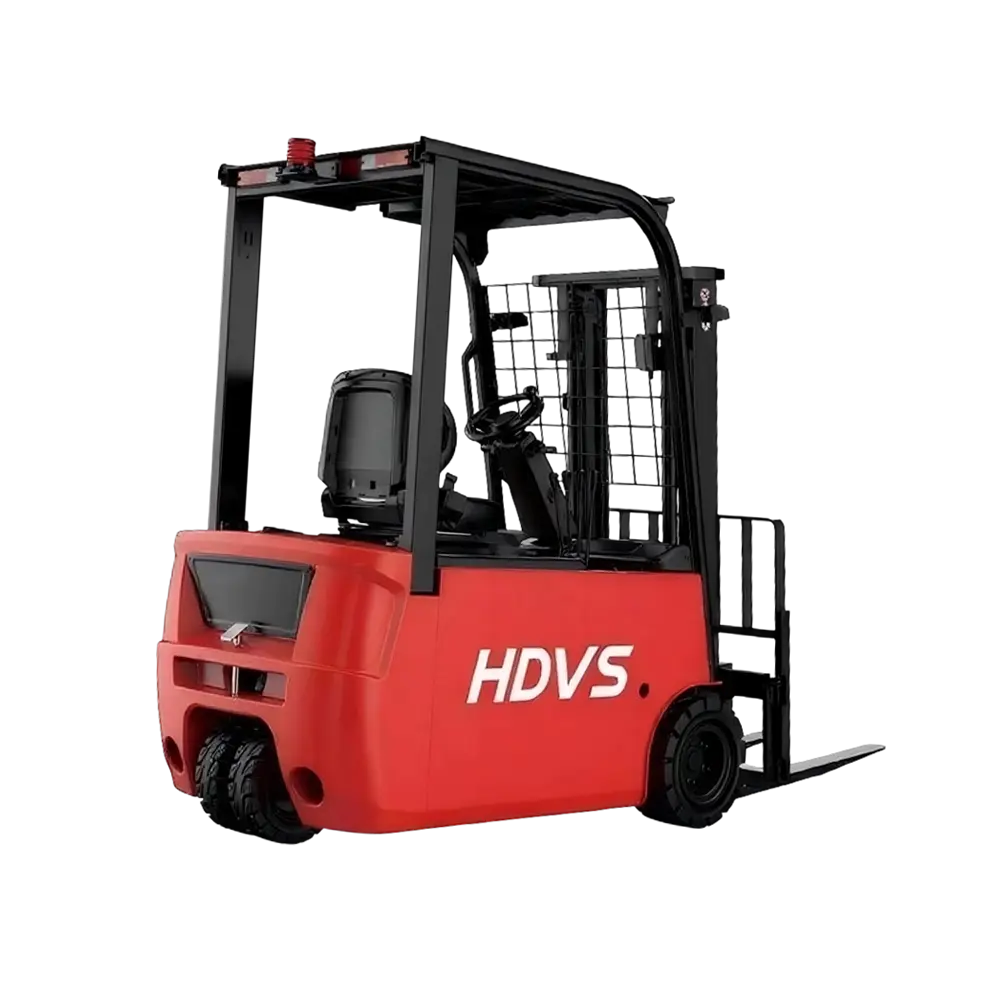
1.5/1.8/2 Ton Cold storage lithium battery Electric Forklift
Why Cold Storage Operations Need Specialized Forklifts
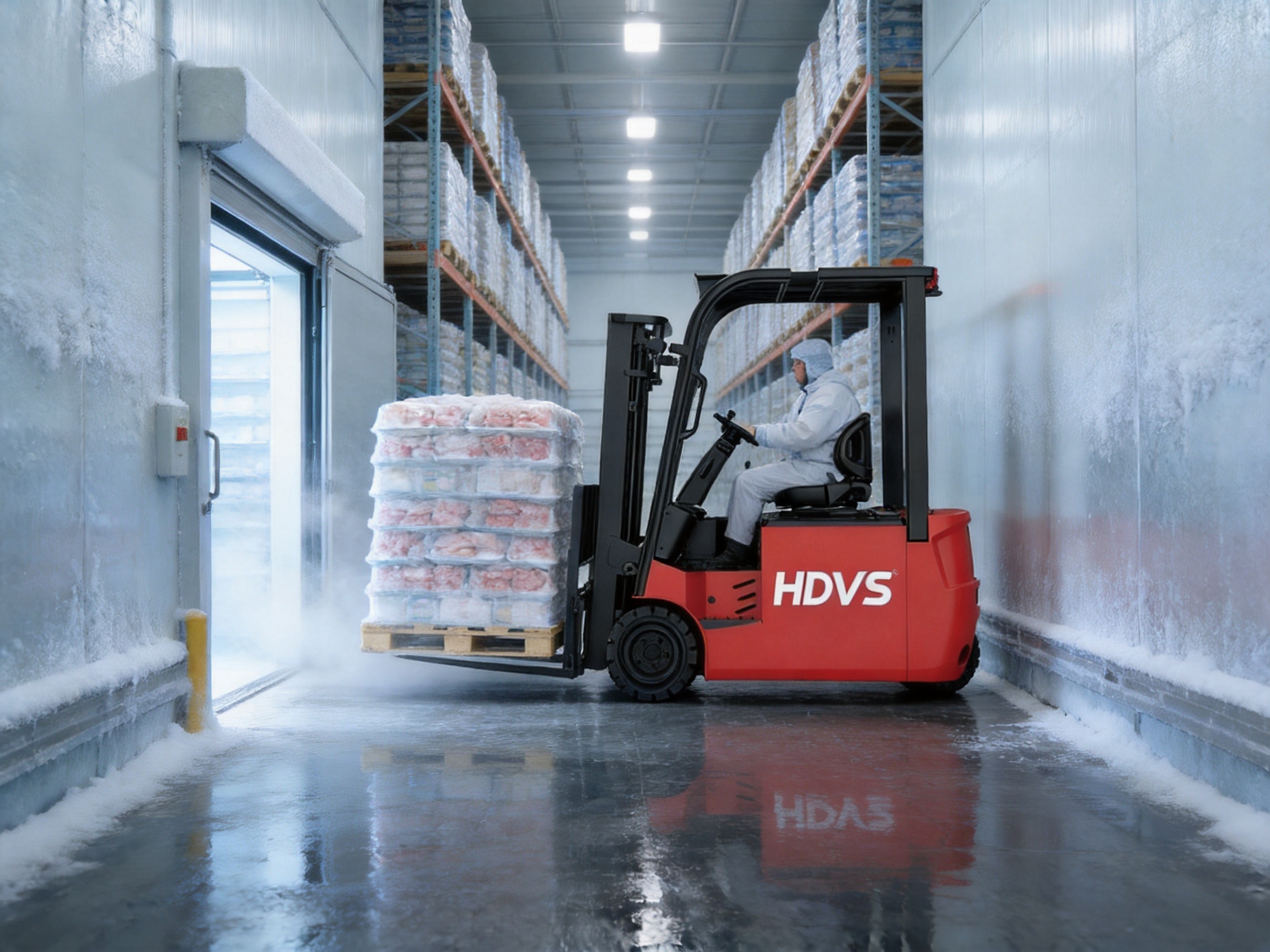
Cold storage warehouses are not simply standard warehouses with a lower thermostat setting. The operating conditions affect nearly every working part of a material handling vehicle. When a forklift repeatedly moves between ambient areas and freezer rooms, condensation can form on electrical parts and metal surfaces. Hydraulic oil can become less responsive, batteries can lose usable performance, tires can harden, and ordinary protective finishes can deteriorate more rapidly.
These conditions become more challenging when the vehicle is used for long shifts. A forklift entering a frozen room several times per hour experiences repeated thermal changes. It may also travel across floors affected by frost, ice, water, or cleaning chemicals. At the same time, the operator must place loads accurately on high racks while working around limited visibility, narrow aisles, insulated walls, dock doors, and other vehicles.
A standard warehouse forklift may perform well in a dry indoor environment but require additional preparation for freezer applications. A cold storage model addresses the problem at the equipment-design level. It uses low-temperature-resistant materials and protective measures to reduce the impact of freezing conditions, moisture, corrosion, and slippery surfaces.
Low-temperature readiness
Selected hydraulic oil, wiring harnesses, and electrical protection measures support reliable operation in severe cold, including applications specified for temperatures down to -40°C.
Moisture protection
Waterproof and dustproof electrical components help reduce the risk associated with condensation, humidity, and the changing conditions found around cold-room entrances.
Stable traction
Cold storage special rubber tires are designed to maintain grip on damp and slippery floors, helping the operator control the vehicle during pallet movement.
Compact handling
The three-wheel layout provides a small turning radius for smoother movement in narrow cold storage aisles and confined loading areas.
Product Overview: Three Capacities for Different Workloads
The product family includes three closely related models. The CPD15TV8 is rated for 1,500 kg, the CPD18TV8 for 1,800 kg, and the CPD20TV8 for 2,000 kg. This capacity range allows an operation to select a vehicle according to its typical pallet weight, rack configuration, aisle space, and desired reserve capacity.
The 1.5-ton model is suitable for lighter palletized goods, packaged food, cartons, and frequent horizontal transportation. The 1.8-ton model provides additional capacity for denser loads and mixed warehouse tasks. The 2-ton model is appropriate where heavier pallets, reinforced packaging, or more demanding loading cycles are common. All three versions use a 500 mm load center distance, providing a consistent reference for planning and comparing load-handling requirements.
Every model is a seated electric forklift. The seated operating position supports longer working periods and gives the operator a stable platform when traveling, lifting, reversing, or positioning a pallet. Electric drive also avoids exhaust emissions inside the warehouse, an important consideration for food, pharmaceutical, and temperature-controlled environments.
| Model |
Rated load |
Battery specification |
Service weight |
Turning radius |
| CPD15TV8 |
1,500 kg |
80 V / 240 Ah |
3,089 kg |
1,570 mm |
| CPD18TV8 |
1,800 kg |
80 V / 300 Ah |
3,238 kg |
1,680 mm |
| CPD20TV8 |
2,000 kg |
80 V / 360 Ah |
3,608 kg |
1,680 mm |
The specifications above are reference values for the listed configurations. Final equipment selection should consider the actual load center, mast type, lift height, attachment, floor conditions, duty cycle, and local operating requirements.
Performance Designed Around the Cold Chain
Low-temperature electrical protection
Electrical reliability is a major concern in a freezer environment. Condensation and moisture may affect connectors, control components, sensors, and wiring. The forklift uses high-protection electrical components with waterproof and dustproof characteristics to support stable performance under low-temperature and humid conditions.
The purpose of this protection is not limited to preventing immediate water entry. It also helps the equipment tolerate the repeated environmental transitions that occur when the forklift moves through doors, loading bays, staging rooms, and deep-freeze areas. A better-protected electrical system can reduce the likelihood of interruptions caused by moisture-related faults and can support more predictable maintenance planning.
Hydraulic performance in severe cold
Hydraulic oil becomes increasingly important as the temperature falls. Oil that is not appropriate for low-temperature use may become more viscous, reducing response speed and making lifting or lowering movements less consistent. This forklift is equipped with low-temperature-resistant hydraulic oil intended to support stable hydraulic operation in conditions as low as -40°C.
Stable hydraulics help the operator perform controlled pallet placement, rack entry, and load lowering. Smooth movement is valuable in a cold store because products may be stacked at height, aisles may be restricted, and the floor may not provide the same traction as a dry warehouse floor. The hydraulic system, mast, and forks should always be used within the rated capacity and the limits stated in the equipment documentation.
Cold-resistant wiring harnesses
Wiring harnesses can become less flexible when exposed to severe cold. Repeated vibration, bending, and temperature changes may place additional stress on ordinary materials. Special cold-resistant wiring harnesses are incorporated to support long-term stability and help protect the electrical network from premature deterioration.
This approach reflects an important engineering principle: cold storage performance depends on the complete vehicle, not only on the battery. Battery selection, wiring, controllers, hydraulic components, tires, surface protection, and operator safeguards must work together. Focusing on one component while ignoring the rest can leave operational weak points.
Lithium battery power for productive warehouse cycles
The forklift uses an 80 V lithium battery system. Battery capacity varies by model: 240 Ah for the CPD15TV8, 300 Ah for the CPD18TV8, and 360 Ah for the CPD20TV8. The larger battery options correspond with the higher rated capacities and support the energy demands of different work cycles.
Lithium battery technology is well suited to organized warehouse operations because it can support opportunity-charging strategies, reduce the need for routine battery watering, and provide a clean power source for indoor work. In a cold-chain application, charging procedures and battery temperature management should follow the supplier’s instructions. The charging area, charger specification, battery condition, and operating schedule should be assessed together before the fleet is placed into service.
How the specialized design adds value
Ordinary indoor forklift
General warehouse use
Cold storage configuration
Freezer and humid environments
This visual illustrates application suitability rather than a laboratory performance measurement.
Traction, Stability, and Operator Safety
Cold storage floors can be affected by frost, condensation, water, ice particles, and cleaning operations. Reduced traction can increase stopping distance and make turning more difficult. The forklift is equipped with high-performance cold storage special rubber tires to improve grip and anti-slip performance on challenging surfaces.
Tire selection is especially important for a compact electric forklift. The tires must support the vehicle during acceleration, braking, turning, and load positioning without damaging the floor. Operators should still reduce speed when necessary, maintain safe distances, keep loads low during travel, and follow the facility’s traffic rules. Specialized tires improve the operating margin, but they do not replace safe driving practices.
The three-wheel design contributes to maneuverability. The CPD15TV8 has a listed turning radius of 1,570 mm, while the CPD18TV8 and CPD20TV8 have a listed turning radius of 1,680 mm. These dimensions can help the vehicle negotiate narrow lanes, turning points, staging zones, and areas near insulated walls or racking systems.
A compact turning radius can also reduce the number of repositioning movements needed to approach a pallet. Fewer corrections may improve cycle efficiency and reduce the time that a freezer door remains open. This can be valuable in temperature-controlled logistics, where minimizing warm-air exchange supports both product quality and energy management.
Overhead protection and optional cargo protection
The forklift is fitted with a reinforced overhead guard for protection during stacking and handling operations. An optional metal protective net can be added to help prevent cargo from slipping toward the operator area. The correct configuration depends on the load shape, packaging quality, rack design, attachment selection, and workplace risk assessment.
Safety performance is strongest when equipment design is combined with operating discipline. Loads should be centered on the forks, within the rated capacity, and positioned according to the load center requirements. The mast should be tilted and raised only as appropriate for the task. Operators should also receive training for freezer-room visibility, pedestrian interaction, ramp travel, dock edges, and emergency procedures.
Lift Height and Warehouse Utilization
The standard configuration lists a maximum lifting height of 3,000 mm. The product information also identifies lifting capability up to 6 meters for stacking and storage operations. Because mast configuration directly affects capacity, visibility, overall height, and aisle requirements, the final lift height must be confirmed when ordering.
Higher racks can increase the storage density of a cold store, helping the facility make better use of expensive temperature-controlled floor space. However, the correct forklift is not selected by lift height alone. The operation must review rack beam height, pallet dimensions, load weight, aisle width, floor flatness, door clearance, overhead guard height, and the required residual capacity at elevation.
The listed overhead guard height is 2,160 mm for all three models. This dimension should be compared with door openings, refrigeration equipment, sprinkler systems, lighting, structural beams, and the lowest clearance within the planned route. A site survey before delivery can prevent costly changes and help ensure that the selected vehicle is compatible with the entire material flow.
Key dimensions and operating data
| Item |
CPD15TV8 |
CPD18TV8 |
CPD20TV8 |
| Standard lift height |
3,000 mm |
3,000 mm |
3,000 mm |
| Overhead guard height |
2,160 mm |
2,160 mm |
2,160 mm |
| Overall length to fork face |
1,990 mm |
2,100 mm |
2,100 mm |
| Travel speed, loaded / unloaded |
13 / 14 km/h |
13 / 14 km/h |
13 / 14 km/h |
| Load center |
500 mm |
500 mm |
500 mm |
Manufacturing Approach and Quality Strengths
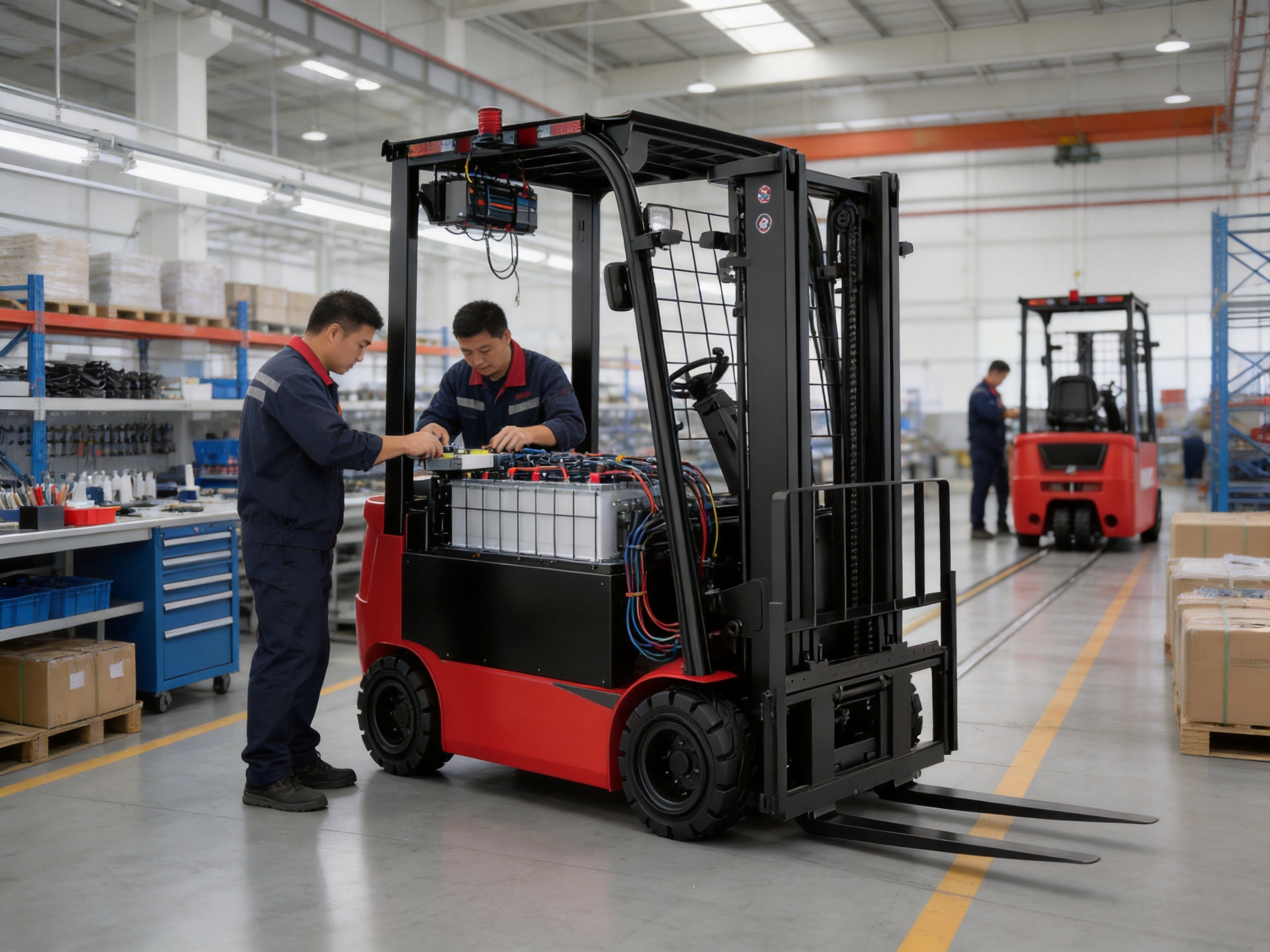
A cold storage forklift must be manufactured with attention to more than appearance. Its reliability depends on the relationship between structural fabrication, component selection, electrical integration, hydraulic assembly, surface treatment, battery installation, inspection, and final testing. A manufacturing organization with experience across new forklifts, used equipment, spare parts, attachments, exports, and leasing can evaluate the product from both production and field-use perspectives.
The manufacturing process begins with application analysis. Capacity, load center, lift height, turning space, temperature range, battery voltage, and work-cycle requirements are reviewed before the equipment specification is finalized. This application-led approach helps avoid selecting a vehicle that is technically capable in one area but unsuitable for the customer’s complete operating route.
Structural fabrication and dimensional control
The chassis, mast, overhead guard, counterweight, and other structural parts must maintain alignment under repeated loading. Fabrication typically involves cutting, forming, welding, machining, and dimensional inspection. Control of weld position, component geometry, and assembly tolerances contributes to stable mast movement and predictable load handling.
For cold storage equipment, structural durability also includes attention to surface preparation and exposed areas where water or condensation may collect. Drainage, coating coverage, joint treatment, and protection around vulnerable metal surfaces can all contribute to longer service life in humid and corrosive surroundings.
Hydraulic system assembly
The hydraulic system is assembled with components selected for the intended operating environment. Low-temperature-resistant hydraulic oil is used to support the specified cold application. During assembly and inspection, cleanliness is important because contamination can affect valves, seals, cylinders, and pumps.
Functional checks should include lifting, lowering, tilting, mast travel, leakage inspection, and response consistency. These checks help identify assembly problems before the forklift reaches the customer’s freezer room. For operations with unusual attachments or special load dimensions, hydraulic requirements should be reviewed during the quotation and engineering stage.
Electrical integration and protection
Electrical integration brings together the lithium battery, controller, drive system, instruments, sensors, wiring harnesses, and protective components. The use of cold-resistant wiring harnesses and high-protection electrical components is particularly relevant to freezer applications. Correct routing and securing of cables can reduce exposure to vibration, abrasion, sharp edges, and repeated movement.
Electrical inspection should verify connector condition, insulation, polarity, control response, battery communication, charging compatibility, and safety functions. A systematic inspection process supports consistency across models and makes later troubleshooting more efficient.
Surface treatment for demanding environments
The vehicle body, mast, hydraulic system, and other structural components receive anti-rust and anti-corrosion treatment. This is important because cold rooms can be humid even when the ambient temperature is low. Condensed moisture, cleaning agents, salty food residues, and frequent transitions through loading zones may accelerate corrosion if exposed metal is not properly protected.
A durable finish also supports easier cleaning and maintenance. In food-related facilities, the equipment should be managed according to the site’s hygiene rules, including cleaning agents, drying procedures, and restrictions on water exposure around electrical parts.
Final inspection and application verification
Before delivery, the complete vehicle should be checked for steering response, braking, travel speed, lifting performance, mast operation, tire condition, battery installation, protective guards, warning labels, fasteners, and visible finish quality. The final inspection should also confirm that the model, capacity, mast, battery, and optional accessories match the customer’s order.
For international delivery, documentation and packaging are also important. Export experience helps the supplier coordinate product preparation, spare parts, operating information, and delivery requirements for different markets. A well-organized process reduces uncertainty from the first inquiry through installation and after-sales support.
Advantages Compared with Conventional Alternatives
Compared with standard electric forklifts
The cold storage configuration adds low-temperature-resistant hydraulic oil, cold-resistant wiring, enhanced electrical protection, anti-corrosion treatment, and specialized tires. These features address environmental risks that a general indoor model may not be designed to manage.
Compared with internal combustion forklifts
The electric power system avoids fuel exhaust inside the facility, reduces engine noise, and is well suited to enclosed warehouses. It also supports cleaner operation around food and pharmaceutical products when managed according to site procedures.
Compared with larger forklifts
The 1.5 to 2 ton capacity range and compact three-wheel layout provide a practical balance between load capability and maneuverability, particularly where aisle width and turning space are limited.
Compared with general-purpose tires
Cold storage special rubber tires are selected to improve grip on damp or slippery floors, helping support safer travel and more controlled pallet positioning in freezer rooms.
These advantages should be evaluated against the actual site rather than viewed as isolated features. For example, a facility with wide aisles may prioritize battery capacity and lift height, while a compact frozen-food warehouse may place greater value on turning radius and tire traction. The three-model range makes it possible to match capacity and battery configuration with the specific material flow.
Applications Across Temperature-Controlled Industries
Frozen food distribution
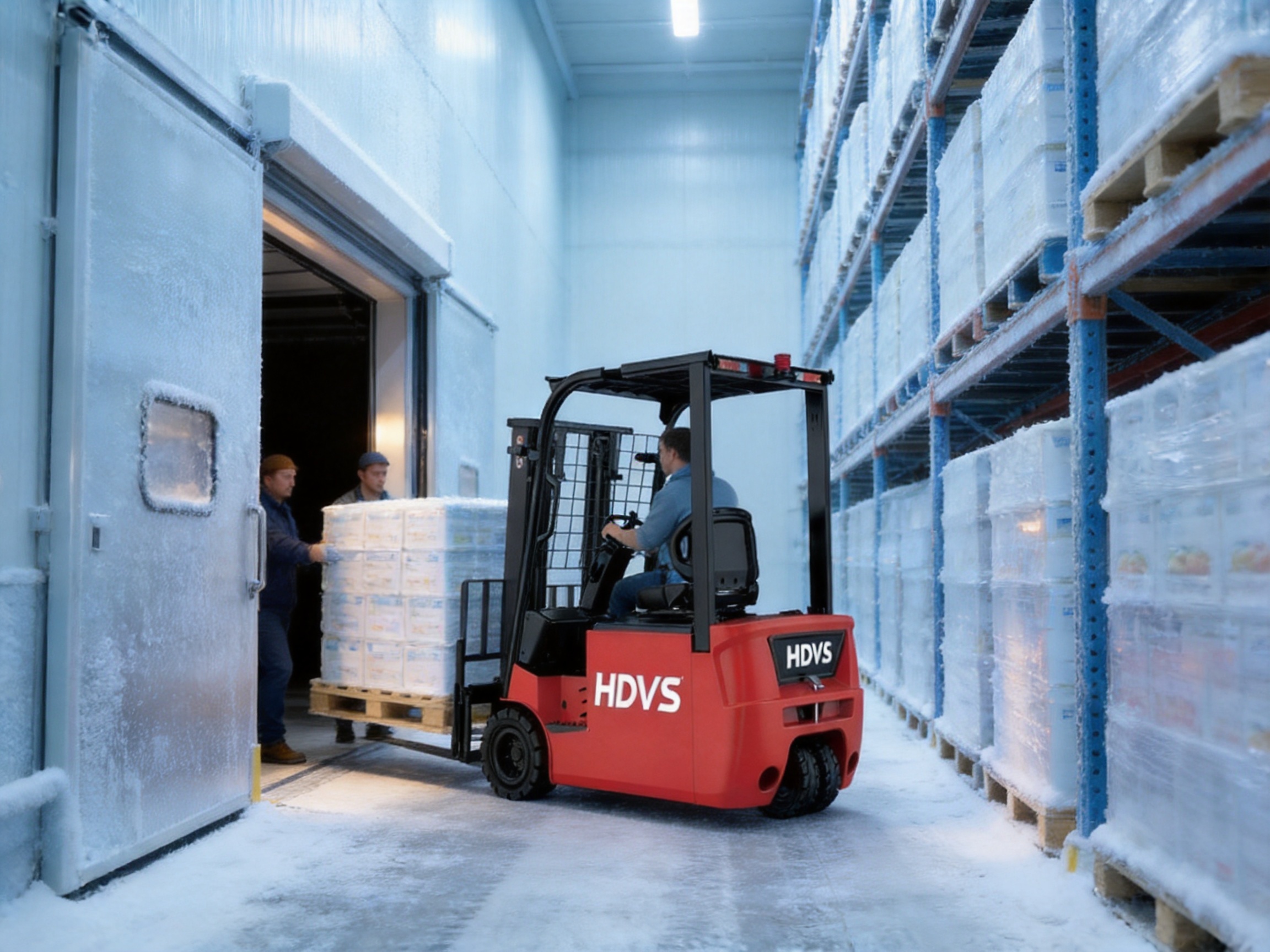
Frozen meat, seafood, vegetables, prepared foods, ice cream, and other products often move through several temperature zones. The forklift can support pallet receiving, put-away, order consolidation, rack replenishment, and outbound loading. Its electric operation is suitable for enclosed spaces where emissions and noise must be controlled.
Pharmaceutical and medical logistics
Pharmaceutical warehouses may require strict environmental control, accurate inventory movement, and dependable equipment availability. The forklift can be specified for pallet handling between refrigerated zones and staging areas, subject to the facility’s hygiene, validation, and safety procedures.
Cold-chain manufacturing
Food processors and temperature-controlled manufacturers often need to move raw materials, packaging, finished products, and production supplies. A dedicated cold storage forklift can reduce the need to bring a general-purpose truck repeatedly into severe cold, helping create a more consistent handling process.
Refrigerated logistics hubs
Distribution hubs may have high door traffic and short loading windows. Compact maneuverability helps the forklift move between dock zones, staging lanes, and storage aisles. The selected battery capacity should be matched with shift length, charging opportunities, and the amount of time spent in deep-freeze conditions.
How to Select the Correct Model
Choosing between the CPD15TV8, CPD18TV8, and CPD20TV8 begins with the heaviest routine load, not merely the average pallet weight. The rated capacity must be considered together with the load center and lift height. A load that is within the nominal capacity at floor level may require a different specification when lifted higher or positioned farther forward.
01
Confirm the load profile
Record the maximum pallet weight, typical pallet weight, dimensions, center of gravity, packaging stability, and whether attachments will be used.
02
Measure the route
Check aisle width, turning points, door clearances, ramp gradients, rack dimensions, dock edges, and the transition between ambient and frozen zones.
03
Define the duty cycle
Estimate operating hours, travel distance, lifting frequency, time in the freezer room, shift pattern, and available charging windows.
04
Specify protection needs
Discuss cold temperature, humidity, condensation, corrosion exposure, floor conditions, protective net requirements, and operator visibility.
The CPD15TV8 may be appropriate when most loads remain within 1,500 kg and maximum maneuverability is a priority. The CPD18TV8 provides a useful middle option for mixed loads and higher capacity requirements. The CPD20TV8 offers the highest rated capacity in this series for operations handling heavier pallets within a compact electric forklift category.
Customers should also confirm whether the standard 3,000 mm mast meets the rack plan or whether a higher mast, different free lift arrangement, or other configuration is needed. The impact of any option on overall height, residual capacity, visibility, and turning space should be evaluated before production.
Maintenance Practices for Long-Term Reliability
Specialized design reduces environmental risk, but scheduled care remains essential. A cold storage forklift should be inspected before each shift for tire condition, forks, mast chains, hydraulic leakage, warning devices, steering response, brakes, battery condition, and visible damage to the overhead guard or protective net.
After operation in a freezer room, the forklift may require a controlled transition to a suitable area. Sudden temperature changes can contribute to condensation. The facility’s maintenance plan should define where the vehicle is parked, how it is dried, how charging is managed, and how moisture around electrical components is controlled.
Hydraulic oil, connectors, wiring harnesses, fasteners, coatings, and tires should be checked at intervals suitable for the duty cycle. Corrosion should be addressed early rather than allowed to spread beneath coatings or around structural joints. Any unusual noise, reduced lifting speed, intermittent electrical response, or change in steering should be investigated promptly.
Battery charging should follow the specified charger and battery instructions. Operators should not use damaged cables, unauthorized chargers, or unsuitable charging locations. Battery data, charging frequency, and shift performance can be recorded to identify changes in energy consumption and plan preventive service.
| Inspection frequency |
Recommended focus |
| Before each shift |
Tires, forks, brakes, steering, warning devices, battery condition, visible leaks, and safety guards. |
| Weekly or according to duty cycle |
Mast components, chains, hydraulic hoses, connectors, fasteners, corrosion points, and tire wear. |
| Scheduled service |
Hydraulic performance, electrical diagnostics, battery system, braking system, steering components, and structural inspection. |
| After unusual events |
Inspection after impact, water exposure, abnormal noise, warning alarms, or unexpected performance changes. |
Support from an Experienced Material Handling Supplier
Equipment selection is only one part of a successful forklift program. A supplier with experience in new and used forklifts, spare parts, attachments, exports, leasing, technical consultation, operation guidance, maintenance, and after-sales service can support the complete equipment lifecycle.
Shanghai HanDavos International Trading Co., Ltd. operates from Kunshan, Jiangsu, China, and has more than 20 years of experience in the material handling equipment industry. Its standardized warehouse facilities cover more than 20,000 square meters and support inventory management, product preparation, spare parts supply, and international delivery coordination.
The company’s portfolio includes equipment associated with leading forklift brands, as well as new and used machines, parts, attachments, and related services. This broad product knowledge can help customers compare capacity, energy type, mast configuration, tire type, attachment needs, and operating conditions before placing an order.
For international customers, support may include technical communication, product selection, export preparation, documentation, replacement parts, maintenance guidance, and service coordination. A clear specification review is particularly important for cold storage applications because temperature range, battery configuration, mast height, charging method, and floor conditions all influence the final solution.
Application consultation
Review load data, aisle dimensions, temperature range, lift height, shift pattern, and charging requirements.
Equipment configuration
Match capacity, battery size, mast, tires, protective equipment, and accessories with the planned work environment.
Parts and maintenance
Support routine maintenance, replacement parts planning, troubleshooting, and service continuity.
International delivery
Coordinate product preparation, export requirements, shipping documentation, and communication throughout the order process.
Frequently Asked Questions
What temperature range is this forklift designed to support?
The product is designed for extreme cold storage applications and is specified to support operation in environments as low as -40°C. Actual performance depends on the operating cycle, battery management, charging conditions, maintenance, and correct use of the equipment.
What load capacities are available?
The series includes three capacities: 1,500 kg for the CPD15TV8, 1,800 kg for the CPD18TV8, and 2,000 kg for the CPD20TV8. All listed models use a 500 mm load center distance.
What battery system does the forklift use?
Each model uses an 80 V lithium battery. The listed capacities are 240 Ah, 300 Ah, and 360 Ah for the CPD15TV8, CPD18TV8, and CPD20TV8 respectively.
Can the forklift work in humid environments?
Yes. The forklift uses high-protection electrical components with waterproof and dustproof characteristics to support low-temperature and humid conditions. Operators must still follow cleaning, drying, charging, and maintenance procedures.
What is the standard lifting height?
The listed standard maximum lifting height is 3,000 mm. The product information also identifies configurations reaching up to 6 meters. The required mast and final capacity should be confirmed according to the rack layout and load plan.
Why are special tires important in a cold store?
Freezer floors may be damp, frosted, or slippery. Cold storage special rubber tires are designed to improve grip and anti-slip performance, helping the operator maintain better control during travel and pallet positioning.
Is the forklift suitable for narrow aisles?
The three-wheel design and compact turning radius support maneuverability in narrow aisles and confined areas. Final suitability depends on aisle width, pallet dimensions, rack clearance, and the required turning method.
What information should be provided before requesting a quotation?
Useful information includes maximum load weight, load dimensions, load center, lift height, aisle width, door clearance, temperature range, working hours, floor conditions, attachment requirements, charging arrangements, and delivery destination.
Can protective accessories be added?
An optional metal protective net is available to help prevent cargo from slipping toward the operator area. Other configurations should be discussed according to the load type, rack system, and operating risk assessment.
How can the service life of the forklift be extended?
Use the vehicle within its rated capacity, perform pre-shift inspections, maintain the hydraulic and electrical systems, manage battery charging correctly, clean and dry the vehicle appropriately, and address corrosion or abnormal performance without delay.
Conclusion: A Purpose-Built Solution for Low-Temperature Logistics
The 1.5/1.8/2 ton cold storage lithium battery electric forklift is designed for the conditions that make freezer logistics difficult. Its low-temperature-resistant hydraulic oil, cold-resistant wiring harnesses, protected electrical components, anti-corrosion treatment, specialized rubber tires, lithium battery system, compact three-wheel layout, and reinforced overhead guard work together to support dependable material handling.
With three capacity choices, the series can be matched to different pallet weights and warehouse workflows. The CPD15TV8 prioritizes efficient handling for loads up to 1,500 kg, the CPD18TV8 provides a balanced 1,800 kg option, and the CPD20TV8 supports loads up to 2,000 kg. The listed travel speed of 13 km/h under full load and 14 km/h without load helps maintain productive movement, while compact turning dimensions support operation in restricted spaces.
For customers planning a cold-chain equipment upgrade, the most effective approach is to evaluate the entire work environment: temperature, humidity, floor condition, aisle width, rack height, load center, shift pattern, charging routine, and maintenance resources. When the forklift configuration is matched carefully to those conditions, the result can be safer handling, more consistent uptime, cleaner indoor operation, and better use of valuable refrigerated storage space.
References
- Manufacturer-provided technical specifications for the CPD15TV8, CPD18TV8, and CPD20TV8 cold storage lithium battery electric forklift series.
- Manufacturer-provided product information regarding low-temperature operation, waterproof and dustproof electrical components, cold-resistant hydraulic oil, wiring harnesses, tires, and corrosion protection.
- General principles of industrial forklift operation, load-center management, warehouse traffic safety, and preventive maintenance.
- General guidance for lithium battery charging, cold-environment equipment management, and temperature-controlled warehouse operations.
- Manufacturer company information concerning material handling equipment sales, spare parts, attachments, leasing, export services, warehouses, and after-sales support.


 English
 中文简体
 русский
 Español
 عربى