2026-08-23
Content
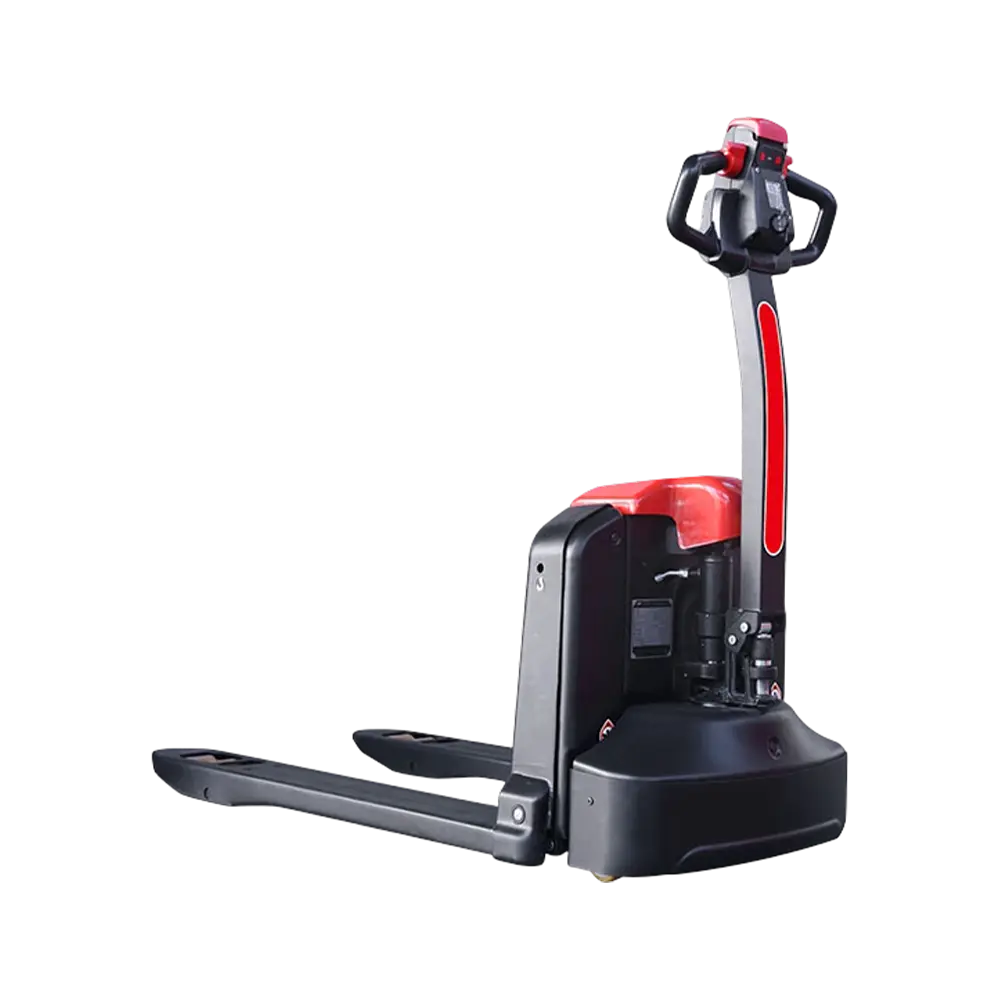
Modern material handling operations increasingly require equipment that can combine the cleanliness of electric drive technology with the strength and mobility traditionally associated with industrial vehicles. The 3 Ton Off-Road All-Electric Pallet Truck is designed for precisely this purpose. With a rated load capacity of 3,000 kilograms, large anti-slip drive wheels, a robust steel structure, electromagnetic braking, and electric travel and lifting systems, it provides a practical solution for demanding warehouse, construction, agricultural, logistics, and outdoor distribution applications.
Unlike conventional manual pallet trucks, this model reduces operator effort during both travel and load lifting. Unlike many standard indoor electric pallet trucks, it is built with features intended to improve stability and passability on uneven surfaces. Its large 350-millimeter drive wheel, polyurethane load rollers, high-torque drive motor, reinforced forks, and anti-corrosion frame coating support operation in working environments where smooth warehouse floors cannot always be guaranteed.
The equipment is supplied by Shanghai HanDavos International Trading Co., Ltd., a material handling company based in Kunshan, Jiangsu Province, China. The company has more than 20 years of experience in forklift sales, spare parts, attachments, exports, rental services, technical support, and after-sales assistance. Its product and service capabilities allow customers to source not only pallet trucks, but also forklifts, replacement parts, attachments, maintenance support, and complete material handling solutions.
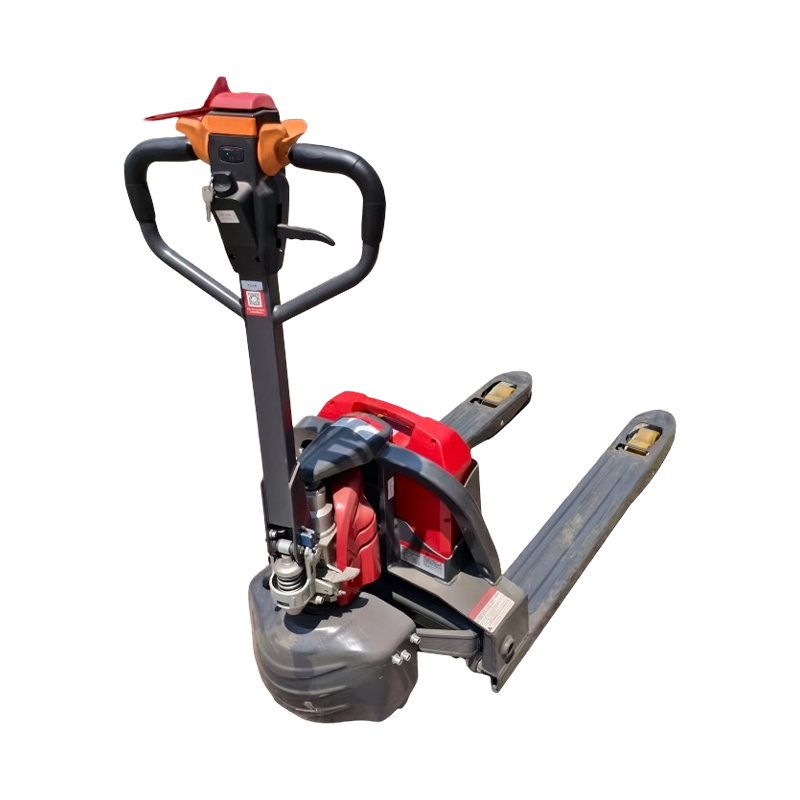
The 3 Ton Off-Road All-Electric Pallet Truck is an electrically driven pedestrian pallet truck intended for heavy load transportation over short and medium distances. It uses an electric drive motor for travel and an electric lifting motor for raising the forks. The operator controls the vehicle through an intelligent handle, walking behind or beside the machine while directing its movement and load-handling functions.
The model has a rated load capacity of 3,000 kilograms. This capacity places it above many light-duty electric pallet trucks, which are commonly designed for loads between 1,500 and 2,500 kilograms. A three-ton rating gives logistics operators additional flexibility when handling dense materials, industrial components, building products, bulk packaging, machinery parts, and heavy pallets.
Its compact overall dimensions are also important. The vehicle length is approximately 1,650 millimeters, while the overall width is available in configurations of approximately 550 or 685 millimeters. The vehicle height is about 1,270 millimeters, and the fork length is 1,200 millimeters. These dimensions allow the pallet truck to remain relatively maneuverable while retaining the structural capacity required for heavy loads.
The truck is intended for environments in which ordinary indoor pallet equipment may not provide sufficient ground clearance, traction, or impact resistance. Typical applications include outdoor warehouses, construction sites, factories with uneven access roads, agricultural storage areas, loading yards, distribution centers, and industrial facilities where goods must be transferred between buildings.
| Specification | Value |
|---|---|
| Product type | All-electric off-road pallet truck |
| Rated load capacity | 3,000 kg |
| Operating method | Pedestrian walking operation |
| Drive method | Electric |
| Vehicle length | 1,650 mm |
| Vehicle width | 550/685 mm |
| Vehicle height | 1,270 mm |
| Lift height | 200 mm |
| Fork dimensions | 56/160/1,200 mm |
| Fork outer width | 550/685 mm |
| Drive wheel | 350 x 100 mm |
| Bearing wheels | Four 80 x 70 mm wheels |
| Travel speed, loaded/unloaded | 4/5 km/h |
| Gradeability, loaded/unloaded | 6%/10% |
| Drive motor | 1.2 kW |
| Lift motor | 0.8 kW |
| Battery rating | 48 V/32 Ah |
| Battery weight | 36.4 kg |
| Brake system | Electromagnetic braking |
| Controller and drive technology | DC brushless |
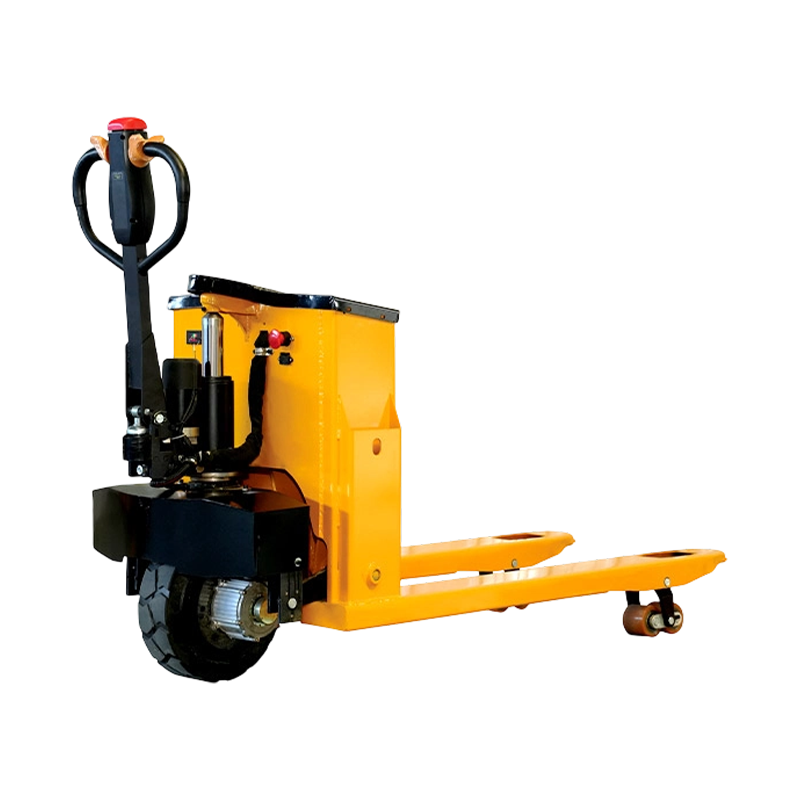
One of the most important differences between a conventional indoor pallet truck and an off-road-oriented electric model is wheel design. Small wheels may perform well on polished concrete but can lose traction or become trapped when they encounter gravel, thresholds, expansion joints, mud, broken pavement, or other uneven surfaces. The 3 Ton Off-Road All-Electric Pallet Truck addresses this challenge with a 350-millimeter-diameter drive wheel.
The drive wheel uses an integrated injection-molded rubber construction. This design combines an anti-slip surface with a solid, wear-resistant body. Because the tire is formed as one integrated component, it is less dependent on complex seams or bonded layers that may weaken under repeated impact. The rubber wheel can provide improved contact with the ground and better traction when the pallet truck is operating on outdoor surfaces.
The large wheel diameter helps the truck pass over shallow obstacles and uneven transitions more smoothly than equipment fitted with smaller indoor wheels. It also increases the contact geometry between the machine and the ground, helping the drive system maintain traction when the load is heavy. For outdoor logistics, this can reduce the need to prepare every route to the same standard as a clean warehouse aisle.
The wheel material is also relevant to operating costs. Wear-resistant rubber can help extend replacement intervals when the machine is used on abrasive surfaces. However, wheel life will still depend on load distribution, travel speed, surface conditions, turning behavior, and maintenance. Operators should avoid unnecessary spinning, abrupt acceleration, and prolonged operation on sharp debris.
3 Ton Off road all electric Pallet Truck
A 3,000-kilogram rated load capacity gives the pallet truck a strong position in the heavy-duty pedestrian equipment segment. Many electric pallet trucks are optimized for light warehouse picking and are not intended to move the densest industrial pallets. This model is designed for applications where a high-capacity load platform is necessary but a full-size counterbalance forklift may be excessive.
The vehicle can be useful when goods must be moved through areas that are too confined for a larger forklift. For example, a factory may need to transfer metal parts from a production line to a staging area, or a construction supplier may need to position heavy pallets near a building entrance. In these situations, the pallet truck can provide powered transportation without requiring the turning radius, fuel system, or operating space associated with a conventional forklift.
Capacity must always be considered together with load center, fork condition, ground condition, slope, and travel direction. A rated capacity is not a guarantee that every possible load can be handled at every position. The load should be centered on the forks, distributed evenly, and secured when necessary. Operators should follow the manufacturer’s rating plate, operating instructions, workplace risk assessment, and applicable safety regulations.
The reinforced forks use thickened steel and integrated bending molding. The absence of welding seams in key load-bearing areas helps reduce potential stress concentration. A continuously formed fork structure can resist bending and cracking more effectively than a poorly designed or inadequately reinforced fork. This is particularly valuable when the pallet truck is repeatedly used with dense loads or on uneven ground.
The forks are specified at approximately 56 millimeters in thickness, 160 millimeters in width, and 1,200 millimeters in length. These dimensions are suitable for many standard pallet formats and provide sufficient fork engagement for common industrial loads. The available outer fork widths of 550 and 685 millimeters allow the equipment to be configured for different pallet and aisle requirements.
Integrated bending molding supports structural continuity. In heavy-duty material handling equipment, every transition between components is important because repeated loading creates cycles of stress. Forks are exposed not only to vertical weight but also to vibration, uneven loading, impact during pallet entry, and dynamic forces during braking. A reinforced one-piece-forming approach helps the load-bearing areas maintain their shape over extended service.
Load stability also depends on the relationship between the forks, bearing wheels, drive wheel, and frame. The pallet truck uses four bearing wheels measuring approximately 80 by 70 millimeters. These supporting wheels help distribute the load and reduce excessive pressure on any single contact point. When combined with the large drive wheel, the arrangement supports controlled movement across a range of surfaces.
Heavy-duty polyurethane rollers can absorb a portion of the vibration generated when the machine travels over irregular ground. This can reduce sudden movement through the pallet and help protect fragile goods. Polyurethane is widely used in material handling equipment because it offers a useful balance between load support, wear resistance, rolling performance, and floor protection.
The pallet truck is equipped with a 1.2-kilowatt drive motor. The drive system is designed to deliver strong torque for starting, low-speed movement, and travel with heavy loads. High torque is particularly important in off-road applications because the machine may need to overcome uneven surfaces, slight inclines, thresholds, or increased rolling resistance.
The model has a stated travel speed of 4 kilometers per hour with a full load and 5 kilometers per hour without a load. These speeds are appropriate for pedestrian operation and are intended to balance productivity with control. A slower loaded speed can help the operator maintain stability when transporting heavy goods, while the unloaded speed allows faster repositioning between tasks.
The truck is rated for a climbing ability of 6 percent with a full load and 10 percent without a load. These values indicate that the drive system can manage moderate gradients under specified conditions. Actual performance depends on surface grip, battery condition, load distribution, temperature, tire wear, and the length of the slope. Slopes should always be assessed before operation, and loads should be handled in accordance with site safety procedures.
DC brushless drive control contributes to smooth and efficient operation. Brushless technology can reduce mechanical wear associated with conventional brush components and may support lower maintenance requirements in the drive system. It also allows the controller to regulate motor output more precisely, improving acceleration response and travel control.
The motor and wheel assembly has been optimized to reduce running friction and operating noise. Lower noise is valuable in warehouses, factories, distribution centers, and mixed-use sites where employees may work near moving equipment. Quieter operation can improve communication and reduce the mechanical noise associated with long shifts.
Heavy loads require dependable braking. The pallet truck uses an electromagnetic braking system that can engage the drive wheel quickly when the operator releases the control or activates the braking function. This design is especially useful when the truck is carrying a heavy load or operating on a gradual slope.
Electromagnetic braking helps prevent unintended rolling. When the vehicle is stopped, the braking force can hold the drive wheel in place and reduce the risk of the machine sliding away from the operator. This provides an additional layer of control during loading, unloading, temporary stops, and positioning activities.
Braking performance is influenced by wheel condition and surface grip. A braking system cannot compensate for severely contaminated, icy, excessively loose, or unstable ground. Operators should inspect the route, avoid unsafe slopes, maintain a suitable travel speed, and confirm that the braking system responds correctly before beginning a work shift.
The brake system also contributes to operational confidence. When operators know that the equipment can stop in a controlled manner, they can position heavy goods more precisely. This is important when working near racks, vehicles, loading docks, production equipment, walls, or other personnel.
The intelligent operation handle is designed to make the pallet truck accessible to operators with different levels of experience. The handle provides control over travel direction, speed, lifting, lowering, braking, and emergency functions. Its ergonomic layout helps reduce unnecessary hand movement and supports more natural operation during repeated handling cycles.
The control system supports switching between fast and slow travel speeds. Slow mode can be selected for narrow aisles, pallet alignment, loading dock approaches, and areas with pedestrian traffic. Fast mode can be used for suitable open routes where the operator has a clear view and adequate stopping distance.
An emergency reverse function is included to help the operator move away from the machine if the truck approaches too closely or if an unexpected obstruction appears. This feature is valuable in tight spaces, where turning around may not be practical. Operators must still maintain awareness of the surroundings and should not rely on the emergency function as a substitute for safe travel practices.
Good ergonomic design can reduce fatigue over a full shift. Manual pallet trucks require repeated pushing and pulling, particularly when loads are heavy or the floor is uneven. Powered travel and lift functions reduce this physical burden, allowing the operator to concentrate on route selection, pallet positioning, load stability, and communication with nearby workers.
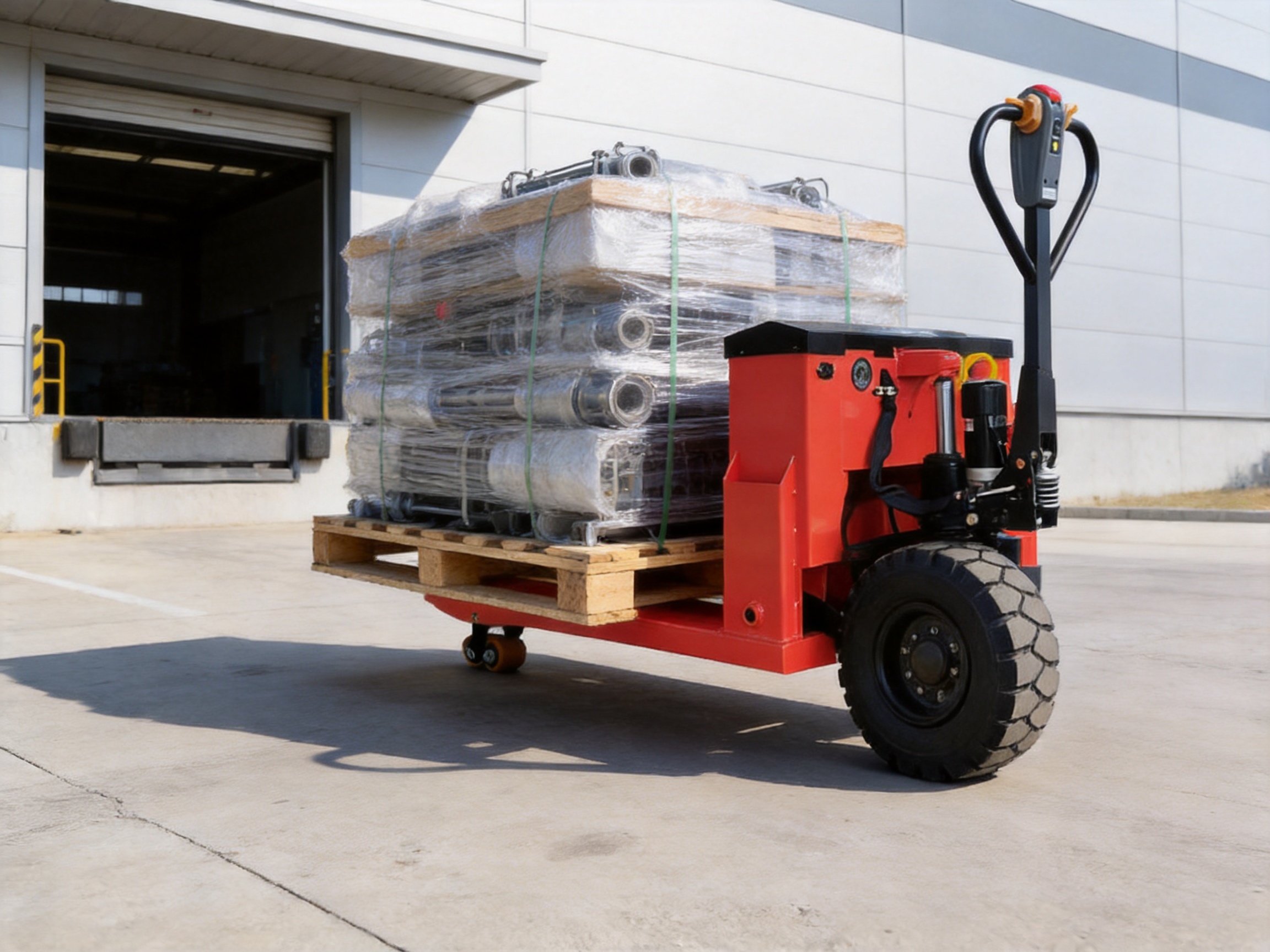
The listed electrical specification is 48 volts and 32 ampere-hours, with a battery weight of approximately 36.4 kilograms. The battery dimensions are approximately 320 millimeters in length, 278 millimeters in width, and 208 millimeters in height. This configuration provides a compact energy source for the travel and lift systems while keeping the machine suitable for pedestrian operation.
The technical table identifies the battery as a maintenance-free lead-acid type. Some of the supplied promotional information refers to a lithium battery pack. Because these are different technologies with different charging, service, weight, and operating characteristics, buyers should confirm the exact battery configuration before placing an order. The final quotation, nameplate, battery documentation, and charger specification should be treated as the controlling information.
A maintenance-free lead-acid battery can be a practical choice for customers seeking familiar technology, straightforward replacement options, and stable purchasing costs. It generally requires less routine attention than traditional serviceable lead-acid batteries. Proper charging discipline remains important. The battery should be charged using the correct charger, protected from extreme temperatures, and inspected periodically for signs of damage or abnormal performance.
If a lithium configuration is offered for a particular order, the operating characteristics may differ. Lithium batteries can provide advantages in energy density, opportunity charging, and reduced battery weight, but they require compatible battery management and charging systems. The customer should verify whether the lithium option is available, what capacity is supplied, how it affects operating time, and which warranty conditions apply.
Battery performance depends on the work cycle. Continuous travel, repeated lifting, heavy loads, slopes, cold temperatures, and rough ground can increase energy consumption. To maximize operating time, operators should avoid unnecessary acceleration, keep wheels properly maintained, use the correct travel mode, and prevent the machine from remaining powered on when it is not in use.
Outdoor material handling exposes equipment to moisture, dust, mud, industrial oils, temperature changes, and accidental impact. The pallet truck uses an all-metal frame with an electrophoretic anti-rust coating. Electrophoretic coating is an industrial finishing process in which electrically charged coating particles are deposited evenly onto a prepared metal surface.
One advantage of electrophoretic coating is the ability to create a consistent protective layer over complex shapes and recessed areas. After appropriate pretreatment and curing, the coating can improve resistance to corrosion and environmental exposure. This is valuable for equipment that may travel between indoor and outdoor locations or work in areas where cleaning and drying conditions are not always ideal.
Surface protection is only one part of corrosion control. The truck should be cleaned when exposed to mud, salt, chemicals, or industrial residues. Drainage areas should remain clear, damaged coating should be repaired, and the frame should be inspected regularly. Preventive cleaning and inspection can significantly extend the service life of the equipment.
The all-metal frame also supports durability under repeated load cycles. Structural strength is influenced by material selection, welding or forming quality, reinforcement design, joint geometry, and stress distribution. A durable frame reduces the likelihood of deformation and helps maintain correct alignment between the forks, wheels, drive unit, and handle assembly.
The supplied product information states that the overall frame stress distribution has been optimized through computer-aided engineering structural simulation. CAE analysis can help engineers examine how forces move through the frame under different loading conditions. It can identify areas of high stress, excessive deflection, or inefficient material use before physical production is finalized.
For an off-road pallet truck, structural analysis is especially useful because the frame experiences more than static vertical loading. It may also encounter impact from uneven ground, vibration from travel, dynamic braking forces, turning loads, and repeated cycles of pallet entry and withdrawal. Simulating these conditions helps engineers design reinforcements where they are most needed.
Balanced force distribution among the forks, drive wheel, bearing wheels, and pull rods can reduce the risk of localized deformation. It can also improve the consistency of steering and load support. When structural components remain correctly aligned, the machine may experience less uneven tire wear and reduced stress on bearings and joints.
Computer simulation does not replace physical testing. A reliable manufacturing process combines engineering analysis with prototype inspection, load testing, drive testing, braking tests, dimensional checks, and quality control documentation. The combination of digital design and practical validation improves confidence in long-term durability.
Shanghai HanDavos International Trading Co., Ltd. is supported by the wider resources of Kunshan Hanzhi and has more than two decades of experience in the material handling industry. The company operates more than 20,000 square meters of standardized warehouse space in Kunshan, Jiangsu Province. This inventory capability supports product availability, spare parts supply, order consolidation, and faster dispatch for international customers.
The company’s product portfolio includes new and used forklifts, electric material handling equipment, forklift parts, attachments, accessories, and related services. It works with products associated with established industrial manufacturers, including BYD, Toyota, HELI, HANGCHA, JAC, and LINDE. This broad product knowledge enables the company to compare capacity, fuel type, mast configuration, attachment requirements, battery systems, and application conditions when recommending equipment.
For the 3 Ton Off-Road All-Electric Pallet Truck, manufacturing quality begins with the selection and preparation of steel components. The fork and frame materials must be suitable for repeated loads and outdoor use. Dimensional accuracy is important because fork spacing, wheel alignment, and frame geometry directly influence pallet entry and stability.
Forming and welding processes must be controlled to maintain consistent strength and shape. Key load-bearing areas should be checked for distortion, surface defects, and dimensional variation. After fabrication, the frame can be prepared for electrophoretic coating to improve corrosion resistance. Coating quality should be assessed for uniformity, coverage, adhesion, and curing.
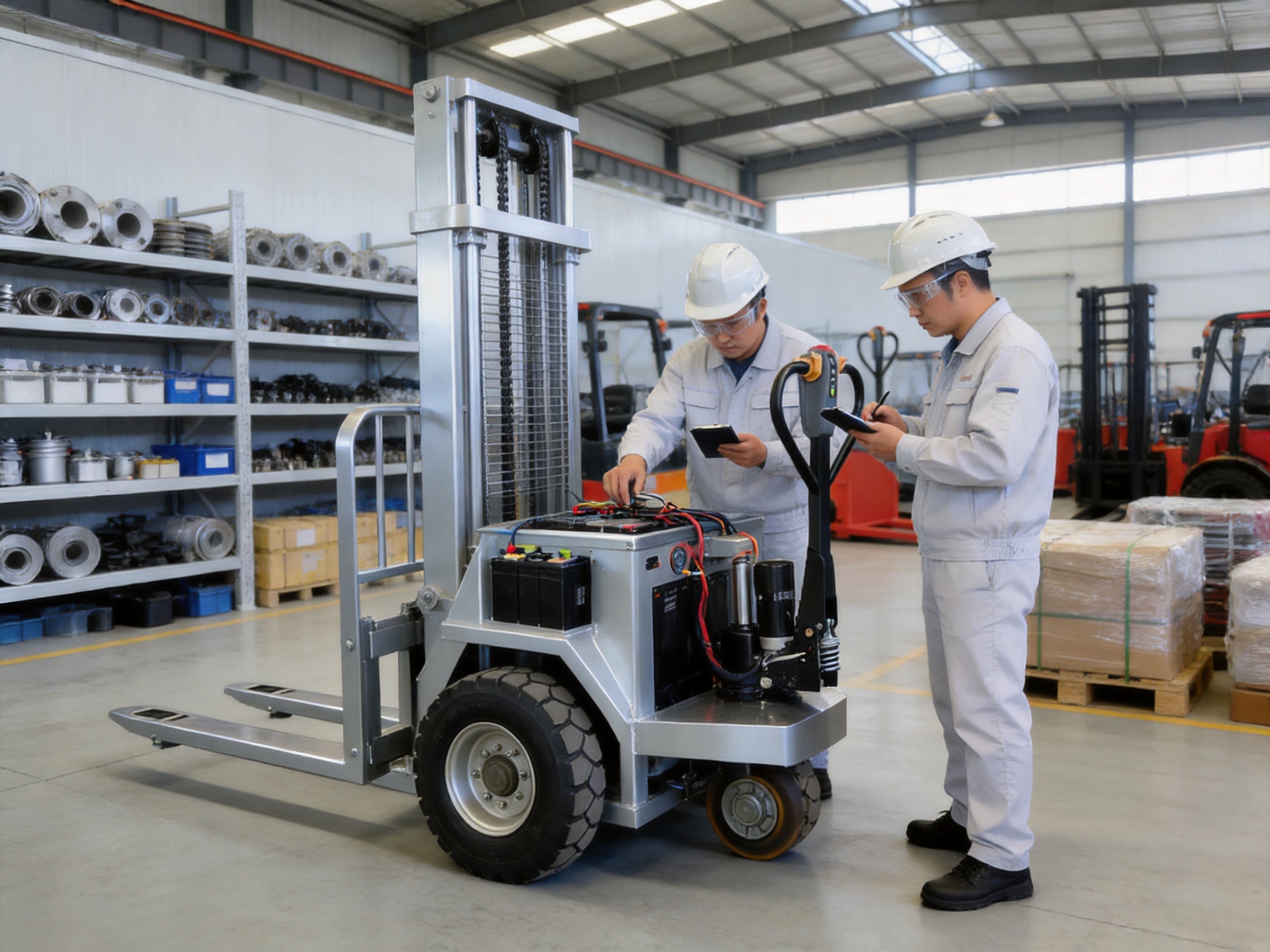
Motor and controller integration is another important stage. The 1.2-kilowatt drive motor, 0.8-kilowatt lift motor, battery, electromagnetic brake, control handle, and wiring system must operate together as a coordinated electrical system. Functional testing can verify acceleration, direction changes, lifting response, braking engagement, emergency reverse operation, and battery protection functions.
Wheel installation requires correct torque, alignment, and bearing condition. The large drive wheel must be securely mounted and positioned to maintain traction. The four bearing wheels must share the load appropriately and rotate freely. Any misalignment can create additional rolling resistance, uneven wear, noise, or instability.
Final quality inspection should include a visual examination, dimensional verification, no-load operation, loaded operation, lifting and lowering checks, brake testing, speed verification, and inspection of warning labels and safety instructions. International buyers may also request product documentation, packing photographs, test records, spare parts lists, and customized inspection procedures.
The 3 Ton Off-Road All-Electric Pallet Truck provides several advantages over manual pallet trucks. Manual equipment has a relatively low purchase cost, but moving a three-ton load by hand requires considerable physical effort. On uneven ground or a slope, manual operation can become slow, tiring, and potentially unsafe. Electric travel and lifting reduce the physical force required from the operator and can improve handling productivity.
Compared with light-duty indoor electric pallet trucks, this model offers a higher rated capacity, a larger drive wheel, stronger structural components, and a design better suited to outdoor transitions. Many indoor pallet trucks prioritize compactness and low rolling resistance on smooth floors. The off-road model places greater emphasis on traction, impact tolerance, ground passability, and frame protection.
Compared with a counterbalance forklift, the pallet truck generally requires less operating space and may be easier to deploy for short-distance pallet movement. It does not require a large counterweight or a tall mast, making it suitable for applications where goods only need to be lifted approximately 200 millimeters for transportation. It can also be appropriate where a customer wants to reduce fuel use and exhaust emissions in or around facilities.
Compared with an internal-combustion pallet-handling solution, an electric design produces no direct exhaust emissions during operation. This can be beneficial in warehouses, food-related facilities, enclosed loading areas, and workplaces where air quality is a concern. Electric systems also generally offer lower operating noise and can reduce the need for fuel storage and engine-related maintenance.
Compared with smaller-wheeled electric models, the 350-millimeter anti-slip drive wheel is a notable advantage on uneven surfaces. A larger wheel can cross thresholds and shallow irregularities more effectively, while the rubber construction helps maintain traction. The benefit is particularly relevant for customers moving goods across outdoor concrete, rough paving, compacted earth, or mixed indoor-outdoor routes.
Construction logistics is one suitable application. Building materials such as tiles, cement products, stone, steel components, doors, fixtures, and packaged equipment can be extremely heavy. A powered pallet truck with off-road-oriented wheels can transfer these loads from delivery vehicles to temporary storage areas or construction access points.
Manufacturing plants can use the equipment to move raw materials, finished goods, molds, dies, machinery components, and production pallets. Its compact length and pedestrian control arrangement allow it to work near production lines, provided that the route is separated from people and other equipment through appropriate site controls.
Outdoor warehouses and distribution yards may benefit from the large drive wheel and protective frame coating. The truck can help transfer goods between storage buildings, loading docks, staging areas, and transport vehicles. Operators should avoid prolonged exposure to standing water and should clean the machine after operation in mud or contaminated environments.
Agricultural and food supply operations may use a suitable configuration for moving feed, packaged produce, containers, and supplies. The exact suitability depends on hygiene requirements, surface conditions, moisture levels, and local regulations. Equipment used in sensitive environments should be specified with appropriate cleaning and material-handling procedures.
Industrial rental fleets can also benefit from the model’s broad application range. Rental companies may offer it to customers who need powered heavy-load transport for temporary projects, facility relocation, construction work, or seasonal distribution peaks. Fleet managers should maintain clear inspection schedules and provide operators with training before each rental period.
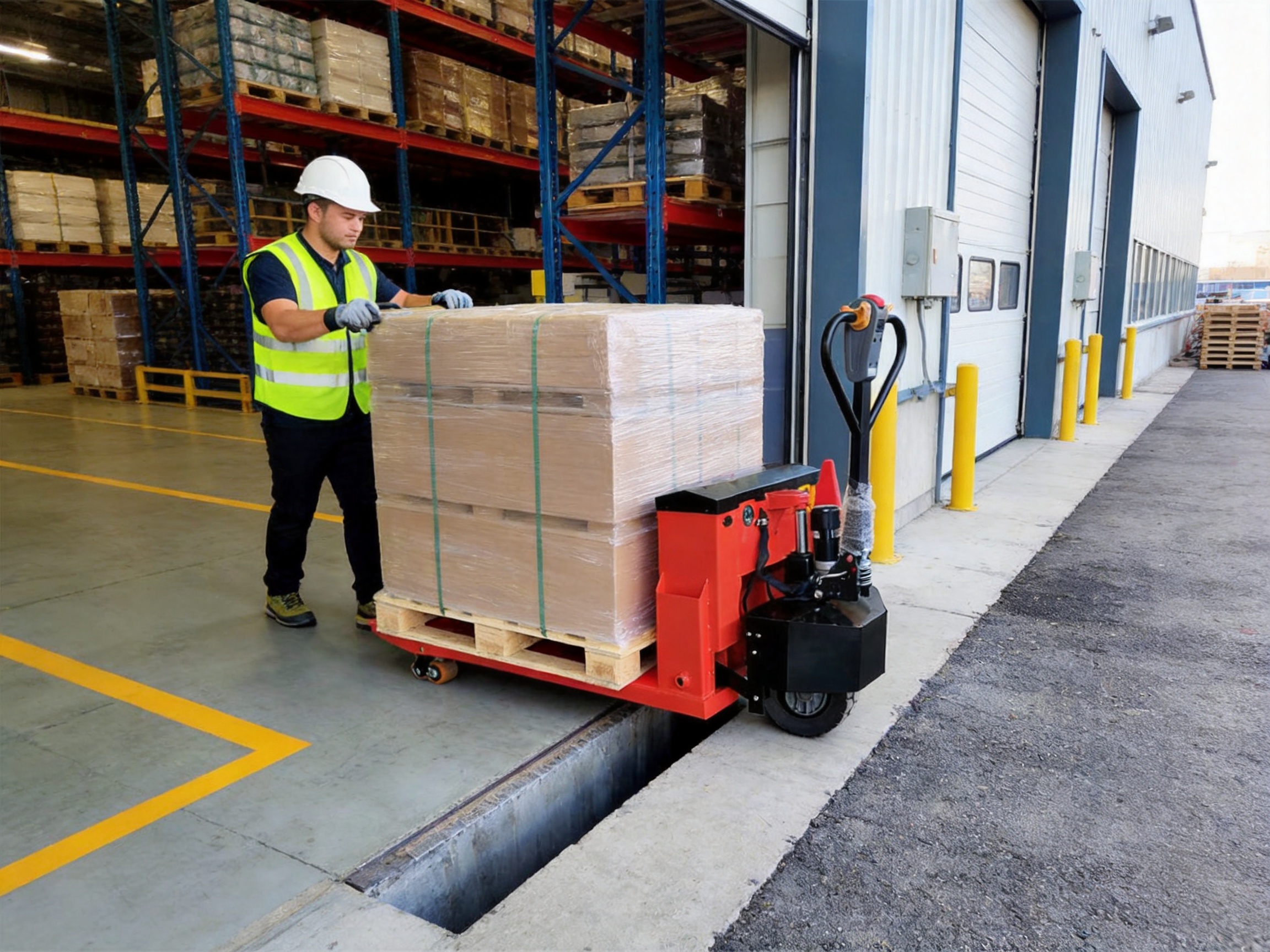
Before operation, the user should inspect the forks, wheels, frame, handle, battery, charging connector, brake, emergency reverse function, and warning devices. Any cracks, severe wear, loose fasteners, damaged cables, leaking components, or abnormal sounds should be reported and corrected before the truck is used.
The pallet should be positioned squarely before the forks enter. The forks should be fully inserted as appropriate for the pallet design, and the load should be centered. Operators should avoid carrying loads that extend excessively beyond the forks or obstruct the forward view. When visibility is limited, the operator should travel in the safer direction or use an approved spotter.
Travel speed should be selected according to the surface, load, visibility, pedestrian traffic, and available stopping distance. Fast mode should not be used simply to increase output when the route is crowded or uneven. Slow travel is preferable near corners, doorways, ramps, loading platforms, and other areas where hazards may appear suddenly.
Loads should not be lifted higher than necessary for travel. The truck has a listed lift height of approximately 200 millimeters, which is intended for pallet clearance and transportation rather than high-level stacking. Keeping the load low helps maintain stability and reduces the consequences of sudden movement.
Slopes require particular care. A loaded pallet truck should be positioned and operated according to the manufacturer’s instructions, with the load kept stable and the operator standing in a safe position. Turning across a slope, exceeding the rated gradeability, or traveling too quickly downhill can increase the risk of loss of control.
Charging should take place in a designated area with adequate ventilation and protection from unauthorized access. The correct charger must be used for the selected battery type. Charging connectors should be kept clean and dry, and damaged cables should be replaced rather than temporarily repaired.
Routine maintenance supports safety, reliability, and lower total operating cost. Daily or shift-based inspections should focus on wheel condition, fork deformation, brake response, handle operation, battery status, and visible frame damage. Operators should also listen for unusual motor, bearing, or roller noise during travel.
Wheel maintenance is particularly important for off-road use. The drive wheel should be inspected for cuts, excessive wear, embedded debris, and reduced traction. Bearing wheels should rotate freely and remain correctly aligned. Polyurethane rollers that become excessively worn may affect load stability and should be replaced according to service recommendations.
The forks should be checked for bending, cracking, surface damage, and abnormal wear. Forks should never be straightened or repaired through unauthorized heating or welding because improper repair can compromise their strength. Replacement forks should match the required dimensions and capacity of the machine.
The electromagnetic brake should be tested regularly. If the truck continues to roll after the control is released, stops inconsistently, or produces unusual sounds, it should be removed from service until inspected by qualified personnel. Brake performance should be verified after maintenance and before returning the equipment to regular operation.
Battery maintenance depends on the battery chemistry. The listed configuration is maintenance-free lead acid, but the final battery type should be confirmed. Charging cycles, storage conditions, temperature, connector condition, and battery age all influence available operating time. Batteries showing swelling, leakage, overheating, or severe capacity loss require professional assessment.
Periodic service may include fastener checks, lubrication of specified points, wiring inspection, controller diagnostics, brake testing, structural examination, and cleaning of the frame and wheels. Customers with intensive outdoor use should establish a more frequent inspection schedule than customers operating only on clean indoor floors.
Before ordering, customers should confirm the required fork outer width, fork length, battery type, charger voltage, wheel material, color, control configuration, and packaging method. The available fork outer widths of 550 and 685 millimeters should be matched to the pallet openings and aisle layout used at the site.
Customers should also provide information about the typical load weight, load dimensions, pallet type, route length, surface condition, gradient, daily operating hours, ambient temperature, and charging opportunities. This information helps determine whether the standard configuration is appropriate or whether additional options are necessary.
For international shipments, buyers should confirm export packing, labeling, documentation, spare parts availability, and destination requirements. Shanghai HanDavos International Trading Co., Ltd. can support product selection, technical consultation, operation guidance, spare parts sourcing, maintenance, and after-sales communication for global customers.
A complete procurement decision should consider more than the initial purchase price. Important factors include energy consumption, tire and roller life, battery replacement cost, service response, parts availability, operator productivity, equipment downtime, and suitability for the intended environment. A pallet truck that is correctly matched to the application can provide better long-term value than a lower-cost model that is unsuitable for heavy or uneven-duty work.
Shanghai HanDavos International Trading Co., Ltd. combines equipment supply with technical and commercial support. Its experience covers new and used forklifts, pallet trucks, forklift parts, attachments, exports, and professional rental services. This breadth is useful for customers managing mixed fleets or seeking a single source for multiple categories of material handling equipment.
The company’s standardized warehouse facilities cover more than 20,000 square meters and support inventory-based supply. A substantial warehouse network can shorten the time needed to locate equipment, consolidate spare parts, prepare export orders, and organize dispatch. It also allows customers to discuss alternative models when a specific configuration is unavailable.
Product selection support is valuable because operating environments vary significantly. A customer may initially request a three-ton pallet truck but later discover that the route requires different wheels, a narrower frame, a specific battery system, or additional safety accessories. Technical consultation helps match the machine to the actual application rather than relying only on a general product description.
After-sales support may include operation guidance, maintenance recommendations, spare parts, troubleshooting assistance, and service coordination. For overseas customers, clear communication and documentation are especially important. The company can be contacted through its international trading office in Kunshan, Jiangsu Province, China, using the supplied telephone and email details.
The rated load capacity is 3,000 kilograms, or three metric tons. The actual safe capacity depends on load center, pallet condition, ground conditions, slope, and compliance with the manufacturer’s capacity plate and operating instructions.
It is designed with outdoor-oriented features, including a 350-millimeter anti-slip rubber drive wheel, polyurethane bearing rollers, electromagnetic braking, a reinforced metal frame, and electrophoretic anti-rust coating. It is suitable for many outdoor logistics and industrial applications, but it should not be treated as a machine for deep mud, flooding, or extremely rough terrain.
The technical specification identifies a 48-volt, 32-ampere-hour maintenance-free lead-acid battery. Some supplied product information mentions lithium technology. Buyers should confirm the exact battery type, charger, warranty, and operating specifications in the final quotation and technical documentation.
The listed lift height is approximately 200 millimeters. This is sufficient for lifting a pallet clear of the ground for transportation. It is not intended to replace a high-lift stacker or forklift for elevated rack storage.
The stated travel speed is 4 kilometers per hour with a full load and 5 kilometers per hour without a load. Operators should select a safe speed based on visibility, traffic, load stability, surface condition, and stopping distance.
The stated gradeability is 6 percent with a full load and 10 percent without a load. Operators must assess the actual slope and surface before use and follow the manufacturer’s instructions. The electromagnetic brake helps control the machine, but it does not make unsafe slopes acceptable.
The truck uses a 1.2-kilowatt electric drive motor and a 0.8-kilowatt lifting motor. The drive system uses DC brushless control technology to support responsive travel and reduced mechanical wear in the motor system.
The intelligent control handle includes an emergency reverse function that allows the operator to move the truck away from a close or unexpected obstruction. Operators should remain familiar with the control layout and should still maintain a clear route and safe distance from people and objects.
The listed fork outer widths are 550 and 685 millimeters. Customers should select the width that matches their pallet openings, load dimensions, and site requirements.
The motor and wheel assembly has been optimized to reduce friction and operating noise. Electric drive also avoids the engine noise associated with internal-combustion equipment. Actual sound levels depend on the surface, load, wheel condition, and surrounding environment.
Maintenance includes inspecting the wheels, forks, frame, battery, brake, control handle, electrical connections, and fasteners. The machine should be cleaned after exposure to mud, dust, salt, or industrial residues. Service intervals should be adjusted to the intensity and conditions of use.
Yes. The company’s business includes forklift spare parts, attachments, accessories, new and used forklifts, pallet trucks, exports, leasing, technical guidance, and after-sales support. Customers can discuss complete fleet or material handling requirements rather than purchasing only one machine.
The 3 Ton Off-Road All-Electric Pallet Truck is a strong option for customers who need powered transportation of heavy pallets in environments that may include uneven ground, outdoor routes, loading yards, and industrial work areas. Its 3,000-kilogram capacity, large anti-slip drive wheel, reinforced forks, polyurethane load rollers, electromagnetic brake, and electric drive system distinguish it from light-duty indoor pallet equipment.
The machine also benefits from design and manufacturing considerations focused on long-term use. Electrophoretic anti-rust coating helps protect the metal frame, while CAE-based structural optimization supports balanced force distribution. The brushless drive system, ergonomic handle, variable travel speeds, and emergency reverse function contribute to practical operation and operator control.
For the best result, buyers should confirm the exact battery chemistry and charger configuration because the supplied technical table identifies a maintenance-free lead-acid battery while some promotional material refers to lithium technology. They should also provide detailed information about loads, surfaces, slopes, operating hours, and pallet dimensions before finalizing the order.
Supported by more than 20 years of industry experience, extensive warehouse resources, international trading capabilities, spare parts supply, technical consultation, and after-sales assistance, Shanghai HanDavos International Trading Co., Ltd. can help customers integrate this electric pallet truck into a broader material handling strategy. When correctly specified, operated, and maintained, the model can improve heavy-load transportation efficiency while reducing manual effort, noise, and direct exhaust emissions.
1. Product technical specification sheet for the 3 Ton Off-Road All-Electric Pallet Truck, including dimensions, capacity, drive system, battery data, wheel configuration, and performance ratings.
2. Manufacturer-provided product information concerning anti-slip drive wheels, electromagnetic braking, motor performance, control handle functions, reinforced forks, load rollers, frame coating, and structural optimization.
3. General principles of industrial pallet truck operation, inspection, load handling, braking, slope control, and preventive maintenance.
4. General engineering references on electrophoretic coating, corrosion protection, polyurethane material handling wheels, brushless motor systems, and computer-aided structural analysis.
5. Company information supplied for Shanghai HanDavos International Trading Co., Ltd., including material handling industry experience, warehouse resources, product categories, export services, spare parts, rental services, and after-sales support.
Recommended Products
Recommended NEWS



 English
 中文简体
 русский
 Español
 عربى